
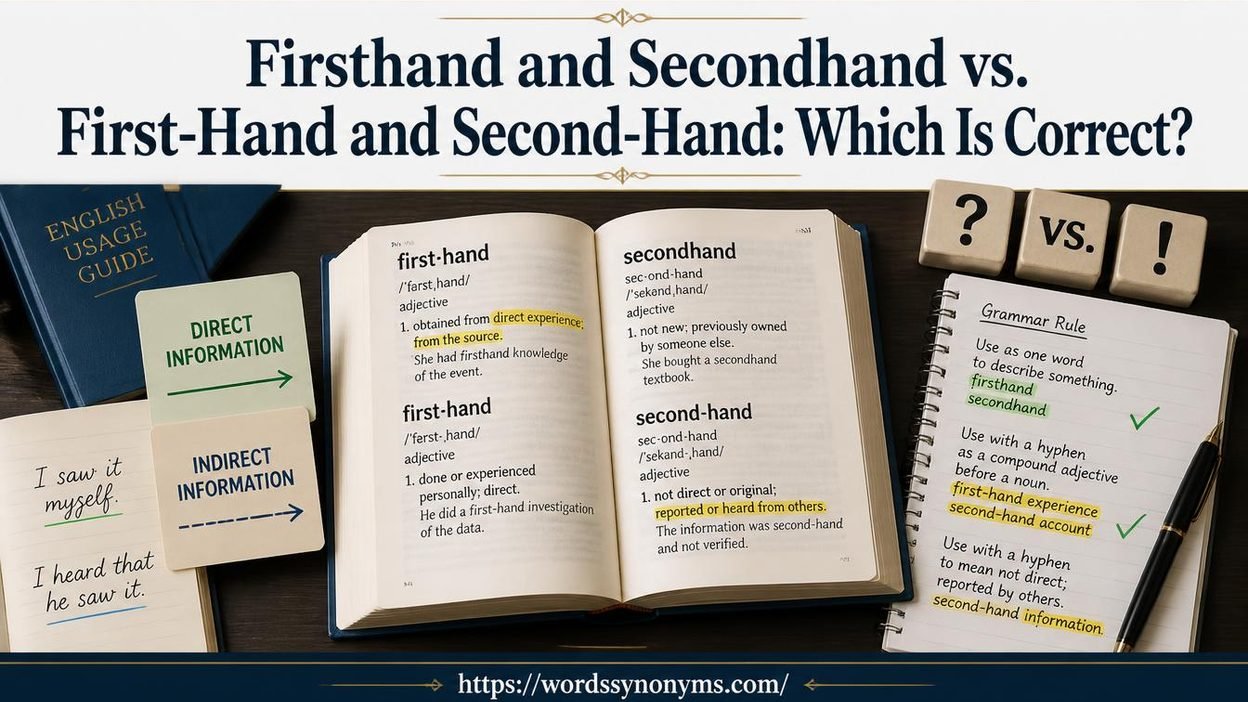
Firsthand and Secondhand vs. First-Hand and Second-Hand explains how information, spelling, and usage change depending on source and style.
Firsthand refers to direct information, knowledge, or personal experience gained from an original source through direct observation. This type of information may function as an adjective or an adverb, depending on how it is used.
In North America, firsthand is generally the preferred spelling, while first-hand follows British spelling and British English conventions; both are correct within their respective language conventions.
From practical writing experience, I have found that understanding spelling variations, American spelling, usage, and grammar makes these compound words and hyphenated forms easier to handle across different regional styles.
Meanwhile, secondhand describes secondhand information, indirect information, or secondhand knowledge that has been relayed through a middleman, unlike a firsthand experience.
The preferred British spelling, second-hand, can also describe clothes and goods that were previously used. The same idea extends to thirdhand, thirdhand information, and thirdhand knowledge, which are far removed from the source of information, while third-hand reflects the alternative style.
Terms such as fourth-hand and fifth-hand are often exaggerations of the broader concept and are always hyphenated, showing increasing distance from personal knowledge and the original account.
Quick Answer
For American English, firsthand is the best default spelling when you mean something obtained through direct experience or observation.
For example:
- She has firsthand experience with the system.
- He witnessed the accident firsthand.
- The reporter gathered firsthand information.
- We received a firsthand account from a witness.
Merriam-Webster defines firsthand as information or experience obtained through direct personal observation or experience. It also lists firsthand as both an adjective and an adverb.
The hyphenated form first-hand can express the same idea:
She provided a first-hand account of the event.
However, if you’re writing ordinary American English and don’t have a house style requiring the hyphen, firsthand is the cleaner choice.
Quick answer
| Form | Meaning | Recommended US English use |
| firsthand | Directly experienced or observed | Preferred |
| first-hand | Same basic meaning | Accepted variant |
| first hand | Separate words with a literal or context-specific meaning | Use only when intended |
The important point is simple: firsthand and first-hand generally mean the same thing when they describe direct experience.
What Does Firsthand Mean?
Firsthand describes something you learn, experience, observe, or obtain directly.
Imagine someone standing in a stadium during a championship game. They see the final play with their own eyes. Their description of that moment is firsthand.
Someone who watches a recording later doesn’t have the same kind of experience. Their knowledge comes from another source.
That distinction gives us the basic meaning:
Firsthand = direct, original, personally observed, or personally experienced.
Merriam-Webster gives examples such as a firsthand account of a war and firsthand experiences used as material for creative work.
Firsthand as an adjective
As an adjective, firsthand describes a noun.
Common combinations include:
- firsthand experience
- firsthand knowledge
- firsthand information
- firsthand account
- firsthand evidence
- firsthand testimony
- firsthand observation
- firsthand report
- firsthand insight
For example:
The researcher collected firsthand information from people who experienced the event.
Here, firsthand tells you something important about the information. It came directly from people with personal experience.
Firsthand as an adverb
Firsthand can also function as an adverb.
Examples include:
- I saw the damage firsthand.
- She experienced the problem firsthand.
- We learned about the process firsthand.
- He witnessed the conditions firsthand.
In these sentences, firsthand tells you how someone obtained knowledge or experienced something.
Firsthand vs. First-Hand: Is the Hyphen Wrong?
No.
Calling first-hand completely wrong would oversimplify the issue.
The hyphenated form appears in published English and can be acceptable under particular style conventions. However, firsthand is the straightforward choice for standard US English.
The most useful rule is this:
If you mean direct personal experience, use “firsthand” unless your chosen style guide specifically prefers “first-hand.”
That approach also prevents unnecessary inconsistency.
For example, don’t write:
She has firsthand experience, but he has first-hand knowledge.
There’s no meaningful reason to switch spellings in the same document.
Choose one convention and stick with it.
First Hand vs. Firsthand: Why the Space Matters
Here’s where the distinction becomes more interesting.
Firsthand is a compound word. It means directly or from direct experience.
First hand, by contrast, consists of two separate words.
Consider these examples:
She has firsthand knowledge of the process.
This means she knows about the process through direct experience.
Now consider:
The first hand in the sequence was painted blue.
Here, first modifies the noun hand. The words don’t form the compound adjective or adverb firsthand.
The difference becomes easier to see when you focus on meaning rather than spelling.
Compare the two
| Form | Meaning | Example |
| firsthand | Directly experienced or observed | She has firsthand knowledge. |
| first-hand | Hyphenated variant of firsthand | He gave a first-hand account. |
| first hand | Separate words | The first hand in the sequence was damaged. |
In normal writing about personal experience, firsthand is usually what you want.
What Does Secondhand Mean?
Secondhand has several related meanings.
When discussing information, secondhand means information received indirectly rather than directly from the original experience or source.
For example:
I heard the story secondhand.
That means someone else experienced or learned about the event and passed the information along.
Merriam-Webster defines secondhand as something received from or through an intermediary. It also defines the adverbial use as receiving something indirectly.
But secondhand has another extremely common meaning: previously owned or used.
For example:
- a secondhand car
- a secondhand book
- secondhand furniture
- a secondhand laptop
- a secondhand clothing store
Merriam-Webster specifically defines the adjective secondhand as something acquired after another person has used it.
So context matters.
Two major meanings of secondhand
Indirect information:
She learned about the incident secondhand.
Previously owned:
He bought a secondhand car.
Both uses are correct. They simply describe different situations.
Secondhand vs. Second-Hand: Which Is Correct?
The same basic spelling principle applies here.
For standard US English, secondhand is the most practical default.
The hyphenated second-hand form can also appear in published writing.
For example:
We received the information secondhand.
Or:
We received the information second-hand.
The meaning remains essentially the same.
When you’re producing an article, essay, report, or website copy, consistency matters more than constantly switching between the two.
The safest US English choice
Use:
- firsthand
- secondhand
Unless your publication, school, employer, or style guide specifies otherwise.
Second Hand vs. Secondhand: The Clock Makes the Difference
The distinction becomes especially obvious with second hand.
A second hand is the hand on an analog clock or watch that indicates seconds.
For example:
The second hand moved steadily around the clock.
Here, second describes the noun hand. You’re talking about an actual part of a timepiece.
By contrast:
I heard about the decision secondhand.
That sentence has nothing to do with clocks. It means the information reached the speaker indirectly.
Merriam-Webster treats secondhand and second hand as separate dictionary entries. It defines second hand as the hand marking seconds on a timepiece.
Compare these sentences
| Sentence | Meaning |
| I heard the news secondhand. | I learned it indirectly. |
| She bought a secondhand phone. | Someone owned it before her. |
| The second hand stopped moving. | The clock’s seconds hand stopped. |
This is one of the clearest examples of why spacing matters.
Firsthand vs. Secondhand Information
Now we can move beyond spelling.
The difference between firsthand and secondhand information concerns the way information reaches you.
Firsthand information comes directly from observation, experience, or an original source.
Secondhand information comes through another person, account, report, or intermediary.
Think of it like a chain.
Firsthand:
Event → person experiences event → person reports experience
Secondhand:
Event → person experiences event → another person learns about it → another person reports it
Each additional link can change what gets communicated.
A simple example
Imagine a fire breaks out at a restaurant.
A customer standing outside watches the firefighters arrive. They see the smoke, hear the alarms, and watch people leave the building.
That customer can provide a firsthand account.
A neighbor who wasn’t there hears the story from the customer. The neighbor now has secondhand information.
A blogger who later reads the neighbor’s social media post has information that is even further removed from the original event.
That doesn’t automatically make the blogger wrong. It simply means the blogger isn’t describing the event from direct personal observation.
Read more: Away vs. A Way: What’s the Difference?
Firsthand Information Isn’t Automatically Perfect
This distinction matters because people sometimes assume that firsthand means unquestionably accurate.
That’s too simplistic.
A firsthand witness can misunderstand what happened. Memory can change. Stress can affect perception. Two people can witness the same event and remember different details.
The Library of Congress makes a similar point when discussing firsthand historical accounts. It notes that firsthand accounts can contain personal bias and that different accounts may conflict with one another.
So firsthand evidence has a valuable quality: proximity to the event.
That doesn’t eliminate the need for critical thinking.
A better way to evaluate firsthand information
Ask:
- Was the person actually present?
- What exactly did they observe?
- When did they record the information?
- Could they have misunderstood something?
- Do other independent sources support the account?
- Does the account distinguish observation from interpretation?
- Does the source have a reason to exaggerate or omit details?
A witness saying, “I saw the car leave the parking lot,” is different from saying, “I know why the driver left.”
The first statement concerns observation.
The second may involve interpretation.
That distinction is crucial.
What Is a Firsthand Account?
A firsthand account comes from someone who directly experienced or witnessed the event being described.
Examples include:
- a soldier describing a battle they experienced;
- a traveler describing a place they personally visited;
- a witness describing an accident they saw;
- a participant describing a historical event;
- a person explaining what happened to them during an interview;
- a diary entry describing the writer’s experiences.
The Library of Congress identifies firsthand recollections as valuable historical evidence and notes that primary sources can include firsthand accounts created during an event or recalled later by eyewitnesses.
Firsthand accounts can include
- diaries
- letters
- interviews
- oral histories
- photographs
- recordings
- eyewitness testimony
- memoirs
- personal journals
- contemporary documents
The exact classification depends on the research context.
For example, a photograph taken during an event can serve as a primary source even though the photographer’s perspective still influences what the image captures.
What Is a Secondhand Account?
A secondhand account describes an event using information obtained from other people or sources rather than direct personal experience.
Examples include:
- a journalist summarizing eyewitness interviews;
- a historian analyzing earlier documents;
- a student explaining an event after reading several books;
- a biographer writing about someone else’s life;
- a commentator discussing an event they didn’t witness.
The Library of Congress describes secondary sources as accounts that retell, analyze, or interpret events, usually from a distance in time or place.
That doesn’t make secondhand accounts useless.
Quite the opposite.
A strong secondhand account can bring together many pieces of evidence that one witness could never see.
Firsthand vs. Secondhand Accounts
Here’s the central distinction:
| Firsthand account | Secondhand account |
| Comes from direct experience | Comes through another source |
| Often produced by a participant or eyewitness | Usually produced by someone analyzing or reporting information |
| Can provide personal observations | Can synthesize multiple perspectives |
| May contain personal bias | May contain the author’s interpretation |
| Can preserve details unavailable to outsiders | Can provide broader context |
| Doesn’t automatically guarantee accuracy | Doesn’t automatically mean unreliability |
The strongest research often uses both.
A firsthand account can show what an individual experienced. A secondhand source can place that experience into a wider context.
Think of it as looking through two windows.
One window shows the event from inside.
The other shows the surrounding landscape.
Firsthand vs. Secondhand Sources
The terms firsthand and secondhand overlap with the concepts of primary and secondary sources, but they aren’t perfect synonyms.
A primary source is generally original evidence connected to the subject being studied. The Library of Congress describes primary sources as original documents and objects created during the period under study.
Secondary sources generally analyze, interpret, or synthesize information from other sources.
The important distinction
Firsthand focuses on direct experience or observation.
Primary source focuses on the source’s relationship to the subject and the research context.
Secondhand focuses on indirect information.
Secondary source focuses on analysis, interpretation, or discussion of existing evidence.
These categories often overlap. They aren’t interchangeable labels.
For example
Suppose a historian studies a historical protest.
A participant’s diary might provide a firsthand account and function as a primary source.
A historian’s later book might provide a secondhand account and function as a secondary source.
However, the same historical work can become a primary source when a later researcher studies it as evidence of how historians in that era interpreted the past.
The Library of Congress explicitly notes that a work can function as either a primary or secondary source depending on how researchers use it.
That’s a subtle point, but it matters.
Firsthand vs. First Person: They Aren’t the Same
Another common mistake is confusing firsthand with first person.
They’re different concepts.
Firsthand describes the relationship between a person and the information.
First person describes grammatical point of view.
A first-person narrative often uses pronouns such as:
- I
- me
- my
- we
- our
For example:
I arrived at the station at 8 p.m.
That sentence uses first-person narration.
But the grammatical perspective alone doesn’t prove that the information is firsthand.
Likewise, a firsthand experience can be described in third person:
Maria witnessed the accident and later described what she saw.
The sentence uses third-person grammar. The information may still come from Maria’s firsthand experience.
Remember this distinction
Firsthand = how the information was obtained.
First person = how the information is narrated.
That one rule eliminates a surprisingly common source of confusion.
How to Tell Whether Information Is Firsthand or Secondhand
Determining the difference requires more than looking for the word “I.”
Use these questions instead.
Ask who experienced the event
Did the author actually witness, participate in, or experience what they’re describing?
If yes, the information may be firsthand.
If not, determine where the information came from.
Identify the original source
Look for phrases such as:
- according to witnesses;
- according to court records;
- researchers reported;
- the study found;
- officials said;
- historians concluded;
- witnesses told reporters.
These phrases can signal that the writer is drawing information from another source.
They don’t automatically make an account secondhand. A journalist can interview a witness directly and report that witness’s firsthand testimony.
Separate observation from interpretation
This step is often overlooked.
Consider:
“I saw smoke coming from the building.”
That’s an observation.
Now compare:
“The fire was caused by faulty wiring.”
That statement makes a claim about the cause.
The person may have experienced the event firsthand without having firsthand knowledge of its cause.
Check the date and circumstances
An account written immediately after an event may preserve details that later disappear from memory.
A memoir written decades later can still be firsthand. However, the passage of time can affect recollection.
That doesn’t make the memoir worthless. It simply gives researchers another factor to consider.
Case Study: A Historical Event
Consider a hypothetical researcher studying a major earthquake.
Three sources are available.
1Source: A resident’s diary was written on the day of the earthquake.
2Source: Three days later, a newspaper article reported on the event using interviews with residents and officials.
3Source: Decades afterward, a historian examined newspapers, government records, photographs, diaries, and scientific studies in a detailed account of the earthquake.
Each source offers something different.
| Source | Likely classification | Main strength |
| Resident’s diary | Firsthand account / primary source | Personal experience |
| Newspaper article | Mixed, depending on material | Immediate reporting and multiple perspectives |
| Historian’s book | Secondary source | Analysis and broader context |
The resident can tell us what the shaking felt like.
The newspaper can show how the community responded.
The historian can explain the earthquake’s causes, consequences, and historical significance.
Good research doesn’t force these sources into a winner-takes-all contest. It compares them.
Case Study: Everyday Information
The same principle applies outside history.
Imagine your friend says:
“The new restaurant is terrible.”
That’s secondhand information if you haven’t visited the restaurant.
You could repeat the statement:
“My friend said the restaurant was terrible.”
You’re reporting someone else’s experience.
After visiting the restaurant yourself, you can say:
“I tried it firsthand.”
Now you have your own direct experience.
Notice what hasn’t changed: your friend might still be right.
Your firsthand experience doesn’t automatically prove your friend’s judgment wrong. It simply gives you another firsthand perspective.
That distinction is useful in product reviews, travel writing, journalism, workplace discussions, and everyday conversation.
Common Mistakes With Firsthand and Secondhand
Writing “first hand” when you mean direct experience
In standard US English, write:
firsthand experience
Not:
first hand experience
The closed compound is the natural choice here.
Assuming “first-hand” is incorrect
The hyphenated form isn’t something that needs to be treated as an error in every context.
First-hand is an established variant.
For a US English website, though, firsthand is usually the cleaner default.
Assuming secondhand means false
It doesn’t.
Secondhand describes the route information took.
A secondhand report can be accurate if the original source was accurate and the information was transmitted correctly.
Assuming firsthand means unbiased
It doesn’t.
A witness can have a personal interest in the outcome. Memory can also be imperfect.
The Library of Congress specifically notes that firsthand historical accounts can contain personal bias.
Confusing secondhand with second hand
Remember the clock:
The second hand is moving.
Remember indirect information:
She heard the news secondhand.
That simple contrast makes the spelling easier to remember.
Firsthand and Secondhand Examples
Examples of firsthand
Adjective:
- She has firsthand experience with the software.
- He provided a firsthand account of the accident.
- We gathered firsthand information from the participants.
- The researcher gained firsthand knowledge during fieldwork.
- They collected firsthand testimony from witnesses.
Adverb:
- She saw the damage firsthand.
- He experienced the problem firsthand.
- We learned about the process firsthand.
- They witnessed the conditions firsthand.
Examples of secondhand
Indirect information:
- I heard the story secondhand.
- She received the information secondhand.
- Much of the report relied on secondhand accounts.
- He had only secondhand knowledge of the incident.
Previously owned:
- She bought a secondhand laptop.
- They purchased secondhand furniture.
- He drives a secondhand car.
- The bookstore specializes in secondhand books.
Indirect effects:
- The campaign raised concerns about secondhand smoke.
- Researchers examined exposure to secondhand information.
Merriam-Webster recognizes both the indirect-information meaning and the previously-owned meaning of secondhand.
Firsthand and Secondhand: A Quick Comparison
| Feature | Firsthand | Secondhand |
| Basic meaning | Direct | Indirect |
| Experience | Personally experienced | Learned through someone else |
| Observation | Directly observed | Reported by another source |
| Information | Comes from an original experience or source | Comes through an intermediary |
| Typical phrase | firsthand knowledge | secondhand knowledge |
| Typical account | firsthand account | secondhand account |
| Used goods | Not applicable | secondhand car, books, furniture |
| Clock meaning | Not normally relevant | second hand = clock hand |
The simplest mental shortcut is:
Firsthand means you were close to the source. Secondhand means the information reached you through another source.
When Should You Use Firsthand Instead of First-Hand?
For most US English writing, choose firsthand.
It works naturally as both an adjective and an adverb:
firsthand experience
witnessed it firsthand
Use first-hand when you’re following a style convention that prefers the hyphenated form.
If you’re writing for a website, consistency is more important than inventing your own spelling rules.
Recommended approach
For standard US English:
Preferred:
- firsthand experience
- firsthand account
- firsthand knowledge
- firsthand information
Accepted variant:
- first-hand experience
- first-hand account
- first-hand knowledge
Usually avoid when meaning the compound:
- first hand experience
- first hand knowledge
When Should You Use Secondhand Instead of Second-Hand?
The same recommendation applies.
For standard US English, use:
- secondhand information;
- secondhand experience;
- secondhand knowledge;
- secondhand reports;
- secondhand books;
- secondhand furniture;
- secondhand cars.
The hyphenated second-hand form can appear when a style guide calls for it.
But don’t mix forms without a reason.
For example, a polished article shouldn’t casually alternate between secondhand information and second-hand information.
Choose a convention.
Stick with it.
A Simple Decision Guide
When you’re unsure which form to use, ask what you mean.
Do you mean direct experience?
Use:
firsthand
firsthand experience
Do you mean information received indirectly?
Use:
secondhand
secondhand information
Do you mean something previously owned?
Use:
secondhand
a secondhand car
Do you follow a style guide that uses hyphens?
Use:
first-hand or second-hand
Do you mean an actual hand in a sequence?
Use the separate words:
first hand or second hand
Are you talking about a clock?
Use:
second hand
The second hand moved across the dial.
FAQs
Is firsthand one word or two?
Firsthand is usually written as one word in American English. First-hand with a hyphen is more common in British English.
What is the difference between firsthand and secondhand information?
Firsthand information comes directly from personal experience or the original source. Secondhand information comes through another person or source.
Is second-hand the correct spelling?
Yes. Second-hand is the preferred British spelling, while secondhand is more common in American English.
Can firsthand be used as both an adjective and an adverb?
Yes. You can say “firsthand experience” or “I learned about it firsthand.” Its role depends on the sentence.
What does thirdhand mean?
Thirdhand refers to information that has passed through multiple people and is further removed from the original source.
Why are fourth-hand and fifth-hand hyphenated?
Terms such as fourth-hand and fifth-hand are generally treated as hyphenated expressions because they extend the idea of information passing through several sources.
Conclusion
Understanding the difference between firsthand and secondhand is really about knowing where information comes from and choosing the spelling style that fits your audience. Firsthand points to direct experience, while secondhand describes information passed along by someone else.
The hyphenated forms, such as first-hand and second-hand, mainly reflect British usage rather than a change in meaning. Once you recognize the connection between source, context, and regional spelling, using these terms becomes much more natural and straightforward.

Muhammad Taqi is a content writer interested in English vocabulary and language. He writes clear and useful articles on synonyms, antonyms, word meanings, and English usage, helping readers expand their vocabulary and improve their communication skills.