Excel vs. Accel: Difference and Correct Usage explains why similar words can cause confusion and how to choose the correct word in writing clearly.
The confusion between Excel and Accel is common because these words sound alike, look similar, and are often mixed up in casual speech when spoken quickly. In writing, the difference is important because Excel is a standard English word with broad acceptance.
Its meaning can refer to doing something very well or get ahead, while Microsoft Excel is popular spreadsheet software used for spreadsheet tasks. Its uses therefore extend beyond ordinary English.
By contrast, Accel is an informal, context-specific short form connected with accelerate and acceleration, meaning speed up, particularly in tech, business, and car-related terms. Accell is not a dictionary-recognized word for these meanings.
This in-depth guide can break down the meanings, origins, correct usage, common mistakes, and examples in simple terms, helping you write and speak clearly.
By the end, you can know exactly which correct word fits the intended meaning, improving spelling, writing clarity, and professionalism when discussing strong performance or acceleration.
Quick Difference
The easiest way to separate these terms is to focus on what the sentence is trying to say.
| Term | Type | Meaning | Common Context |
| excel | Verb | To perform extremely well or be highly skilled | School, work, sports, skills |
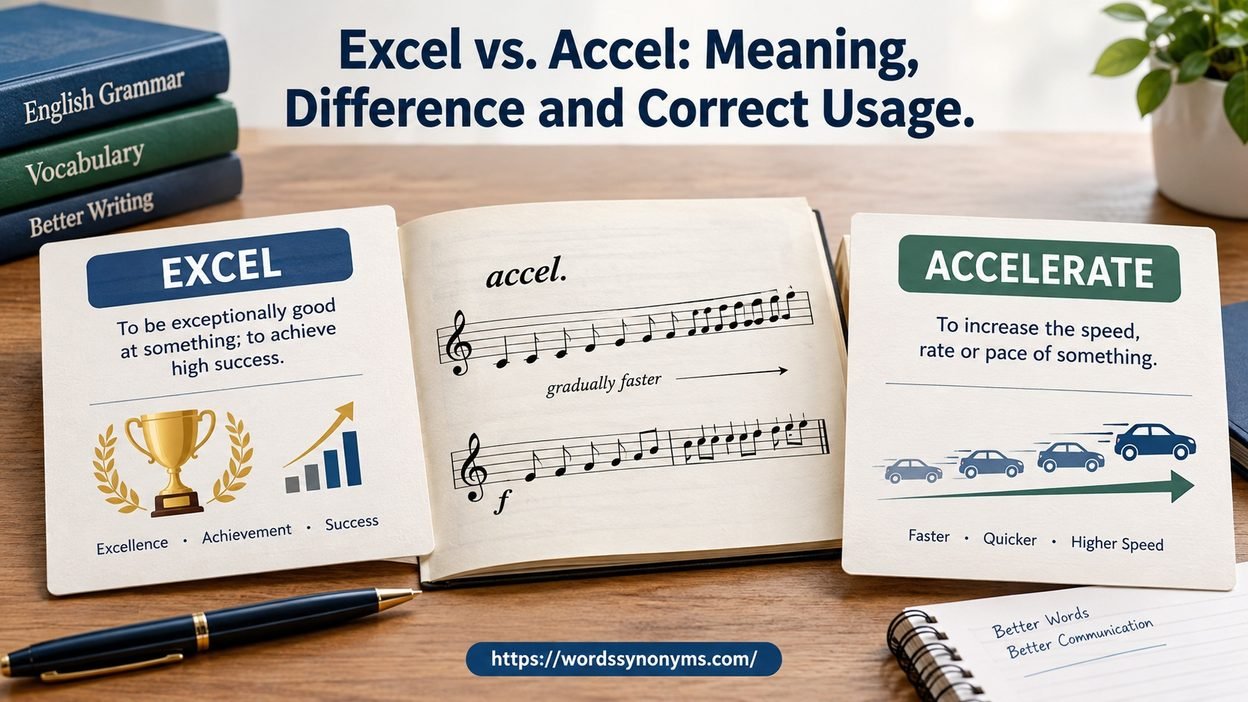
| accel. | Abbreviation | Short for accelerando | Musical notation |
| accelerando | Musical term | A gradual increase in speed | Music |
| accelerate | Verb | To become faster or make something faster | Movement, processes, science |
Excel belongs to everyday English. You can use it when discussing someone’s talents, achievements, or performance. Cambridge defines it as being extremely good at something and gives both excel in and excel at as standard constructions.
Accel., by contrast, has a much narrower role. Cambridge identifies it as a written abbreviation for accelerando, which is a specialized musical term meaning a gradual increase in speed.
In short:
Excel = perform exceptionally well.
Accel. = abbreviation for accelerando in music.
That distinction solves most Excel vs. Accel questions immediately.
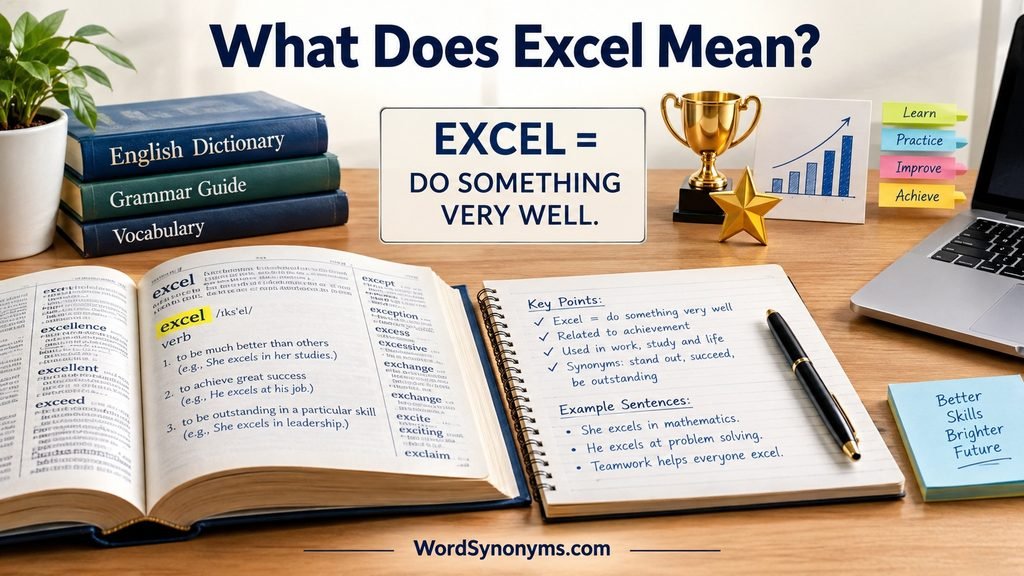
What Does Excel Mean?
Excel is a verb that describes exceptional performance. When someone excels at something, they do it particularly well or demonstrate a high level of skill.
For example:
- Maria excels at mathematics.
- James excels in creative writing.
- The athlete excels at sprinting.
- She excels in leadership.
- This restaurant excels at traditional cooking.
Cambridge lists excel as a verb and defines it as being extremely good at something. Its American English definition also describes the word as doing something very well or being highly skilled and better than most others.
The word works across many areas of life. You can excel in a school subject, a profession, a sport, an art form, or a particular skill.
Excel as a Verb
The most common structure is:
excel + at + activity or skill
For example:
She excels at public speaking.
You can also use:
excel + in + subject, field, or area
For example:
He excels in computer science.
Both excel at and excel in are established English constructions. Cambridge specifically lists them as alternatives in its entry for the phrase excel in something.
The choice often depends on what follows the phrase. Excel at naturally fits activities and skills, while excel in often works well with subjects, fields, and areas of achievement.
Compare these examples:
- She excels at playing the piano.
- She excels in music.
- He excels at solving puzzles.
- He excels in mathematics.
- They excel at customer service.
- They excel in their profession.
There isn’t a rigid wall between the two patterns. English speakers use both naturally.
What Does Excel Mean in Simple English?
In simple terms, excel means to be very good at something.
If your teacher says, “You excel in science,” the teacher means that you perform exceptionally well in science.
If a coach says, “She excels at tennis,” the coach means that she has outstanding ability in tennis.
Think of excel as a stronger version of do well.
| Basic expression | Stronger expression |
| She does well in math. | She excels in math. |
| He does very well at tennis. | He excels at tennis. |
| They are very good at design. | They excel at design. |
| The company does very well in manufacturing. | The company excels in manufacturing. |
The word doesn’t necessarily mean someone is perfect. It highlights unusually strong performance.
Excel: Past Tense and Other Forms
The spelling of excel becomes especially useful when you change its grammatical form.
| Form | Example |
| excel | She can excel in science. |
| excels | He excels at chess. |
| excelled | She excelled in school. |
| excelling | He is excelling in mathematics. |
Notice the double l in excelled and excelling.
Cambridge lists excelling as the present participle and excelled as both the past tense and past participle.
This produces two common spelling mistakes:
- ❌ She exceled in science.
- ❌ He is exceling at sports.
- ✅ She excelled in science.
- ✅ He is excelling at sports.
The doubled l is easy to miss because the base word contains only one l.
What Does Accel. Mean?
Accel. is not simply another spelling of excel.
In standard dictionary usage, accel. is a written abbreviation for accelerando. Cambridge classifies it as a specialized music term.
Accelerando is an Italian musical term used in written music to indicate a gradual increase in speed. In other words, performers should progressively play faster.
For example, a musical score might contain:
accel.
That instruction tells the performer to increase the tempo gradually.
It doesn’t mean:
“Perform exceptionally well.”
That’s the job of excel.
Accel. in Musical Notation
Imagine a pianist playing a calm passage at a steady tempo. The composer wants the music to build momentum toward the next section.
An accel. marking can signal that gradual change.
The performer doesn’t suddenly jump from a slow tempo to a very fast one. Instead, the speed increases progressively.
That makes accel. fundamentally different from excel.
| Word | What changes? |
| excel | Performance or ability |
| accel. | Musical tempo |
| accelerate | Speed or rate |
Cambridge describes accelerando as something used in written music to show that a piece or section should be performed with a gradual increase in speed.
Excel vs. Accel: Why Do People Confuse Them?
The confusion usually comes from sound and spelling.
Both excel and accel. contain the familiar -cel sound. When someone hears a word without seeing it written, the spelling can become uncertain.
English creates plenty of this trouble. Pronunciation doesn’t always provide a reliable map of spelling.
For example, someone may hear:
“She excels at science.”
and mistakenly write:
“She accels at science.”
The second form looks plausible because accel resembles words such as accelerate, acceleration, and accelerating.
However, the meaning gives the answer.
If you’re talking about being exceptionally good at something, use excel.
If you’re talking about increasing speed, think of accelerate or accelerando, depending on the context.
Excel vs. Accel: The Difference in Meaning
The clearest distinction appears when you place the terms side by side.
| Meaning | Correct term | Example |
| Be exceptionally good at something | excel | She excels at painting. |
| Gradually increase musical speed | accel. | The score says “accel.” |
| Make something happen faster | accelerate | The company accelerated production. |
| Increase physical speed | accelerate | The car accelerated quickly. |
These words overlap slightly in sound but not in ordinary meaning.
Consider this pair:
The runner excels at sprinting.
This sentence evaluates the runner’s ability.
Now compare:
The runner accelerated toward the finish line.
This sentence describes a change in speed.
One focuses on performance. The other focuses on movement.
That’s the semantic dividing line.
Excel vs. Accel: Excel at or Accel at?
This is one of the most common questions surrounding the spelling.
The correct phrase is:
excel at
Not:
❌ accel at
Examples:
- She excels at mathematics.
- He excels at basketball.
- They excel at solving difficult problems.
- The company excels at customer service.
- My brother excels at woodworking.
Cambridge specifically records excel at something alongside excel in something.
So if you are describing someone’s ability, excel at is the form to remember.
Excel in or Excel at?
Both are correct, although they often appear in slightly different contexts.
| Phrase | Typical use | Example |
| excel at | Activities, skills, tasks | She excels at drawing. |
| excel in | Subjects, fields, areas | She excels in biology. |
These patterns aren’t absolute rules. Native English usage allows some overlap.
For instance:
- He excels at mathematics.
- He excels in mathematics.
Both can sound natural depending on the speaker and sentence.
The important point is that neither becomes accel.
Excel vs. Accel vs. Accelerate
Adding accelerate to the comparison makes the distinction much easier.
Excel relates to quality of performance.
Accelerate relates to increasing speed or rate.
Accel. is a specialized abbreviation for accelerando in music.
| Term | Meaning | Example |
| excel | Perform exceptionally well | She excels at chess. |
| accelerate | Become faster or make something faster | The car accelerated. |
| accel. | Musical abbreviation for accelerando | The score says “accel.” |
| accelerando | Gradually increasing musical speed | The finale becomes accelerando. |
Cambridge defines accelerate as becoming faster or making something happen faster or sooner.
That gives you a useful memory chain:
Excel → excellent performance
Accelerate → increased speed
Accel. → accelerando in music
Once the meanings are separated, the spelling becomes much easier.
Examples of Excel in Everyday Sentences
Because excel appears in many settings, seeing it in context helps lock in the correct form.
School and Education
Students can excel in subjects that match their interests and strengths.
Examples:
- Maya excels in biology.
- Daniel excels at solving mathematical problems.
- The student excelled in several advanced courses.
- She has always excelled at writing essays.
The word emphasizes strong performance rather than simple participation.
Work and Business
Professional writing also uses excel frequently.
Examples:
- The company excels at customer support.
- She excels in project management.
- He excels at negotiating complex contracts.
- Their team excels in product development.
Here, excel highlights an area in which a person, team, or organization performs particularly well.
Sports
Sports provide another natural setting.
Examples:
- The athlete excels at sprinting.
- She excelled in swimming from a young age.
- The goalkeeper excels at reading difficult shots.
- The team excels in defensive play.
The word works especially well when describing a particular strength.
Creative Skills
You can also use excel for artistic abilities.
Examples:
- She excels at portrait photography.
- He excels in classical composition.
- The designer excels at minimalist layouts.
- The writer excels in character development.
Again, the central idea is outstanding ability.
Examples of Accel. in Music
The context changes completely when accel. appears in a musical score.
Examples include:
- accel. before the final passage
- accel. poco a poco to indicate gradual acceleration
- A musical section marked accelerando
- A transition that becomes progressively faster
The exact notation can vary between scores. However, the underlying instruction remains the same: the music should gradually increase in speed.
Cambridge identifies accel. specifically as a written abbreviation for accelerando.
So a musician seeing accel. shouldn’t interpret it as a spelling variation of excel.
It’s a technical instruction.
A Simple Case Study: The Student and the Musician
Consider two people named Alex.
Alex is a student who performs extremely well in mathematics.
You might write:
Alex excels in mathematics.
Here, excel describes ability.
Now imagine Alex is also a pianist. During a performance, the musical score contains:
accel.
The pianist gradually increases the tempo.
The same person encounters both terms, yet the meanings have nothing to do with each other.
| Situation | Correct term | Why |
| Alex performs exceptionally well in math | excel | It describes ability |
| Alex sees a musical instruction to increase tempo | accel. | It abbreviates accelerando |
This example shows why spelling alone isn’t enough. Context determines meaning.
Common Mistakes With Excel and Accel
A few mistakes appear repeatedly because the words look deceptively similar.
Mistake: “She Accels at Math”
Incorrect:
❌ She accels at math.
Correct:
✅ She excels at math.
The sentence describes strong academic performance. Therefore, excel is the appropriate verb.
Mistake: “He Exceled in Sports”
Incorrect:
❌ He exceled in sports.
Correct:
✅ He excelled in sports.
The past tense requires excelled with a doubled l. Cambridge lists excelled as the past tense and past participle.
Mistake: “The Song Was Marked Excel”
Incorrect in the intended musical sense:
❌ The passage was marked excel.
Correct:
✅ The passage was marked accel.
Here, the composer is giving a tempo instruction. The abbreviation refers to accelerando.
Mistake: Treating Accel. as a General Verb
In ordinary writing, don’t replace excel with accel simply because the two look similar.
For example:
❌ Our team accels at customer service.
Use:
✅ Our team excels at customer service.
Accel. has a specialized role. It isn’t the everyday spelling of excel.
Is “Accel” a Correct English Word?
The answer depends on exactly what accel means in the context.
Accel. is a recognized abbreviation for accelerando in music. Cambridge lists it as such.
However, that doesn’t mean accel can replace excel in ordinary English sentences.
If you’re writing:
She excels at tennis.
you shouldn’t shorten or alter excel to accel.
There are also situations where Accel may appear as a proper name, company name, product name, or specialized shorthand. In those cases, capitalization and context matter.
The important distinction is this:
A specialized use of “accel.” doesn’t make it a substitute for “excel.”
Always identify the intended meaning first.
Excel vs. Accel: A Quick Usage Guide
When you’re unsure, run the sentence through this simple checklist.
Are you describing exceptional ability?
Use excel.
She excels at public speaking.
Are you describing increasing speed?
Use accelerate.
The vehicle accelerated rapidly.
Are you reading musical notation that calls for a gradual increase in tempo?
Use accel. or the full term accelerando, depending on the notation.
The score is marked accel.
Are you referring to a proper name or specialized term?
Keep the official spelling used in that context.
This approach is more reliable than trying to remember the words by sound.
Excel, Excellent, and Excellence
Here’s another useful spelling trick.
The words excel, excellent, and excellence are closely connected in form and meaning.
| Word | Part of speech | Meaning |
| excel | Verb | Perform exceptionally well |
| excellent | Adjective | Extremely good |
| excellence | Noun | Outstanding quality or performance |
For example:
She excels at science.
She produces excellent scientific work.
Her work demonstrates excellence.
This family resemblance can help you remember the spelling.
When the meaning involves outstanding performance, think of excellent. That connection points you toward excel, not accel.
Read more: Caesarean vs. Cesarean vs. Caesarian: Which Spelling Is Correct?
Why “Excel” Has a Double L in Its Past Forms
The base form is:
excel
But the common forms are:
excelled
excelling
That doubled l can surprise writers because many verbs don’t behave exactly this way.
Examples:
- Present: excel
- Past: excelled
- Present participle: excelling
The spelling is especially important in resumes, academic writing, performance reviews, and professional biographies.
Compare:
She excelled in chemistry.
with:
❌ She exceled in chemistry.
The first version follows the standard spelling.
Excel vs. Accel in Professional Writing
Choosing the right form matters even more in formal writing.
A resume might say:
Excel at developing client relationships
An academic recommendation might say:
She excels in advanced mathematics.
A performance review might say:
He excels at managing complex projects.
Using accel in any of these sentences would look like a spelling mistake.
Meanwhile, a musician, composer, or music student may encounter:
accel.
on a score.
That’s perfectly legitimate because the context is different.
The lesson is simple: specialized terminology should stay in its specialized lane.
Excel vs. Accel: Final Comparison
| Feature | Excel | Accel. | Accelerate |
| Word type | Verb | Abbreviation | Verb |
| Main meaning | Perform extremely well | Short for accelerando | Become faster or make something faster |
| Everyday English | Yes | No, specialized | Yes |
| Music | Not a tempo marking | Yes | Sometimes used descriptively |
| Example | She excels at art. | The score says “accel.” | The car accelerated. |
| Past form | Excelled | — | Accelerated |
| Common phrase | Excel at/in | Accel. in notation | Accelerate quickly |
This table captures the central distinction without relying on pronunciation.
FAQs
Is Excel a correct English word?
Yes. Excel is a standard English word that means to do something very well or perform better than others. It is also the name of Microsoft Excel, the well-known spreadsheet software.
Is Accel a correct English word?
Accel is generally used as an informal or shortened form related to accelerate or acceleration. It may appear in tech, business, and car-related terms, but it does not have the same general use as Excel.
Does Excel mean to speed up?
No. Excel means to perform very well or get ahead, not to speed up. When you mean increasing speed, accelerate is the appropriate word.
What does Accel mean?
Accel can be used as a short form for accelerate or acceleration, depending on the context. Its exact meaning should be understood from the field or terminology in which it appears.
Is Accell the same as Excel?
No. Accell and Excel are different spellings. Excel is the established English word, while Accell is not generally recognized as the standard word for either performing very well or increasing speed.
How can I remember Excel vs. Accel?
Think of Excel as being connected with excellence and strong performance. Think of Accel as being connected with acceleration and increasing speed. This simple distinction can help prevent spelling and usage mistakes.
Conclusion
Choosing between Excel and Accel becomes much easier once you connect each word with its purpose. Excel belongs to standard English and can describe someone who does something very well or gets ahead. It is also familiar as Microsoft Excel, the popular spreadsheet program. Accel, meanwhile, is usually a shortened, informal form connected with accelerate or acceleration, especially in specific tech, business, or automotive contexts.
A quick spelling check can save you from an awkward mistake. If you’re talking about strong performance, excellence, or the spreadsheet software, choose Excel. If the idea is increasing speed, the full word accelerate is usually clearer. Keeping that simple distinction in mind makes your writing more precise and easier to understand.

Samreen Saif is a passionate writer and language enthusiast who contributes informative and engaging content to WordsSynonyms.com. She enjoys exploring English vocabulary, synonyms, antonyms, word meanings, and language usage to help readers understand and use words with confidence.
Samreen focuses on creating clear, accurate, and easy-to-read content for students, writers, professionals, and English learners. Through her articles, she aims to make vocabulary learning simple, practical, and useful for everyday communication.
When she is not writing, Samreen enjoys learning about language, discovering new words, and creating helpful content that makes English learning more accessible to everyone.