
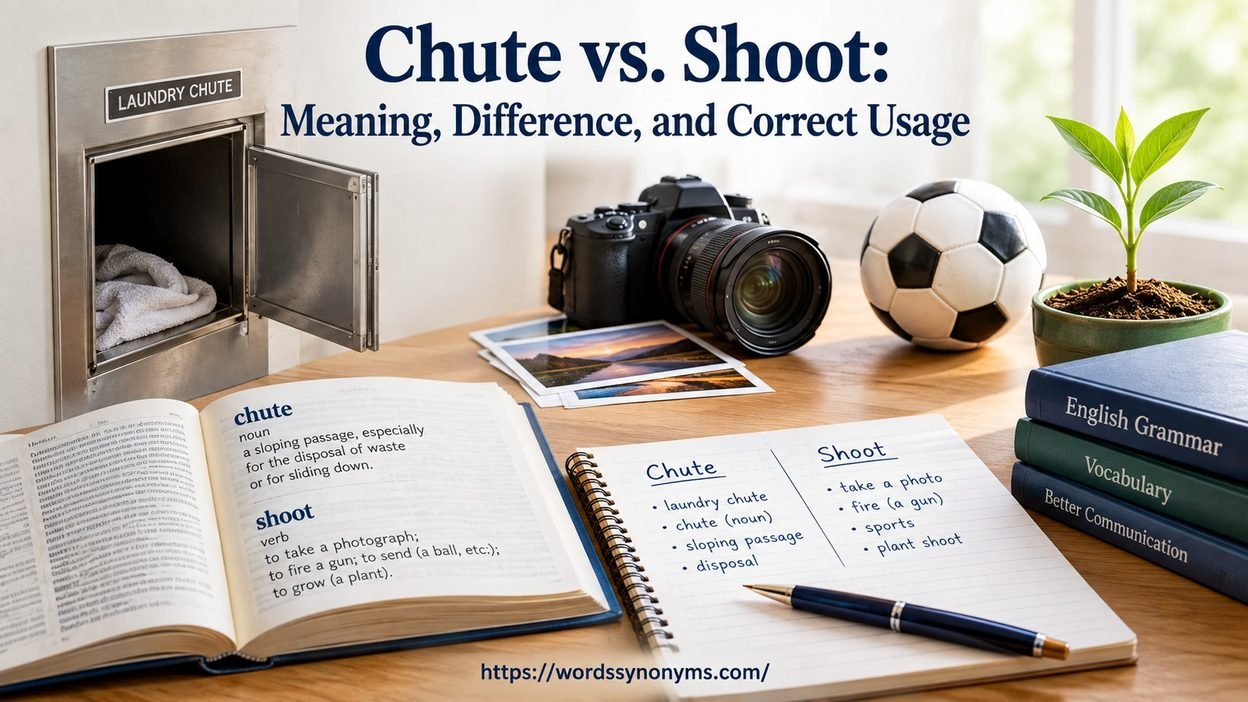
Chute vs. Shoot: Meaning and Correct Usage can be easier when you focus on the difference, meaning, correct usage, and spelling of each word.
A chute is an inclined channel, tube, passage, sloping channel, or trough through which objects and things move down or pass. It is commonly used for waste disposal, sending items from one level to another level, transportation, loading, and shipping.
The word comes from a French word meaning fall. It can also be short for parachute, and its uses include a waterfall or a channel through which things may pass. Thus, down the chute is the correct phrase, while down the shoot is a misspelling.
Shoot has its own word usage and usually describes propelling something rapidly or forcefully. In firearms, firing is an action associated with this meaning. For example, a shipper could shoot cans of bamboo shoots down a chute toward a loading dock.
Here, shoot describes the movement, while chute names the passage. Because the words sound similar, writers may misspell one for the other. Keeping their sense separate improves clear communication and makes your writing more accurate.
Quick Answer
Chute vs. shoot: Chute usually means a passage, channel, or slide through which something moves, as in laundry chute or garbage chute. Shoot can mean to fire, propel, photograph, move quickly, or produce new plant growth, as in shoot the ball or new plant shoot. Both words are pronounced /ʃuːt/, so the context determines the correct spelling.
Chute vs. Shoot: Quick Difference
The simplest way to separate these words is to focus on what the word represents.
| Word | Part of Speech | Main Meaning | Example |
| Chute | Usually noun | A passage, channel, tube, or slide | The clothes fell down the chute. |
| Shoot | Verb and noun | To fire, propel, photograph, move quickly, or produce plant growth | We watched the player shoot the ball. |
| Shoot | Noun | A photography or film session | The magazine scheduled a photo shoot. |
| Shoot | Noun | New growth from a plant | A green shoot appeared overnight. |
Both chute and shoot are pronounced /ʃuːt/. They are therefore homophones: words that sound alike but have different spellings and meanings. Oxford specifically lists them together as homophones.
Here’s the quickest memory trick:
Chute is usually a thing you move through. Shoot is usually an action, activity, or new plant growth.
That isn’t a rule covering every possible use. It is simply a useful shortcut for everyday writing.
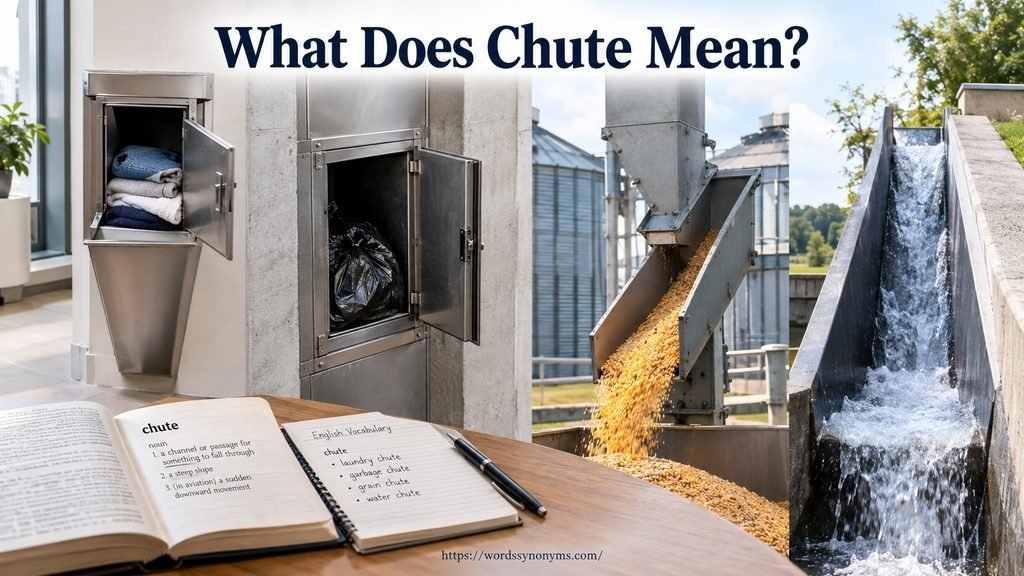
What Does Chute Mean?
The noun chute generally describes a passage or structure that allows people or objects to slide or move from one place to another.
Imagine a smooth channel with gravity doing most of the work. Something enters at one point and travels through the chute toward another point. A chute may be enclosed like a tube or open like a slide.
Common examples include:
- laundry chute
- garbage chute
- rubbish chute
- water chute
- escape chute
- grain chute
- loading chute
Oxford defines the main sense of chute as a tube or passage down which people or things can slide.
Chute as a Passage or Channel
The most familiar meaning of chute involves controlled movement through a passage.
For example:
The hotel has a laundry chute on every floor.
Here, chute names the physical structure. You don’t perform the action of “chuting” the clothes. Instead, you put the clothes into the chute, and they travel through it.
Consider another example:
The workers poured the grain down the chute.
Again, chute refers to the channel that guides the grain downward.
The same basic idea appears in many settings. A chute can move laundry, waste, water, grain, packages, or other materials. Its shape and construction depend on the job.
Laundry Chute
A laundry chute is a passage designed to move dirty clothes from one level of a building to another location, often near a laundry room.
For example:
Put the towels in the laundry chute.
The spelling chute is essential because you’re naming a passage. Writing laundry shoot changes the word into something that does not fit the intended meaning.
This is one of the most common places where people confuse the two words. Since chute and shoot sound identical, someone writing from memory may choose the wrong spelling.
Garbage Chute
A garbage chute is another familiar compound.
In a tall building, residents may place waste into an opening that connects to a vertical passage. Gravity carries the waste downward to a collection area.
For example:
Residents can put household waste down the garbage chute.
Here again, the word describes a physical passage.
The same principle applies to rubbish chute, particularly in British English:
The rubbish goes down the chute into a large bin.
Oxford lists laundry, rubbish, and garbage among common words used with chute.
Water Chute
A water chute is a sloped or channel-like structure through which water flows. The term can also describe a water slide or similar recreational feature.
For example:
The children raced down the water chute.
The key idea remains movement through a channel.
Chute as a Parachute
There is another established meaning of chute that may surprise you.
In informal English, chute can mean parachute. Oxford lists this as an informal sense and identifies it as a shortened form of parachute.
For example:
The pilot deployed his chute.
In this sentence, chute doesn’t mean a laundry passage or industrial channel. It means a parachute.
The shortened form developed from parachute, whose second element comes from French chute, meaning “fall.”
So chute has more than one meaning. Context tells you which sense applies.
Can Chute Be a Verb?
Yes, although the verb is much less common than the noun.
Dictionary sources record chute as a verb in parachute-related usage. In that sense, it can describe descending by parachute or sending something down by parachute.
The everyday word you’ll encounter far more often is the noun:
The packages went down the chute.
For most ordinary writing, you should expect chute to function as a noun.
What Does Shoot Mean?
The word shoot has a much wider range of meanings than chute.
As a verb, shoot can mean to fire a weapon, take a photograph, make a film, propel something, move suddenly, direct something quickly, or attempt to score in sports. As a noun, it can refer to a new part of a plant or an occasion for making photographs or films.
That broad meaning range explains why shoot appears in so many everyday expressions.
Shoot as a Verb
One of the best-known meanings of shoot is to fire a gun or another weapon.
The soldiers learned to shoot at targets.
The word can also describe firing something from a weapon:
The archer shot an arrow toward the target.
Notice the verb forms:
| Form | Word |
| Base form | shoot |
| Third-person singular | shoots |
| Past tense | shot |
| Past participle | shot |
| -ing form | shooting |
The past tense is particularly important because it doesn’t become shooted.
You say:
She shot the ball.
Not:
She shooted the ball.
Oxford lists shoot → shot → shot as the core verb pattern.
Shoot in Sports
Sports provide another extremely common meaning.
In basketball, soccer, hockey, and other sports, shoot can mean attempting to send a ball or puck toward a goal or scoring area.
For example:
The basketball player tried to shoot from the three-point line.
Or:
She shot the ball into the corner of the net.
This use has nothing to do with a chute.
That’s an important distinction because the sentence can sound perfectly natural when spoken. Only the context reveals which spelling belongs on the page.
Shoot in Photography
Shoot also has a major meaning in photography and filmmaking.
As a verb, it means to take photographs or make film or video.
The photographer will shoot the portraits tomorrow.
The crew plans to shoot the final scene at sunrise.
This meaning is common in professional and everyday creative language.
The noun shoot comes from the same area:
The photographer has a fashion shoot tomorrow.
A photo shoot is an occasion when someone takes photographs for a particular purpose. A film shoot refers to a period or session in which filmmakers record scenes. Oxford lists these as established noun uses.
Shoot as Rapid Movement
Shoot can also describe sudden or rapid movement.
For example:
The rabbit shot across the road.
The plane shot across the sky.
Her hand shot forward.
This use gives shoot a sense of speed and sudden direction. The subject doesn’t necessarily involve a weapon.
A sentence such as The car shot down the street simply means that the car moved very quickly.
Shoot for Plant Growth
Plants provide another important meaning.
When a plant shoots, it produces new growth. A shoot can be a new stem or part of a plant that grows upward from the ground.
For example:
The bulbs began to shoot after several warm days.
As a noun:
Tiny green shoots appeared in the garden.
Oxford defines a plant shoot as a part that grows from the ground or a new part that develops on a plant or tree.
This meaning is easy to remember because shoot describes growth pushing outward or upward.
Chute vs. Shoot: Pronunciation
The pronunciation causes the confusion in the first place.
Both words are pronounced:
/ʃuːt/
The beginning sounds like the sh in shoe. The ending sounds like the oot in boot.
So:
- chute → /ʃuːt/
- shoot → /ʃuːt/
They sound the same even though they look completely different.
That’s the defining feature of a homophone.
Why Pronunciation Doesn’t Solve the Problem
Suppose someone says:
“Put it down the shoot.”
If you’re only listening, you have no way to know whether the speaker intends shoot or chute.
Once the sentence appears in writing, however, the meaning becomes obvious:
Put it down the chute.
The word refers to a passage.
The same problem appears in reverse:
She booked a photo shoot.
Writing photo chute would produce a completely different and incorrect expression.
The practical lesson is simple:
Don’t choose between chute and shoot by sound. Choose by meaning.
Chute vs. Shoot: Key Differences in Meaning and Grammar
The two words become easier to separate when you compare their grammatical roles.
| Feature | Chute | Shoot |
| Pronunciation | /ʃuːt/ | /ʃuːt/ |
| Homophone | Yes | Yes |
| Common part of speech | Noun | Verb and noun |
| Physical passage | Yes | No |
| Firing a weapon | No | Yes |
| Photography | No | Yes |
| Film production | No | Yes |
| Plant growth | No | Yes |
| Sports action | No | Yes |
| Informal meaning “parachute” | Yes | No |
| Common compound | Laundry chute | Photo shoot |
This table reveals the central distinction.
Chute generally names a thing. Shoot often describes an action.
However, shoot can also function as a noun. That’s why the distinction isn’t simply “noun versus verb.”
Chute vs. Shoot in Sentences
Examples make homophones much easier to understand because context does the work that pronunciation cannot.
Examples With Chute
- The dirty clothes disappeared down the chute.
- The apartment building has a garbage chute.
- Water rushed through the narrow chute.
- The workers poured grain into the chute.
- The emergency chute opened beneath the aircraft.
- The amusement park added a new water chute.
- The parachutist checked his chute before the jump.
Each sentence gives chute a physical or parachute-related meaning.
Examples With Shoot
- The player tried to shoot the ball into the net.
- The photographer will shoot the portraits tomorrow.
- The rabbit shot across the field.
- New leaves began to shoot from the stem.
- The director plans to shoot the final scene outdoors.
- The athlete took a quick shot at the goal.
- The photographer scheduled a fashion shoot.
These examples demonstrate how broad shoot can be.
Side-by-Side Examples
Sometimes the easiest method is to put the words next to each other.
The clothes went down the laundry chute.
The photographer will shoot the clothing for the catalog.
Or:
The grain moved through the chute.
The player tried to shoot the ball.
The surrounding words act like clues. Once you recognize the meaning, the spelling usually follows naturally.
Common Phrases With Chute
Some combinations occur so often that learning them as complete phrases can prevent spelling mistakes.
Laundry Chute
A laundry chute carries dirty clothes from one part of a building to another.
The hotel installed a laundry chute beside the service elevator.
Garbage Chute
A garbage chute allows waste to travel through a building to a collection area.
Please place the bag in the garbage chute.
Rubbish Chute
Rubbish chute is a common British English expression.
The residents put their rubbish down the chute.
Water Chute
A water chute provides a channel for water or can refer to a recreational water slide.
The children waited at the top of the water chute.
Escape Chute
An escape chute provides a rapid route for people leaving an aircraft or other structure.
Passengers were instructed to use the escape chute.
The common thread is clear: chute describes a passage or route for movement.
Common Phrases With Shoot
The word shoot appears in many everyday combinations.
Shoot a Ball
In sports, you shoot a ball when you attempt to score.
Maya decided to shoot from outside the penalty area.
Shoot a Photo
Photographers commonly use shoot as a verb meaning to take a photograph.
We need to shoot the product photos before sunset.
Photo Shoot
A photo shoot is a photography session.
The magazine arranged a photo shoot for its spring issue.
Film Shoot
A film shoot is a period during which a film crew records scenes.
The film shoot lasted several weeks.
Shoot New Growth
Plants can shoot new growth.
The rose bushes began to shoot after the weather warmed.
These phrases demonstrate why context matters so much. The same pronunciation appears in completely different situations.
Common Mistakes With Chute and Shoot
Because the words sound identical, spelling errors usually happen when writers rely on sound rather than meaning.
Mistake: “Laundry Shoot”
Incorrect:
The towels went down the laundry shoot.
Correct:
The towels went down the laundry chute.
The word needs to be chute because it names the passage carrying the towels.
Mistake: “Garbage Shoot”
Incorrect:
Put the bag in the garbage shoot.
Correct:
Put the bag in the garbage chute.
Again, the object is a physical passage.
Mistake: “Photo Chute”
Incorrect:
The photographer booked a photo chute.
Correct:
The photographer booked a photo shoot.
A photo shoot is a photography session. The spelling chute doesn’t fit this meaning.
Mistake: “Shoot” for Every Meaning of “Shute”
Another problem occurs when writers know the pronunciation but not the spelling.
They may write shoot because it looks familiar. Familiarity doesn’t make it correct.
The sentence itself provides the clue.
Ask:
What does the word mean here?
If the answer is “a passage,” choose chute.
If the answer involves photography, sports, movement, firing, or plant growth, shoot may be the correct choice.
How to Remember Chute vs. Shoot
A simple mental picture works better than an elaborate mnemonic.
Remember Chute as a Route
Think:
Chute → channel → things move through it
Picture a laundry chute in a tall building. Clothes enter at the top and travel downward.
You can also connect it with:
- laundry chute
- garbage chute
- water chute
- escape chute
Remember Shoot as an Action or Growth
Think:
Shoot → action, movement, photography, sports, or plant growth
Picture a basketball player shooting at a hoop. Then picture a photographer taking pictures. Finally, imagine a green shoot emerging from the soil.
One word can cover all those meanings.
A Fast Memory Test
When you’re unsure, ask yourself:
Is the word naming a passage or channel?
If yes, use chute.
Is the word describing an action, a photography session, or plant growth?
If yes, use shoot.
This quick test handles most everyday cases.
Chute vs. Shoot: Word Origins
The history of these words adds an interesting layer to the distinction.
Chute entered English through French. Oxford traces its main passage-related sense to French chute, meaning “fall,” from Old French and ultimately Latin roots associated with falling. The English word was originally associated with falling or flowing material and was later influenced by shoot.
The parachute-related sense developed later as a shortened form of parachute. Oxford dates that informal shortening to the 1920s.
Shoot has a different history. Oxford traces it to Old English scēotan and identifies it as a word of Germanic origin. The historical family includes related forms in other Germanic languages and the English word shot.
So although the modern words sound alike, their histories are not simply two spellings of one original English word.
Why Do Chute and Shoot Sound the Same?
Historical sound changes and borrowing helped produce the modern pronunciation.
English contains many homophones that developed from different historical paths. Chute came through French, while shoot comes from Old English. Over time, their pronunciations converged.
That’s why spelling remains the best clue to their written identities.
The relationship is a useful reminder that English pronunciation doesn’t always provide a reliable spelling guide.
Is Chute the Same as Shoot?
No.
Chute and shoot are homophones, not interchangeable spellings.
A chute is commonly a passage, channel, or slide. It can also serve as an informal shortened form of parachute.
A shoot can be a verb meaning to fire, propel, photograph, move rapidly, or produce new plant growth. It can also be a noun referring to a plant’s new growth or a photography or film session.
Compare these sentences:
The clothes went down the chute.
The photographer will shoot the clothes for the advertisement.
The pronunciation may be identical. The meanings clearly aren’t.
Is “Chute” a Verb?
Yes, although the verb is uncommon in ordinary modern writing.
The verb chute has parachute-related usage. The more familiar noun is the one you’ll encounter in expressions such as laundry chute, garbage chute, and water chute.
For everyday writing, don’t assume that every use of the sound /ʃuːt/ should become shoot. Context still controls the spelling.
Is “Shoot” a Noun?
Yes. In fact, shoot has several important noun meanings.
One meaning refers to new plant growth:
The first green shoot appeared after the rain.
Another refers to a photography or film session:
The advertising shoot begins tomorrow.
Oxford also records a British English noun use for a group hunting or shooting animals or birds for sport.
So the idea that shoot is “only a verb” is incorrect.
Chute vs. Shoot in American and British English
Neither word represents a simple American-versus-British spelling difference.
American and British English both use chute for the passage or channel sense. Both also use shoot for its various verb and noun meanings.
There can be differences in individual expressions and specialized uses. For example, Oxford identifies the noun meaning of shoot involving organized hunting and shooting as especially associated with British English.
The core distinction remains the same:
- chute = passage, channel, slide, or informal parachute
- shoot = action, movement, photography, plant growth, and related noun uses
So you shouldn’t change chute to shoot simply because you’re writing for an American audience.
Chute vs. Shoot: Quick Reference Table
| If you mean… | Use |
| A laundry passage | chute |
| A garbage passage | chute |
| A water slide or channel | chute |
| A grain passage | chute |
| An escape passage | chute |
| An informal parachute | chute |
| Firing a weapon | shoot |
| Kicking or throwing toward a goal | shoot |
| Taking a photograph | shoot |
| Recording a film | shoot |
| Moving suddenly | shoot |
| New plant growth | shoot |
| A photography session | shoot |
| A film-making session | shoot |
A Practical Case Study: Choosing the Correct Word
Consider this sentence:
The building manager told residents to put their laundry down the ___.
Which spelling belongs in the blank?
The answer is chute.
Why? The missing word names a passage through which the laundry travels.
Now consider:
The photographer scheduled a fashion ___ for Friday.
The answer is shoot.
This time, the missing word describes a photography session.
Now try one more:
Tiny green ___ appeared beside the main stem.
The answer is shoots.
Here, the word refers to new plant growth.
The pronunciation doesn’t change much across these examples. The meaning does.
That’s exactly why context is the best spelling guide.
Read more: Excel vs. Accel: Difference and Correct Usage
Why “Chute” and “Shoot” Are Easy to Confuse
English spelling contains plenty of traps, but homophones are especially troublesome.
When two words sound identical, your brain can’t rely on pronunciation to separate them. You have to use the sentence around them.
The problem becomes even stronger when both words are familiar. Shoot is an extremely common English word, while chute appears frequently in specific compounds such as laundry chute and garbage chute.
A writer who knows the spoken phrase but hasn’t seen it in writing may naturally spell it incorrectly.
For example, someone may hear:
“The clothes went down the laundry chute.”
and later write:
“The clothes went down the laundry shoot.”
The mistake isn’t caused by poor pronunciation. The speaker heard the word correctly. The problem comes from choosing the wrong written form.
That distinction matters.
Useful Facts About Chute and Shoot
- Chute and shoot are pronounced /ʃuːt/.
- They are homophones.
- Chute is usually a noun.
- Shoot works as both a verb and a noun.
- Chute commonly describes a passage or channel.
- Shoot has meanings connected with weapons, sports, photography, movement, and plant growth.
- Photo shoot uses shoot, not chute.
- Laundry chute uses chute, not shoot.
- Garbage chute uses chute, not shoot.
- Shoot has the irregular past forms shot and shot.
- Chute can be used informally to mean parachute.
FAQs
What is the main difference between chute and shoot?
Chute is a noun for a channel, tube, or passage used for moving things downward. Shoot has several meanings, including propelling something quickly, firing a weapon, or taking a shot.
Is “down the shoot” correct?
Usually, no. When you mean a channel or passage, the correct phrase is “down the chute.” “Down the shoot” can be a spelling mistake caused by the similar pronunciation of the two words.
What does chute mean?
A chute is a sloping channel, tube, or passage through which objects can move. It can be used for waste disposal, loading, transportation, or other situations where things need to move from one level to another.
Can chute mean parachute?
Yes. Chute can be used as a shortened form of parachute. This meaning is different from a chute used as a channel for moving objects.
What does shoot mean in everyday English?
Shoot can mean to propel something rapidly or forcefully. It can also refer to firing a firearm, taking a photograph, or other actions depending on the context.
Why are chute and shoot commonly confused?
The two words have similar pronunciation, so they’re easy to mix up in writing. Remembering that chute is associated with a channel or passage, while shoot has its own verb and noun meanings, can help you choose the correct word.
Conclusion
Chute and shoot may sound alike, but they do very different jobs in a sentence. Use chute when you mean a channel, passage, or tube through which something moves, as in “send the boxes down the chute.” Use shoot when you mean actions such as propelling, firing, or taking a photograph.
Once you connect chute with a physical passage and shoot with an action, the difference becomes much easier to remember. A quick check of the sentence’s meaning and context can also help you avoid the common mistake of writing “down the shoot” when you mean “down the chute.”

Samreen Saif is a passionate writer and language enthusiast who contributes informative and engaging content to WordsSynonyms.com. She enjoys exploring English vocabulary, synonyms, antonyms, word meanings, and language usage to help readers understand and use words with confidence.
Samreen focuses on creating clear, accurate, and easy-to-read content for students, writers, professionals, and English learners. Through her articles, she aims to make vocabulary learning simple, practical, and useful for everyday communication.
When she is not writing, Samreen enjoys learning about language, discovering new words, and creating helpful content that makes English learning more accessible to everyone.