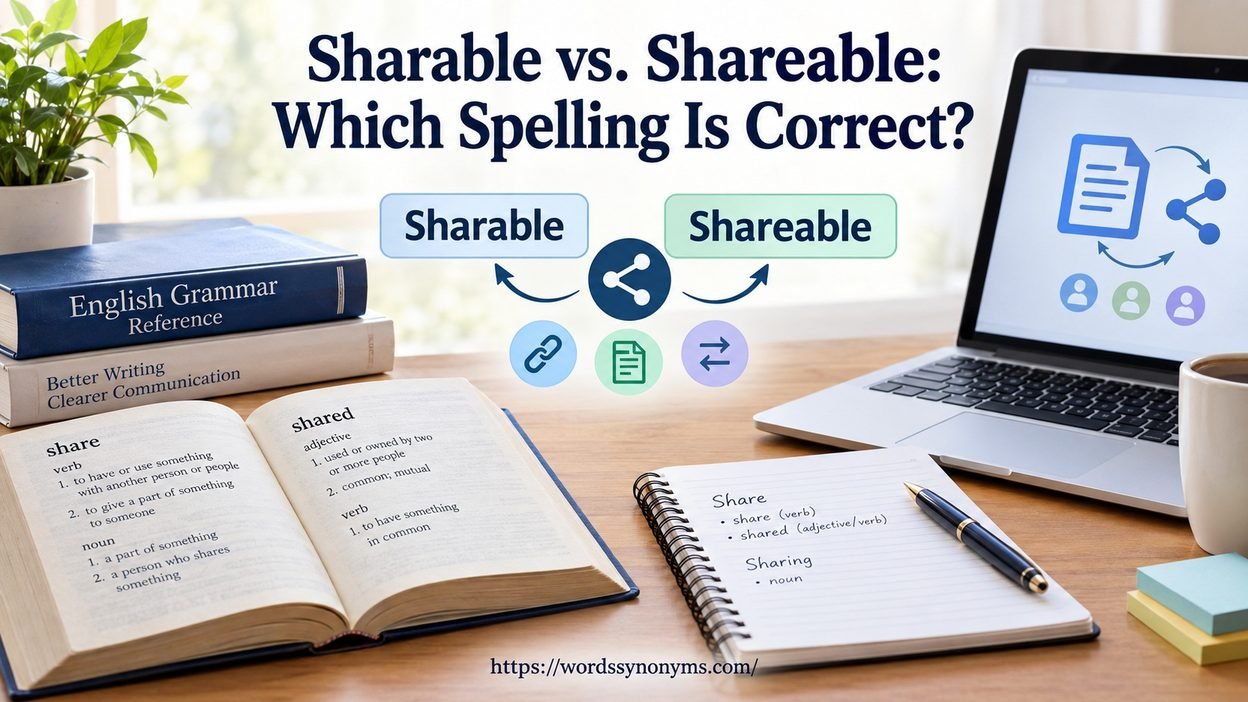
Sharable vs. Shareable: Correct Spelling Explained can look confusing, but both are an adjective meaning able to be shared, with a small spelling difference in modern usage.
Shareable keeps the silent e before the -able words suffix, while sharable uses dropping. This difference comes from English word formation and creates a useful spelling variant. In the U.S. and Canada, both forms are common, although shareable is increasingly familiar in contemporary usage.
The latter, sharable, reflects a longstanding American preference for dropping the silent e, but this preference has eroded in recent decades. Today, shareable prevails by a noticeable margin in American texts.
North American regional usage accepts both forms, while outside North America, shareable is generally preferred. The U.S. and Canada therefore show more variation than other English-speaking regions, although modern texts increasingly favor shareable.
Quick Answer
If you’re looking for the practical answer, here’s the short version:
- Shareable is a standard adjective.
- Sharable is also a valid adjective.
- Both mean able or suitable to be shared.
- The two forms generally have the same pronunciation.
- Neither spelling creates a different core meaning.
- Shareable is a familiar choice in modern digital English.
- Sharable isn’t automatically a spelling mistake.
- In formal writing, consistency matters more than switching between the two forms.
- If you don’t have a specific house style to follow, shareable is a straightforward default because it is highly familiar to contemporary readers.
For example:
Please send me a shareable link.
You could also write:
Please send me a sharable link.
The meaning remains the same.
What Does Shareable Mean?
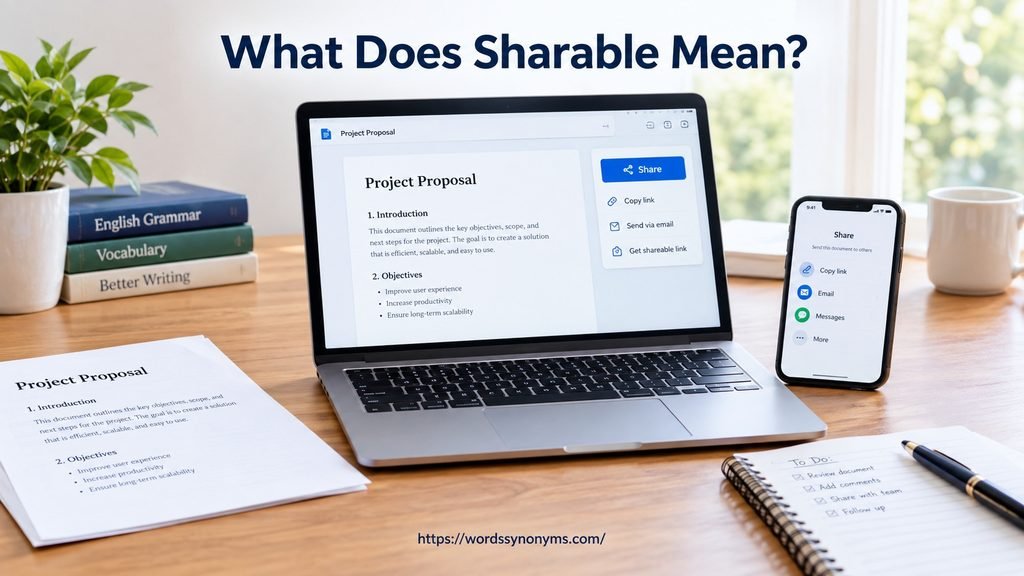
Shareable is an adjective that describes something that can be shared with another person or group. Cambridge Dictionary specifically defines it as something that can be shared with other people, particularly over the internet.
The word comes from the verb share plus the adjective-forming ending -able.
The basic idea looks like this:
share → shareable
The verb share can describe several actions. You can share an object, divide something with someone, tell another person information, use something jointly, or make digital material available to others. Cambridge includes these different senses of share, including sharing something on a social media website.
Adding -able changes the word into an adjective describing possibility or suitability.
For example:
- The file can be shared. → The file is shareable.
- The image can be shared. → The image is shareable.
- The article can be shared. → The article is shareable.
That makes shareable especially useful in technology and online communication.
Examples of Shareable
Consider these natural examples:
- The presentation is shareable with everyone on the team.
- Create a shareable link for the document.
- This image is shareable on social media.
- The recipe includes a shareable version for your friends.
- The calendar has a shareable public link.
- We need a shareable copy of the report.
- The video became highly shareable after the announcement.
- Make the graphic shareable before publishing it.
Notice what all these examples have in common. Shareable describes the thing rather than the act of sharing itself.
What Does Sharable Mean?
Sharable has the same basic meaning as shareable: it describes something that can be shared.
The spelling removes the final e from share before adding -able:
share + able → shareable
versus
shar(e) + able → sharable
That spelling difference doesn’t create a new meaning.
For example:
- The document is shareable.
- The document is sharable.
Both sentences say that the document can be shared.
Examples of Sharable
Here are several natural examples:
- The file is sharable with other employees.
- We need a sharable version of the presentation.
- This folder contains sharable resources.
- The photograph is sharable online.
- Can you create a sharable link?
- The report needs to be converted into a sharable format.
- The template is sharable with the entire class.
The shorter spelling may look unusual to some readers simply because shareable is more visually familiar. That doesn’t make sharable incorrect.
Shareable vs. Sharable: Meaning and Usage
The most important point in the sharable vs. shareable debate is that there isn’t a meaningful semantic divide between the two forms.
Both words describe something that can be shared.
Think of them as two spellings pointing toward the same destination. The route looks slightly different, but the destination hasn’t changed.
| Feature | Shareable | Sharable |
| Meaning | Able to be shared | Able to be shared |
| Part of speech | Adjective | Adjective |
| Pronunciation | Generally the same | Generally the same |
| Can describe digital content? | Yes | Yes |
| Can describe physical things? | Yes | Yes |
| Valid spelling? | Yes | Yes |
| Common in modern digital English? | Yes | Yes |
| Meaningfully different? | No | No |
This distinction matters because many spelling questions incorrectly assume that two forms must have different meanings.
They don’t.
Do Shareable and Sharable Mean the Same Thing?
Yes.
Consider these pairs:
- This photo is shareable.
- This photo is sharable.
Both mean that the photo can be shared.
Another pair:
- We need a shareable document.
- We need a sharable document.
Again, the meaning stays intact.
The same pattern works with link, image, file, video, resource, and content.
Are Shareable and Sharable Both Adjectives?
Yes. Both forms function primarily as adjectives.
An adjective modifies a noun by describing a quality, condition, or characteristic.
For example:
- shareable file
- sharable file
- shareable image
- sharable image
- shareable link
- sharable link
- shareable content
- sharable content
In each phrase, the adjective tells you something about the noun.
1 A shareable file is a file that can be shared.
2 A shareable link is a link designed or configured so that other people can use it to access something.
3 A shareable image is an image that can be passed along to other people.
The same grammatical pattern applies to sharable.
Why Is It Shareable but Also Sharable?
This is where English spelling gets interesting.
The base word share ends in a silent e. When English forms adjectives with -able, spelling patterns don’t always produce one universal result.
Compare:
- share → shareable
- shar(e) → sharable
The first form retains the e. The second removes it.
Neither spelling changes the underlying pronunciation or meaning in ordinary usage.
English contains many words whose spelling changes when suffixes are added. Sometimes the final silent e disappears. Sometimes it remains. Historical development, word formation, pronunciation, convention, and lexical familiarity all influence the forms English speakers accept.
That is why it isn’t useful to treat shareable and sharable as though one follows an absolute spelling law while the other breaks it.
The dictionaries matter here.
That provides strong evidence that sharable is an established alternative spelling.
Shareable vs. Sharable Pronunciation
For most speakers, shareable and sharable have the same pronunciation.
In simple terms, it sounds roughly like:
SHAIR-uh-buhl
The spelling doesn’t normally create a meaningful pronunciation contrast between the two forms.
That creates an interesting situation:
Different spelling, same basic sound, same core meaning.
This is one reason the distinction can feel confusing when you encounter the words in writing. If someone says the word aloud, you can’t necessarily tell which spelling they have chosen.
Shareable vs. Sharable in American English
For American English readers, shareable is a particularly familiar spelling in digital communication.
You see it in phrases such as:
- shareable content
- shareable link
- shareable image
- shareable post
- shareable video
- shareable document
- shareable calendar
That distinction is useful when choosing a form for an article, report, website, email, or business document.
If the audience includes a broad group of American English readers, shareable is a familiar and immediately recognizable choice.
However, familiarity shouldn’t be confused with exclusive correctness.
Sharable remains valid.
Shareable vs. Sharable in British English
British English also recognizes shareable and sharable as alternative forms.
So this isn’t a simple case of:
American English = shareable
British English = sharable
That would be misleading.
The spelling distinction isn’t equivalent to common US-versus-UK pairs such as color/colour or center/centre.
Instead, both forms can occur in English regardless of that regional distinction.
Is Shareable More Common Than Sharable?
In contemporary digital writing, shareable is a highly familiar form.
It’s especially common in phrases connected with online communication:
- shareable content
- shareable links
- shareable graphics
- shareable posts
- shareable videos
- shareable resources
The important point, however, is that frequency and correctness aren’t identical concepts.
A word can appear less often while remaining perfectly valid.
Think about two roads leading to the same town. One may carry far more traffic, but the quieter road still reaches the destination.
That’s essentially the relationship between shareable and sharable.
When Should You Use Shareable?
Shareable is a sensible default when you want the spelling most readers will recognize quickly.
It’s especially natural in:
Formal and professional writing
- Please provide a shareable version of the report.
- The team created a shareable document for clients.
Digital communication
- Send me a shareable link.
- The video needs a shareable format.
Social media
- The graphic should be clear and shareable.
- The campaign produced several shareable images.
Educational material
- Students received a shareable study guide.
- The teacher uploaded a shareable worksheet.
General writing
- The recipe is simple, practical, and shareable.
In all these situations, shareable sounds natural because readers frequently encounter the form.
When Can You Use Sharable?
You can use sharable when it fits your editorial preference, organizational style, or existing terminology.
For example:
The spreadsheet is sharable with everyone in the department.
There is nothing inherently wrong with this sentence.
You might also encounter:
The platform creates sharable resources for educators.
Again, the meaning is clear.
The main practical rule is consistency.
If a document uses shareable throughout, suddenly switching to sharable can look like an editing mistake even though both forms are valid.
Likewise, if a company’s established style uses sharable, repeatedly changing it to shareable can create unnecessary inconsistency.
Common Phrases With Shareable
Some combinations appear naturally in modern communication.
| Phrase | Example |
| shareable content | The marketer created shareable content. |
| shareable link | Use the shareable link to access the file. |
| shareable image | The designer created a shareable image. |
| shareable file | The PDF is shareable with the team. |
| shareable document | Save a shareable document before sending it. |
| shareable video | The editor exported a shareable video. |
| shareable resource | The teacher prepared a shareable resource. |
| shareable calendar | The group uses a shareable calendar. |
| shareable post | The announcement became a shareable post. |
| shareable format | Export the report in a shareable format. |
These phrases show why shareable has become particularly useful in technology-related English.
Common Phrases With Sharable
The shorter spelling can appear in the same grammatical combinations:
- sharable content
- sharable link
- sharable file
- sharable document
- sharable image
- sharable resource
- sharable data
- sharable format
- sharable information
For example:
The database contains sharable information.
You could replace sharable with shareable without changing the basic meaning:
The database contains shareable information.
The difference is orthographic rather than semantic.
Shareable vs. Sharable Example Sentences
The clearest way to understand the distinction is to put the forms side by side.
| Context | Shareable | Sharable |
| File | The file is shareable. | The file is sharable. |
| Link | Create a shareable link. | Create a sharable link. |
| Image | This image is shareable. | This image is sharable. |
| Document | The document is shareable. | The document is sharable. |
| Video | The video is shareable. | The video is sharable. |
| Content | The content is shareable. | The content is sharable. |
| Resource | The resource is shareable. | The resource is sharable. |
| Calendar | We use a shareable calendar. | We use a sharable calendar. |
The pattern is remarkably consistent.
Example: Digital File
Shareable:
The PDF is shareable with anyone who has the link.
Sharable:
The PDF is sharable with anyone who has the link.
The meaning doesn’t change.
Example: Social Media
Shareable:
The company created a shareable graphic for its announcement.
Sharable:
The company created a sharable graphic for its announcement.
Again, the adjective describes the same quality.
Example: Workplace Communication
Shareable:
Please send me a shareable version of the spreadsheet.
Sharable:
Please send me a sharable version of the spreadsheet.
Neither sentence changes the underlying instruction.
Shareable vs. Shared: Don’t Confuse Them
Although shareable and shared are related, they don’t mean exactly the same thing.
This distinction is much more important than the spelling difference between shareable and sharable.
Shareable means something can be shared.
Shared generally indicates that something has been given, used, experienced, owned, or divided by more than one person.
Compare these sentences:
The file is shareable.
This tells you that the file can be shared.
The file is shared.
This could mean that multiple people already have access to it or that they use it together.
The distinction is subtle but important.
| Word | Core idea | Example |
| shareable | Can be shared | The link is shareable. |
| sharable | Can be shared | The link is sharable. |
| shared | Already shared, jointly used, or jointly held | We use a shared folder. |
| sharing | The act or process of sharing | File sharing saves time. |
| share | The action or thing being divided/given | Please share the document. |
Shareable vs. Sharing
Sharing is the present participle of share and can function as a noun or part of a verb phrase. Cambridge identifies sharing as the present participle of share.
Compare:
The document is shareable.
This describes the document’s potential.
We are sharing the document.
This describes an action happening now.
That difference becomes clearer with a simple timeline:
Possible → Action → Result
shareable → sharing → shared
For example:
The file is shareable.
The file can be shared.
We are sharing the file.
Someone is doing the sharing.
The file has been shared.
The sharing has happened.
This three-way distinction can prevent many awkward sentences.
Is “Sharable” a Word?
Yes.
This is one of the most important answers in the entire sharable vs. shareable discussion.
Therefore, treating every occurrence of sharable as a spelling error isn’t justified.
For example:
The document is sharable.
That sentence is grammatically sound.
If a particular style guide, editor, or organization prefers shareable, it may ask you to change the spelling. That’s a matter of editorial consistency rather than proof that sharable isn’t a word.
Is “Shareable” a Word?
Yes.
Shareable is the dictionary headword used by Cambridge for the adjective. It means something that can be shared with other people, particularly through the internet.
The word has become especially useful as digital communication has expanded.
Before the internet became central to everyday communication, people could still describe physical objects as shareable. Today, however, the adjective appears naturally alongside digital nouns:
- shareable link
- shareable post
- shareable photo
- shareable video
- shareable file
- shareable document
The digital world has simply given the adjective a much larger playground.
Is Shareable or Sharable More Correct?
Neither form needs to be labeled “incorrect.”
Both are valid spellings.
The better question is:
Which spelling should you use for your particular audience and context?
If you want a familiar default, shareable is a practical choice.
If an established style guide uses sharable, there is no linguistic reason to assume the spelling is wrong simply because it looks less familiar.
The distinction can be summarized like this:
Correctness: Both are valid.
Meaning: Essentially the same.
Pronunciation: Generally the same.
Spelling: Different.
Usage preference: May vary by writer, publication, organization, or context.
That is a much more accurate way to understand the pair.
Shareable vs. Sharable in Formal Writing
When writing a business report, academic document, website, email, or professional article, shareable is often a comfortable choice because it is immediately recognizable.
For example:
Please upload a shareable copy of the final report.
The sentence is direct and easy to understand.
However, sharable is also possible:
Please upload a sharable copy of the final report.
The important thing is not to create an artificial rule that says one spelling is grammatical and the other isn’t.
Instead, consider three practical factors:
Audience familiarity
Choose the spelling that your readers will recognize easily.
Editorial consistency
Use the same spelling throughout a document unless there is a deliberate reason to change it.
House style
If a company, publication, school, or organization has a preferred spelling, follow that style.
Good editing often comes down to consistency rather than chasing a mythical single “correct” form.
Shareable vs. Sharable in Digital Communication
The digital world has made this adjective especially common.
A file may be shareable because its permissions allow multiple people to access it.
A link may be shareable because it can be copied and sent to other people.
An image may be shareable because its format makes it easy to distribute online.
A post may be described as shareable because users can repost or distribute it through a platform.
In each case, the adjective focuses on possibility or suitability for sharing.
For example:
Make sure the document has a shareable link.
Here, shareable doesn’t mean that someone has already shared the document. It means the link can be used to let other people access it.
That distinction matters in technical instructions.
A Useful Case Study: Shareable Link vs. Shared Link
Imagine a team storing a project report online.
The manager says:
Send me a shareable link.
The manager wants a link that can be given to another person.
Now imagine the manager says:
Send me the shared link.
That could refer to a link that has already been distributed or one associated with a shared resource.
The two adjectives therefore create different implications.
Shareable focuses on capability.
Shared focuses on existing access, use, ownership, or distribution.
This distinction is more than cosmetic.
It can affect instructions in workplace communication, software documentation, customer support, and educational materials.
Read more: Espresso vs. Expresso: Which Spelling Is Correct?
Common Mistakes With Sharable and Shareable
Mistake: Calling Sharable a Spelling Error
Because shareable looks more familiar, some writers assume sharable must be wrong.
That’s not accurate.
Cambridge recognizes sharable as an alternative.
Mistake: Assuming the Words Have Different Meanings
There isn’t a standard semantic distinction between the two.
Both describe something that can be shared.
Mistake: Using Shareable as a Verb
Shareable is an adjective.
You don’t normally write:
I will shareable the document.
Instead, write:
I will share the document.
Then use shareable to describe the document:
The document is shareable.
Mistake: Confusing Shareable With Shared
These forms describe different ideas.
- shareable = capable of being shared
- shared = already jointly used, owned, experienced, or distributed
Mistake: Switching Spellings Randomly
If an article begins with shareable and later changes to sharable without a reason, readers may assume the writer missed an editing error.
Pick one form and stick with it.
A Simple Grammar Pattern to Remember
The easiest way to use both words correctly is to remember this pattern:
Subject + linking verb + shareable/sharable
Examples:
- The file is shareable.
- The image is shareable.
- The document is sharable.
- The resource is sharable.
You can also place the adjective before a noun:
shareable + noun
- shareable file
- shareable link
- shareable content
Or:
sharable + noun
- sharable file
- sharable link
- sharable content
This structure makes the grammatical role clear.
Shareable vs. Sharable: Memory Trick
If you frequently forget which spelling to choose, use this simple memory aid:
Shareable keeps the visual shape of share:
share + able = shareable
Sharable drops the final e:
shar(e) + able = sharable
Then remember the bigger rule:
Both mean “able to be shared.”
You don’t need to memorize two separate definitions.
There is only one central meaning.
Quick Reference Table
| Question | Answer |
| Is shareable a word? | Yes. |
| Is sharable a word? | Yes. |
| Are they adjectives? | Yes. |
| Do they have different meanings? | Generally no. |
| Do they normally have different pronunciations? | No. |
| Can both describe digital content? | Yes. |
| Can both describe physical things? | Yes. |
| Is shareable a familiar modern form? | Yes. |
| Is sharable automatically incorrect? | No. |
| Should you use both randomly? | No. Use one consistently. |
| Which is a practical default? | Shareable is a familiar choice for many readers. |
FAQs
Is shareable or sharable the correct spelling?
Both shareable and sharable are accepted spellings. Shareable is more widely used today, while sharable remains common, especially in some North American usage.
What is the difference between sharable and shareable?
There is no major difference in meaning. Both words describe something that is able to be shared. The main difference is their spelling and regional usage.
Why does shareable keep the silent e?
Shareable keeps the silent e from the base word share before the -able suffix. English spelling conventions allow this form, even though the e isn’t pronounced.
Is sharable more common in American English?
Sharable has a longstanding connection with American spelling preferences that often involve dropping a silent e before certain suffixes. However, shareable is now more common in American texts.
Which spelling should you use in North America?
In the U.S. and Canada, you can use either shareable or sharable. Shareable is generally the more common contemporary choice.
Is shareable preferred outside North America?
Yes. Shareable is generally the preferred spelling outside North America. It is widely recognize
Conclusion
Choosing between sharable and shareable is mostly a matter of spelling preference rather than meaning. Both words describe something able to be shared, so either can make sense depending on the style and audience you’re writing for.
For most modern writing, shareable is the safer choice because it is widely recognized and increasingly common in both North American and international English. If you come across sharable, don’t assume it’s incorrect. It’s a valid spelling that reflects a different approach to forming words with the -able suffix.

Syeda Naalain Zahra is a content writer with an interest in English vocabulary and language. She creates simple and informative articles about synonyms, antonyms, word meanings, and everyday English usage. Her aim is to help readers build better vocabulary and communicate more confidently.