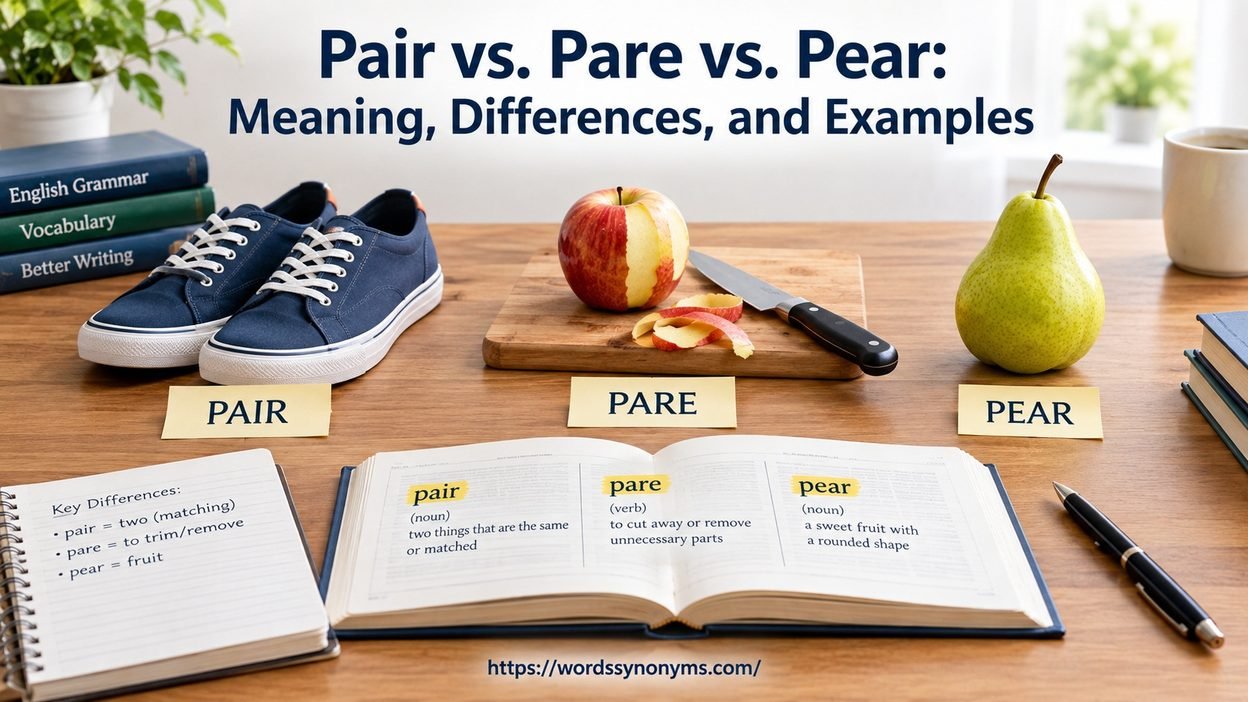
In Pair vs. Pare vs. Pear: Differences and Examples, these homophones show how sound, spelling, and context can change meaning in everyday English.
English learners and writers can feel confused because pair, pare, and pear sound exactly the same, but they have different meanings and spellings. These words can cause spelling mistakes in writing, schoolwork, emails, and social media posts. A pair is a set of two, and it can act as a verb meaning to provide a partner or make a set of two.
For example, bought a pair can describe two matching or related things. Pare means to trim the outer parts of something. It can also be used figuratively, such as when a household budget is tight and you pare down grocery expenses. A pear is a fruit with a spherical base and tapered top, while tree can refer to the plant that bears this fruit.
For correct usage, connect each spelling with a clear image or action. Think of pair as two things together, pare as cutting or reducing something, and pear as the fruit. This simple way helps you understand the differences, meanings, and examples and use them correctly in different situations in everyday English.
The words come from different language histories, but their shared sound can lead to common mistakes. When choosing pair or pear or pare, check the context: pair relates to two or a partner, pare relates to trimming or down, and pear relates to a fruit, its base, top, or tree. This makes the sentence meaning and language choice easier to identify.
Quick Answer
Pair, pare, and pear sound alike but have different meanings. Pair means two related things, pare means to cut, trim, or reduce something, and pear is a type of fruit.
- Pair: I bought a pair of shoes.
- Pare: Please pare the apple before serving it.
- Pear: She ate a ripe pear.
Easy trick: Pair = two, pare = trim, pear = fruit.
Pair vs. Pare vs. Pear: Quick Comparison
| Word | Part of Speech | Main Meaning | Simple Memory Cue | Example |
| Pair | Noun, verb | Two related things or people; to put two things together | Two | I need a pair of socks. |
| Pare | Verb | To cut away an outer layer or reduce something | Trim | Pare the apple before serving it. |
| Pear | Noun | A sweet fruit with a rounded bottom and narrower top | Fruit | The pear was ripe and juicy. |
The quickest rule is simple:
Pair = two. Pare = trim. Pear = fruit.
That three-word distinction solves most spelling problems involving these homophones.
What Does “Pair” Mean?
Pair has several related meanings, but its central idea involves two things, people, or parts considered together.
As a noun, pair commonly refers to two similar things intended to be used together. You might buy a pair of shoes, wear a pair of gloves, or lose a pair of socks in the laundry.
Cambridge defines pair as two things that have the same appearance or size and are intended to be used together. It also includes things made from two joined parts, such as scissors.
Pair as a Noun
The noun pair appears constantly in everyday English.
Consider these examples:
- I bought a new pair of shoes.
- She found a matching pair of earrings.
- He packed two pairs of socks.
- I need a pair of scissors.
- The child wore a pair of gloves.
- We bought a pair of tickets for the concert.
Notice something important. A pair doesn’t always mean two completely separate objects that simply happen to be near each other.
A pair of scissors, for example, refers to one tool made of two connected blades. Likewise, a pair of pants refers to one garment with two leg sections.
So, when you see a pair of, think about two related parts or two things treated as one unit.
Pair as a Verb
Pair can also function as a verb.
For example:
- The teacher paired the students for the activity.
- Please pair the socks before putting them away.
- The chef paired the sauce with grilled chicken.
- The phone needs to be paired with the speaker.
- The coach paired the two players for doubles practice.
This use is especially common in education, technology, sports, and cooking.
You may also encounter pair up or pair off.
The students paired up for the exercise.
Here, paired up means that the students formed groups of two.
Common Expressions With “Pair”
Several useful expressions contain pair:
- a pair of — two matching or related things
- pair up — form a group of two
- pair off — separate into pairs
- pair with — combine one thing with another
- in pairs — in groups of two
- a perfect pair — two things or people that work especially well together
The verb also appears in figurative combinations. For example, food writers often talk about flavors that pair well.
The pear pairs well with blue cheese.
That sentence contains both pear and pair, which makes it a useful example of the distinction.
What Does “Pare” Mean?
Pare is a verb meaning to cut away an outer layer or part of something. It commonly describes preparing food by removing a thin outer portion.
For example:
- Pare the apple before slicing it.
- She used a small knife to pare the potato.
- He pared the carrot before adding it to the soup.
That second meaning is particularly useful in formal and professional writing.
Pare as a Literal Action
The most concrete meaning of pare involves cutting away part of a physical object.
Imagine holding an apple and carefully removing its skin with a knife. You are paring the apple.
The same idea applies to vegetables and other foods:
- pare an apple
- pare a potato
- pare a carrot
- pare a vegetable
- pare away the outer layer
Pare is therefore closely associated with the idea of trimming.
It doesn’t simply mean “cut” in every situation. The word often emphasizes removing an outer layer or cutting away an unnecessary portion.
Pare as “Reduce”
Here’s where the word becomes more interesting.
English also uses pare figuratively to describe reducing something by removing parts.
For example:
- The editor pared down the article.
- The company pared back its expenses.
- The designer pared the plan down to its essentials.
- The team pared away unnecessary features.
Think of it as trimming a tree.
You remove unnecessary branches until only the useful structure remains. In the same way, you can pare down a budget, schedule, argument, report, or plan.
Common Expressions With “Pare”
You’ll most often encounter pare in these constructions:
- pare down — reduce something
- pare back — reduce something
- pare away — remove parts gradually
- pare something to the essentials — reduce something to its most important elements
- pare to the bone — reduce something drastically
For example:
The editor pared down the article to its essential points.
The article isn’t being physically cut with a knife. The sentence uses pare figuratively to mean that unnecessary material was removed.
What Does “Pear” Mean?
Pear is a noun referring to a type of fruit.
A typical pear has a rounded lower portion and a narrower upper portion near the stem. Pears can vary considerably in shape, color, texture, and flavor depending on the variety.
Common pear varieties include:
- Bartlett
- Bosc
- Anjou
In ordinary English, pear refers to the fruit itself rather than an action or grammatical process.
For example:
- I ate a pear for breakfast.
- The pear was soft and sweet.
- She sliced the pear into thin pieces.
- We added fresh pear to the salad.
- The tree produced several pears this year.
Unlike pair and pare, the word pear has a straightforward noun meaning in everyday usage.
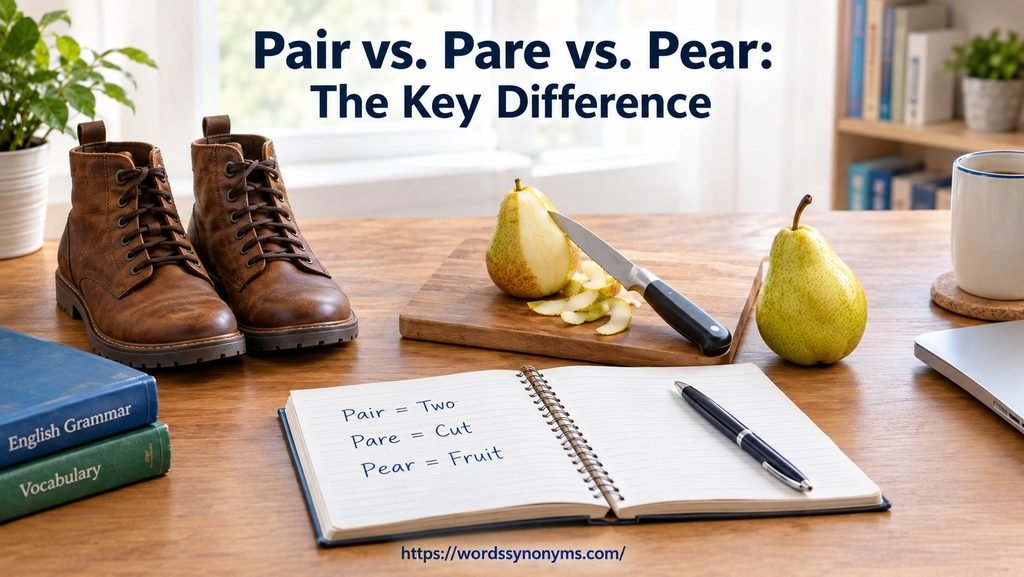
Pair vs. Pare vs. Pear: The Key Difference
The easiest way to separate these words is to stop focusing on how they sound.
Instead, ask what the sentence means.
Pair = Two Things Together
Use pair when you’re talking about two related things, two people, or two parts considered together.
I bought a pair of boots.
The boots come as two matching items.
Pare = Cut or Reduce
Use pare when something is being trimmed, cut away, or reduced.
Please pare the apple.
The action involves removing part of the apple.
Pear = Fruit
Use pear when you’re talking about the fruit.
The pear is ripe.
There’s no cutting or pairing in that sentence. You’re simply naming the fruit.
This distinction gives you a reliable shortcut:
| If you mean… | Use… |
| Two things together | Pair |
| To trim or cut away | Pare |
| A type of fruit | Pear |
Pair vs. Pare
Pair and pare can both function as verbs, which makes them particularly easy to confuse.
However, their actions move in opposite conceptual directions.
Pair means put together.
Pare means take away.
Consider these sentences:
Pair the students for the activity.
You are bringing two people together.
Pare the vegetables before cooking them.
You are removing part of something.
That’s the central contrast.
Pair brings together. Pare takes away.
You can also use this distinction outside everyday physical actions:
- Pair two ideas together.
- Pare an argument down.
- Pair two devices.
- Pare a budget.
- Pair ingredients.
- Pare unnecessary words.
Once you connect pair with combining and pare with removing, the spelling becomes easier to remember.
Pair vs. Pear
Pair and pear are often confused because both are common words and both have several everyday uses.
The difference is straightforward:
Pair relates to two.
Pear is fruit.
Compare:
I need a pair of shoes.
I need a pear for my lunch.
The pronunciation doesn’t help much when you’re speaking. The surrounding words do.
If someone says, “I need a pair,” the meaning could involve shoes, gloves, scissors, tickets, or something else that comes in twos.
If someone says, “I need a pear,” the context points toward food.
A Useful Context Trick
Look at the word that follows pair.
The construction a pair of is extremely common:
- a pair of shoes
- a pair of socks
- a pair of glasses
- a pair of scissors
- a pair of gloves
You wouldn’t normally say a pear of shoes because a pear is a fruit.
That simple pattern catches many spelling errors immediately.
Pare vs. Pear
The distinction between pare and pear becomes clearer when you remember their grammatical roles.
Pare is normally a verb.
Pear is a noun.
Compare:
Pare the pear before serving it.
This sentence is particularly useful because it contains both words.
- Pare = the action
- pear = the fruit
Here’s another example:
She pared the pear with a small kitchen knife.
Again, the first word describes what she did. The second names what she worked on.
This is one of the easiest ways to remember the difference.
You pare a pear.
The phrase sounds almost like a little tongue twister, which makes it surprisingly memorable.
Pair, Pare, and Pear Are Homophones
The words pair, pare, and pear are homophones.
A homophone is a word that sounds the same as another word but has a different meaning and usually a different spelling.
Other familiar examples include:
- to / too / two
- there / their / they’re
- right / write
- flower / flour
- sea / see
The important point is that homophones create more trouble in writing than in speech.
When someone says:
“I bought a pair.”
You hear the intended meaning from the context.
But when you’re writing, you have to select the correct spelling yourself.
That’s why understanding the meaning behind each word matters more than memorizing pronunciation.
Pair vs. Pare vs. Pear: Pronunciation
In standard US English, pair, pare, and pear are generally pronounced alike.
A common pronunciation is represented approximately as /per/ in US English. Cambridge gives pair and the US pronunciation of pare with this pronunciation.
The pronunciation similarity explains the confusion.
However, pronunciation alone cannot tell you which spelling to choose. You need context.
Think of these three words as identical sound packages with different labels:
pair → two
pare → trim
pear → fruit
The sound stays essentially the same. The meaning changes completely.
Common Mistakes With Pair, Pare, and Pear
These words produce predictable spelling mistakes. Here are some of the most common ones.
Mistake: Using “Pear” for Two Things
Incorrect:
I bought a pear of shoes.
Correct:
I bought a pair of shoes.
Shoes come as two matching items, so pair is correct.
Mistake: Using “Pair” for Fruit
Incorrect:
She ate a pair after dinner.
Correct:
She ate a pear after dinner.
If you’re talking about the fruit, choose pear.
Mistake: Using “Pair” for Cutting
Incorrect:
Please pair the apple.
Correct:
Please pare the apple.
If the intended meaning is to remove the apple’s outer layer, use pare.
Mistake: Using “Pear” as a Verb
Incorrect:
He peared the potato.
Correct:
He pared the potato.
Pear names the fruit. Pare describes the trimming action.
Pair vs. Pare vs. Pear: Memory Tricks
You don’t need a complicated mnemonic. Three simple associations do the job.
Pair = Two
Think of pair whenever you see two matching or connected things.
Pair = two.
Shoes, socks, gloves, earrings, and many other objects can come in pairs.
Pare = Trim
Think about a knife trimming an apple.
Pare = trim.
The word often describes removing an outer layer or reducing something.
Pear = Fruit
Picture a ripe pear.
Pear = fruit.
That’s it.
The Three-Word Memory Rule
Pair together. Pare away. Pear to eat.
This sentence captures the basic distinction without forcing you to memorize dictionary definitions.
Read more: Sharable vs. Shareable: Correct Spelling Explained
Pair vs. Pare vs. Pear Examples
Examples become especially useful when the words appear in natural situations.
1. Examples With Pair
- I bought a new pair of sneakers.
- She lost one shoe from the pair.
- The teacher asked us to work in pairs.
- Please pair the socks before putting them away.
- The jacket pairs well with dark jeans.
- The technician paired the phone with the speaker.
- The coach paired the two players for practice.
- They make an excellent pair.
2. Examples With Pare
- Pare the apple before slicing it.
- She used a sharp knife to pare the potato.
- The cook pared the carrots before adding them to the soup.
- The editor pared down the article.
- The company pared back unnecessary spending.
- We need to pare the proposal down.
- The designer pared away several unnecessary details.
- The team pared the plan to its essential elements.
3. Examples With Pear
- The pear was ripe and juicy.
- She sliced a pear for the salad.
- I packed a pear for lunch.
- The tree produced several pears.
- He added diced pear to the dessert.
- The pear had a sweet, delicate flavor.
- She bought three pears from the market.
- A ripe pear makes an easy snack.
Pair, Pare, and Pear in the Same Sentence
Using all three words together can make the difference much easier to remember.
Pair the plates with the napkins, pare the fruit, and save the pear for dessert.
Here’s another:
The chef asked us to pair the cheese with a ripe pear after we pared the fruit.
And another:
Pair the ingredients carefully, pare the vegetables, and leave the pear whole.
These sentences demonstrate why context matters so much.
Each word sounds the same. Yet the grammar and meaning around it immediately reveal the correct spelling.
A Practical Case Study: One Kitchen, Three Words
Imagine you’re preparing a simple meal.
You have two matching plates on the counter, an apple that needs trimming, and a pear waiting for dessert.
You could describe the scene like this:
Put the plates in a pair, pare the apple, and save the pear for dessert.
Now the three words become almost impossible to confuse.
The pair identifies two related objects. Pare describes an action. Pear identifies the fruit.
This is a useful learning strategy for homophones in general. Don’t memorize isolated spellings. Put each word into a situation where its meaning becomes obvious.
Pair vs. Pare vs. Pear in Everyday English
These words appear in different types of writing.
| Word | Common Contexts |
| Pair | Clothing, shopping, education, relationships, technology, cooking, sports |
| Pare | Cooking, editing, business, finance, planning, design |
| Pear | Food, gardening, farming, recipes, nutrition, shopping |
Pair has the broadest everyday range. You’ll see it in conversations about clothing, people, devices, food combinations, and teamwork.
Pare appears frequently when someone describes trimming or reducing something. Its figurative uses make it useful in professional writing too.
Pear usually appears in contexts involving food, fruit, recipes, trees, gardens, and produce.
Pair vs. Pare vs. Pear: Grammar Guide
Understanding the grammar of each word gives you another reliable clue.
| Word | Typical Grammatical Role | Example |
| Pair | Noun | I bought a pair of gloves. |
| Pair | Verb | Pair the students together. |
| Pare | Verb | Pare the apple. |
| Pear | Noun | The pear is ripe. |
Notice the pattern.
Pair can be either a noun or a verb.
Pare normally functions as a verb.
Pear functions as a noun when referring to the fruit.
If you’re unsure about the spelling, identify what job the word performs in the sentence. That clue can narrow your choice immediately.
Is “Pair” Always Used for Exactly Two Things?
In its basic sense, pair refers to two things considered together.
For example:
- a pair of shoes
- a pair of gloves
- a pair of people
- a pair of birds
However, English also uses pair for objects that consist of two connected parts or are conventionally treated as a unit.
Examples include:
- a pair of scissors
- a pair of glasses
- a pair of pants
This is why a pair of scissors doesn’t necessarily mean two separate scissors. It refers to one cutting instrument with two connected blades.
Is “Pare” the Same as “Peel”?
Not always.
Pare can mean to remove an outer layer, particularly from food, so it overlaps with peel in some contexts. However, the words aren’t interchangeable in every sentence.
Peel commonly refers to removing a skin or outer covering.
Pare often emphasizes cutting away a thin outer portion with a knife or reducing something by removing parts.
For example:
She peeled the banana.
That is more natural than she pared the banana.
By contrast:
He pared the apple with a small knife.
That wording emphasizes the cutting action.
The broader figurative meaning also separates pare from peel:
The editor pared down the article.
You wouldn’t normally replace pared down with peeled down.
Can “Pare” Be Used Figuratively?
Yes.
This is one of the most useful details to remember about pare.
The physical meaning involves cutting away material. The figurative meaning extends that idea to reducing something by removing unnecessary parts.
For example:
The company pared back its expenses.
The writer pared down the introduction.
The designer pared the project to its essentials.
The image is the same in each case: remove excess material until the remaining structure is smaller and more focused.
Quick Test: Pair, Pare, or Pear?
Try completing these sentences without looking at the answers.
- I bought a ___ of sunglasses.
- Please ___ the potato before cooking it.
- She ate a ripe ___.
- The teacher asked us to work in ___.
- The editor had to ___ down the report.
- We served the cheese with a fresh ___.
- Please ___ the vegetables.
- The two players make a strong ___.
- The phone must ___ with the computer.
- The company decided to ___ back its spending.
Answer Key
- pair
- pare
- pear
- pairs
- pare
- pear
- pare
- pair
- pair
- pare
The fastest way to solve the test is to identify the meaning first.
- Two or matching things? Pair
- Cut or reduce? Pare
- Fruit? Pear
Pair vs. Pare vs. Pear: At-a-Glance Summary
| Question | Correct Word |
| Are you talking about two related things? | Pair |
| Are you putting two things together? | Pair |
| Are you trimming an apple or vegetable? | Pare |
| Are you reducing a budget or article? | Pare |
| Are you talking about the fruit? | Pear |
| Are you talking about two matching shoes? | Pair |
| Are you cutting away an outer layer? | Pare |
| Are you eating something sweet and fruit-shaped? | Pear |
The three words may sound identical, but their meanings provide a clear dividing line.
Pair brings things together.
Pare cuts things down.
Pear is something you can eat.
Once those three ideas become familiar, the spelling becomes much easier.
FAQs
What is the difference between pair, pare, and pear?
Pair means two things considered together, pare means to trim or reduce something, and pear is a type of fruit. Although they sound alike, their meanings and spellings are different.
Is pair or pear correct?
Both pair and pear are correct, but they are used in different situations. Use pair for two matching or related things, while pear refers to the fruit or its tree.
What does pare mean in a sentence?
Pare means to cut away or reduce something. For example, “We need to pare down our grocery expenses” means we need to reduce those expenses.
Are pair, pare, and pear homophones?
Yes. Pair, pare, and pear are homophones because they have the same pronunciation but different spellings and meanings.
How can I remember pair and pear?
A simple trick is to associate pair with two things and pear with the fruit. When you see the word “pear,” picture the fruit to help remember its spelling.
Why do people confuse pair, pare, and pear?
People often confuse these words because they sound exactly alike. The easiest way to choose the correct word is to look at the context and ask whether you mean two things, trimming something, or the fruit.
Conclusion
Choosing between pair, pare, and pear becomes much easier once you connect each word with its meaning. Pair refers to two things or a set of two, pare means to trim or reduce, and pear is the fruit or the tree that produces it. Although these words sound alike, their meanings and spellings are completely different.
A quick check of the sentence can usually tell you which word fits. You have a pair of matching plates, an apple to pare, and a pear waiting for dessert. Keep these simple distinctions in mind, and these tricky homophones will be much easier to use correctly.

Syeda Naalain Zahra is a content writer with an interest in English vocabulary and language. She creates simple and informative articles about synonyms, antonyms, word meanings, and everyday English usage. Her aim is to help readers build better vocabulary and communicate more confidently.