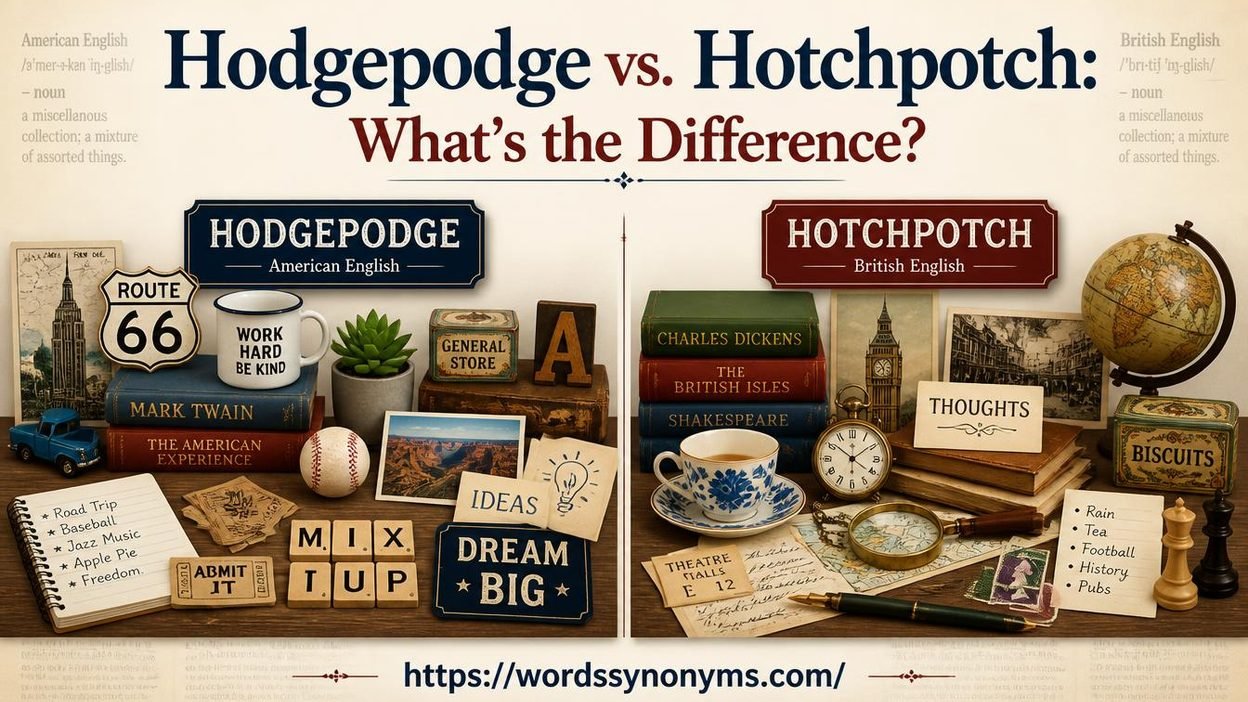
In Hodgepodge vs. Hotchpotch, the British term hotchpotch describes a mixture of elements from various sources in an eclectic mix of ideas and dishes.
A mutton stew may contain vegetables such as peas, cauliflower, cabbage, leeks, carrots, turnips, and parsley. Khicurri, an Indian dish made with rice, lentils, onion, chili, peppers, and spices, also shows how a mixed collection can earn this word.
This food example makes the meaning easy to grasp because many different ingredients come together in one dish.
The variant hotchpot is a legal term connected with the reunion of properties with the intent of rendering an equal division. Hotchpot comes from the Anglo-French hocher, meaning to shake. Hodgepodge is the North American form, derived from hotchpotch by associating it with Hodge, a British name for a farm laborer.
Both terms can describe a jumbled assembly of not-quite matching items brought together in a confused fashion, although regional usage determines which form sounds more natural.
Quick Answer
Hodgepodge and hotchpotch have almost the same meaning. Both describe a mixed, disorganized collection of different things.
| Word | Common Usage | Meaning | Example |
| Hodgepodge | American English | A confusing mixture | The article is a hodgepodge of facts and opinions. |
| Hotchpotch | British English | A confusing mixture | The room was a hotchpotch of different styles. |
The Main Difference
The biggest difference is regional preference rather than meaning.
- 🇺🇸 Hodgepodge → preferred in American English
- 🇬🇧 Hotchpotch → especially common in British English
- Both → can describe a mixture of ideas, objects, styles, ingredients, or other things
Simple rule: If you’re writing for an American audience, choose hodgepodge. For a British audience, hotchpotch may sound more natural.
In short: Hodgepodge and hotchpotch are essentially synonyms, with the main distinction being where they’re commonly used.
Hodgepodge vs. Hotchpotch at a Glance
The quickest way to understand the distinction is to put the two words side by side.
| Feature | Hodgepodge | Hotchpotch |
| Basic meaning | A confused or miscellaneous mixture | A confused or miscellaneous mixture |
| Main regional association | American English | British English |
| North American usage | Very common | Less common |
| British usage | Less typical | Especially common |
| Informal word | Yes | Yes |
| Can describe ideas? | Yes | Yes |
| Can describe objects? | Yes | Yes |
| Can describe styles? | Yes | Yes |
| Historical food connection | Yes | Yes |
| Best choice for US readers | Hodgepodge | Usually not |
| Best choice for UK readers | Usually not | Hotchpotch |
Oxford lists hodgepodge as a North American English word and identifies hotchpotch as its British counterpart. Its entry for hotchpotch makes the reverse distinction as well: the word is especially British while North American English usually uses hodgepodge.
That means neither spelling is wrong. The choice largely depends on where your readers are and which variety of English you’re using.
What Does Hodgepodge Mean?
Hodgepodge is a noun meaning a confused mixture of different things.
The important word here is mixture. A hodgepodge isn’t simply a collection containing variety. It usually suggests that the different parts don’t fit together neatly or don’t have a clear organizing principle.
For example, imagine opening a kitchen drawer and finding a screwdriver, three batteries, a measuring tape, birthday candles, loose coins, and a pair of scissors.
That’s a hodgepodge.
The objects aren’t necessarily connected. They simply ended up together.
Cambridge defines hodgepodge as a “confused mixture of different things.” Oxford similarly describes it as several things mixed together without a particular order or reason.
Hodgepodge Examples
The word works in many situations because the idea of a messy mixture applies far beyond physical objects.
Ideas:
The article was a hodgepodge of theories, opinions, and unsupported claims.
Architecture:
The neighborhood contains a hodgepodge of architectural styles.
Objects:
The garage had become a hodgepodge of old tools, boxes, and furniture.
Writing:
The first draft felt like a hodgepodge of unrelated observations.
Food:
Dinner was a hodgepodge of leftovers from the refrigerator.
Organizations:
The new system became a hodgepodge of old procedures and newer rules.
Notice the common thread. Each example contains different elements brought together without much unity.
Does Hodgepodge Always Mean Something Negative?
Not necessarily, although the word often carries a mildly critical tone.
Calling something a hodgepodge can suggest that it lacks organization, consistency, or cohesion. A speaker might use the word humorously, neutrally, or critically depending on the context.
Compare these two sentences:
The museum contains a hodgepodge of artifacts from different periods.
This could simply describe an unusual collection.
Now consider:
The report is a hodgepodge of statistics copied from unrelated sources.
That sentence clearly criticizes the report’s structure and quality.
The context does the heavy lifting.
What Does Hotchpotch Mean?
Hotchpotch has essentially the same modern figurative meaning as hodgepodge.
It refers to a confused mixture of different things. Oxford specifically gives the example of “a hotchpotch of ideas,” which captures the word’s figurative use perfectly.
Cambridge likewise defines hotchpotch as a confused mixture and identifies it as mainly British English.
Hotchpotch Examples
The word can describe almost anything that combines disparate elements.
Ideas:
The proposal was a hotchpotch of competing ideas.
Architecture:
The street is a hotchpotch of medieval buildings and modern offices.
Politics:
The policy became a hotchpotch of promises and compromises.
Writing:
The book is a hotchpotch of essays, interviews, and personal reflections.
Rules:
The regulations form a hotchpotch of outdated requirements.
In each example, the word highlights the same basic idea: different pieces have been brought together without forming a particularly coherent whole.
Is Hodgepodge the Same as Hotchpotch?
Yes, in their modern figurative use, they are essentially synonyms.
This is the most important point to remember.
You can generally replace hodgepodge with hotchpotch without changing the fundamental meaning of a sentence.
For example:
The website contains a hodgepodge of articles, guides, and opinion pieces.
and:
The website contains a hotchpotch of articles, guides, and opinion pieces.
The meaning remains virtually identical.
The difference is mainly regional and stylistic.
For American readers, hodgepodge will usually sound familiar and natural. For British readers, hotchpotch is a more characteristic choice. Major learner dictionaries make this distinction directly rather than treating the words as unrelated vocabulary.
The Simple Rule
If you need a quick rule, use this:
- American English → hodgepodge
- British English → hotchpotch
- Meaning → essentially the same
- Both words are correct
- Neither is simply a misspelling of the other
That rule will handle most everyday writing situations.
Hodgepodge vs. Hotchpotch in American English
American English strongly favors hodgepodge.
Cambridge labels hodgepodge as US and notes hotchpotch as the mainly British equivalent. Oxford also identifies hodgepodge as North American English and says hotchpotch is especially British.
That doesn’t mean an American reader won’t understand hotchpotch. English speakers regularly encounter vocabulary from other varieties of English. The word is recognizable, especially in formal reading.
Still, recognizable isn’t the same as natural.
If you’re writing an American blog post, newspaper article, product description, or essay, hodgepodge will usually fit the expected vocabulary better.
American Examples
Here are several situations where hodgepodge sounds natural:
- A hodgepodge of furniture fills the room.
- The report contains a hodgepodge of statistics.
- The recipe combines a hodgepodge of leftover ingredients.
- The neighborhood has a hodgepodge of architectural styles.
- His bookshelf is a hodgepodge of novels, textbooks, and magazines.
The word is informal enough for everyday writing while still being perfectly understandable in more serious contexts.
Hodgepodge vs. Hotchpotch in British English
British English commonly uses hotchpotch where American English uses hodgepodge.
Cambridge labels hotchpotch as mainly UK and specifically gives hodgepodge as the usual US alternative.
For a British audience, therefore, hotchpotch can sound entirely ordinary.
Consider:
The new system is a hotchpotch of old and new regulations.
A British reader would have little reason to find the word unusual.
The same sentence using hodgepodge isn’t incorrect. It simply carries a stronger North American flavor.
Why Regional Vocabulary Matters
Regional vocabulary isn’t just about spelling.
English has many words that communicate the same basic idea while signaling different varieties of English. Apartment and flat provide an obvious example. Elevator and lift do the same thing.
Hodgepodge and hotchpotch work in a similar way.
The meaning stays stable while the regional preference changes.
The Etymology of Hodgepodge and Hotchpotch
The history of these words is far more interesting than their modern difference suggests.
Hodgepodge and hotchpotch belong to the same historical word family.
Oxford traces hotchpotch to late Middle English as a variant of hotchpot, which came through Anglo-Norman French and Old French hochepot. Oxford connects hochepot with French hocher, meaning “to shake,” plus pot.
The image is remarkably concrete: things being shaken or mixed together in a pot.
That physical idea eventually became a metaphor for anything containing a mixture of disparate elements.
From a Cooking Pot to a Figurative Mixture
Early forms of the word were associated with food.
The older French term hochepot referred to a stew or soup containing various ingredients. English later developed related forms, including hotchpotch. Etymonline records hotchpotch in the late 14th century and hodgepodge as an alteration appearing in the early 15th century.
That gives the modern metaphor a wonderfully literal foundation.
Picture a large cooking pot.
Meat goes in.
Vegetables follow.
Seasonings join the mixture.
Everything cooks together.
The final dish isn’t one ingredient. It’s a combination of many ingredients.
That same mental picture eventually became useful for describing mixed collections of things.
A hodgepodge of ideas works much like a hodgepodge of ingredients. The individual pieces remain recognizable, yet they’re all crowded into one mixture.
Where Did “Hodge” Come From?
This part of the story is especially interesting because the spelling appears to have changed through association.
Oxford says that hodgepodge is a late Middle English form that was changed by association with Hodge, an old familiar name for a typical English agricultural laborer.
Etymonline likewise records early forms such as hogpoch and describes hodgepodge as an alteration of hotchpotch.
So the word didn’t begin as a completely separate invention.
Its unusual spelling developed from an older word.
That’s why hodgepodge and hotchpotch look different today while remaining closely related historically.
The Historical Food Meaning
The food connection hasn’t completely disappeared.
Hotchpotch can refer to a thick soup or stew made from mixed ingredients. Modern dictionaries recognize this culinary sense alongside the figurative meaning.
This matters because the word’s history isn’t merely a strange linguistic coincidence.
The figurative meaning grew naturally from the literal one.
A dish containing many ingredients becomes an image for a collection containing many different things.
The Concept in One Sentence
Hotchpotch originally described a mixed dish; later, the idea of a mixed dish became a metaphor for a mixed collection.
That simple transition explains much of the word’s modern character.
Hodgepodge and Hotchpotch Can Describe More Than Physical Objects
One common mistake is to assume that these words apply only to messy collections of physical things.
They don’t.
Both words can describe abstract mixtures.
You can have:
- a hodgepodge of opinions
- a hodgepodge of theories
- a hodgepodge of traditions
- a hodgepodge of policies
- a hodgepodge of influences
- a hotchpotch of ideas
- a hotchpotch of architectural styles
- a hotchpotch of cultural traditions
- a hotchpotch of regulations
- a hotchpotch of competing demands
This flexibility makes the words useful in analytical writing.
For instance, a historian might describe a society as a hotchpotch of cultural influences. A critic might call a film a hodgepodge of genres. A business writer might describe a new policy as a hodgepodge of old rules and recent amendments.
The mixture doesn’t have to be physical.
Hodgepodge vs. Hotchpotch vs. Mishmash
These words overlap, but they’re not interchangeable in every situation.
| Word | General meaning | Typical tone |
| Hodgepodge | A confused mixture | Informal, often mildly critical |
| Hotchpotch | A confused mixture | Informal, especially British |
| Mishmash | A confused or untidy mixture | Informal |
| Jumble | A disorderly mixture | Neutral to informal |
| Assortment | A collection of different things | Usually neutral |
| Medley | A combination of different elements | Often neutral or positive |
| Mélange | A mixture of different elements | More literary or polished |
| Farrago | A confused or nonsensical collection | Strongly critical |
The distinction becomes clearer when you compare tone.
An assortment can be carefully organized.
A medley can be deliberately created.
A hodgepodge usually suggests that the mixture lacks a satisfying structure.
That nuance is easy to miss.
Read more: Suit vs. Suite: What’s the Difference?
Hodgepodge Does Not Simply Mean “Variety”
Here’s a useful test.
If the different elements are intentionally selected and arranged, hodgepodge may not be the best word.
Imagine a restaurant serving a tasting menu featuring six carefully chosen cuisines. That’s a deliberate combination.
Calling it a hodgepodge could imply that the chef threw random dishes together.
Now imagine opening a refrigerator and finding half a pizza, three sauces, leftover rice, an apple, and a container of soup from last week.
That’s much more clearly a hodgepodge.
The difference is organization and coherence.
A Simple Comparison
Variety:
The festival offers a variety of international foods.
This sounds positive and organized.
Hodgepodge:
The festival menu is a hodgepodge of unrelated dishes.
This suggests that the offerings don’t work well together.
The words therefore carry different attitudes toward mixture.
When Should You Use Hodgepodge?
Choose hodgepodge when you’re writing in American English and want to describe a mixture that feels somewhat disorganized or mismatched.
It works particularly well when:
- Several unrelated things appear together.
- A collection lacks a clear organizing principle.
- Different styles have been combined.
- Ideas don’t connect neatly.
- A system contains layers from different periods.
- You want an informal but precise description of a jumble.
Strong Examples
The website has become a hodgepodge of old articles and new content.
His argument was a hodgepodge of facts, assumptions, and speculation.
The room contained a hodgepodge of modern furniture and antique decorations.
The policy is a hodgepodge of regulations adopted at different times.
Each sentence uses the word to signal mixture plus some degree of disorder.
When Should You Use Hotchpotch?
Choose hotchpotch when writing primarily for British readers or when you want the distinctly British form.
It works naturally in contexts such as:
The town is a hotchpotch of architectural influences.
The legislation has become a hotchpotch of amendments.
The exhibition presents a hotchpotch of paintings from different periods.
The book is an entertaining hotchpotch of memoir, history, and commentary.
The meaning is the same basic concept as hodgepodge. The regional flavor changes.
Pronunciation: Hodgepodge vs. Hotchpotch
The two words don’t sound identical.
Hodgepodge
In American English, hodgepodge is commonly pronounced roughly like:
HAHJ-pahj
Cambridge gives the American pronunciation as /ˈhɑːdʒ.pɑːdʒ/.
Hotchpotch
Hotchpotch is roughly:
HOTCH-potch
Cambridge gives distinct UK and US pronunciation forms, reflecting the vowel differences between the two varieties of English.
The pronunciation is fairly intuitive once you’ve heard the word aloud.
Hodgepot, Hotchpot, and the Legal Connection
There’s another related word worth knowing: hotchpot.
Although modern readers often encounter hotchpotch in ordinary descriptions of mixed things, hotchpot has a more specialized historical and legal meaning.
The term developed from the same older word family connected with putting property into a common “pot” for purposes of distribution. Etymological sources trace the legal sense to an Anglo-French term involving a collection of property brought together before division.
That history helps explain why hotchpot, hotchpotch, and hodgepodge are related.
Still, don’t treat them as interchangeable in modern legal writing.
Hotchpot is a specialized legal term.
Hodgepodge and hotchpotch are ordinary words for mixtures.
That distinction is worth remembering.
Common Mistakes With Hodgepodge and Hotchpotch
Understanding the meaning is only half the battle. Writers also need to know what not to assume.
Mistake: Thinking One Word Is Correct and the Other Is Wrong
Both are legitimate English words.
The issue isn’t correctness. It’s regional preference.
Use hodgepodge naturally in American English. Use hotchpotch naturally in British English.
Mistake: Assuming They Have Completely Different Meanings
They don’t.
Their modern figurative meanings overlap closely.
If someone describes something as a hodgepodge or a hotchpotch, they’re generally pointing to the same basic quality: a mixture of different things without a strong sense of order or unity.
Mistake: Using Hodgepodge for Any Diverse Collection
Diversity alone doesn’t create a hodgepodge.
A carefully arranged museum exhibition can contain objects from ten countries and five centuries. It may be diverse, but that doesn’t automatically make it a hodgepodge.
The word works best when the mixture feels unstructured, mismatched, or incoherent.
Mistake: Assuming Hotchpotch Is Just an Old-Fashioned Spelling
Not quite.
Hotchpotch remains an established word and continues to be especially associated with British English. Cambridge and Oxford both identify it as the British counterpart of American hodgepodge.
Mistake: Confusing Hotchpotch With Hotpot
These words have related historical territory but aren’t simply different spellings.
Hotchpotch refers to a mixed collection in its figurative sense and can also refer to a mixed stew.
Hotpot is a different culinary term.
Don’t use one automatically in place of the other.
A Practical Case Study: Describing Architecture
Architecture provides a perfect example of the difference between variety and hodgepodge.
Imagine a street with Georgian townhouses, Victorian buildings, modern glass offices, and converted warehouses.
You could say:
The street has a variety of architectural styles.
That’s neutral.
You could also say:
The street is a hodgepodge of architectural styles.
Now the description carries a little more attitude. It suggests that the styles don’t form a particularly coherent visual whole.
For British readers, the equivalent might be:
The street is a hotchpotch of architectural styles.
The core observation stays the same. The vocabulary shifts with the variety of English.
This is exactly where choosing between hodgepodge vs. hotchpotch becomes useful rather than merely academic.
A Practical Case Study: Writing and Ideas
Suppose an article jumps from economics to psychology, then suddenly moves into personal anecdotes before ending with a discussion of ancient history.
You might call the article:
A hodgepodge of unrelated ideas.
For British readers:
A hotchpotch of unrelated ideas.
Again, neither sentence changes the basic criticism.
The writer has assembled several different elements without giving them enough connective tissue.
That’s the heart of both words.
Hodgepodge vs. Hotchpotch: Which One Should You Use?
The answer depends primarily on your audience.
| If you’re writing for… | Best choice |
| United States | Hodgepodge |
| Canada | Hodgepodge is generally the familiar choice |
| United Kingdom | Hotchpotch |
| International audience with US English | Hodgepodge |
| International audience with British English | Hotchpotch |
| A literal stew context | Hotchpotch can be appropriate |
| Informal American writing | Hodgepodge |
| Informal British writing | Hotchpotch |
If you’re unsure, think about the rest of your article.
When you consistently use American spellings and vocabulary, hodgepodge will probably fit.
For writing that follows British conventions, hotchpotch is the more natural choice.
Consistency matters more than trying to force one word into every variety of English.
Is Hodgepodge One Word?
Yes.
Hodgepodge is commonly written as a single word.
Historical and dictionary sources also record forms such as hodge-podge and hodge podge, reflecting the word’s long development. Etymonline records these variant forms alongside the modern one-word spelling.
For contemporary general writing, however, hodgepodge is the straightforward form.
Is Hotchpotch One Word?
Yes.
Hotchpotch is also normally written as one word in modern English.
Older sources contain variations in spelling and hyphenation because English spelling was far less standardized historically. Modern dictionaries list hotchpotch as the standard form.
So:
- hodgepodge ✓
- hotchpotch ✓
- hodge-podge → historical or variant form
- hotch-potch → historical or variant form
Hodgepodge vs. Hotchpotch: The Short Answer
If you only need the answer in a few seconds, here’s the whole distinction:
Hodgepodge and hotchpotch mean essentially the same thing. Both describe a confused or miscellaneous mixture. “Hodgepodge” is the usual American English form, while “hotchpotch” is especially common in British English. Hotchpotch also has a literal culinary sense referring to a mixed stew.
That’s the key.
Everything else comes down to context, audience, tone, and history.
FAQs
1. What does hodgepodge mean?
Hodgepodge means a confusing mixture or collection of different things that don’t seem to match well.
2. What does hotchpotch mean?
Hotchpotch means a mixture of different things. In British English, it can also refer to a mixed mutton stew.
3. Is hodgepodge American or British?
Hodgepodge is mainly used in North American English, while hotchpotch is the more common British form.
4. Are hodgepodge and hotchpotch synonyms?
Yes. Both words describe a mixture of different elements, especially when they appear jumbled or poorly matched.
5. Can hotchpotch describe food?
Yes. Hotchpotch can describe a stew containing a varied combination of vegetables and meat.
6. Which word should I use: hodgepodge or hotchpotch?
Use hodgepodge for North American English and hotchpotch for British English. The meaning is generally the same.
Conclusion
Ultimately, hodgepodge and hotchpotch are two forms of the same basic idea: different things brought together into one mixed collection. Hotchpotch is more closely associated with British English, while hodgepodge is the more familiar North American choice.
Once you connect both words with the image of many unrelated pieces sharing the same place, their meaning becomes much easier to remember. Whether you’re describing a meal, a collection of objects, or a confusing combination of ideas, either word can capture that sense of delightful disorder.

Syeda Naalain Zahra is a content writer with an interest in English vocabulary and language. She creates simple and informative articles about synonyms, antonyms, word meanings, and everyday English usage. Her aim is to help readers build better vocabulary and communicate more confidently.