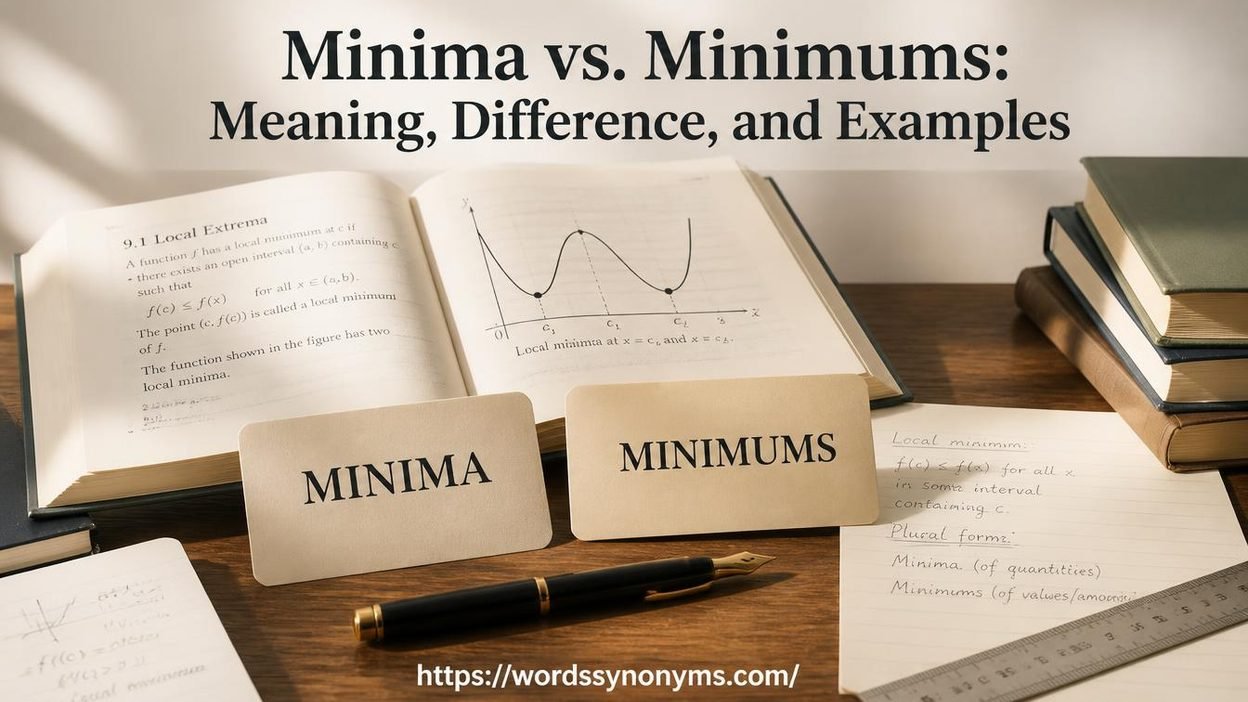
The article Minima vs. Minimums: Meaning, Difference and Examples explains when each plural form fits everyday English and technical writing.
Minima is the Latin plural of minimum, while minimums is the regular English plural. Both plural forms express more than one minimum, but their preferred usage differs across various registers of English.
Latin forms often appear in formal English, particularly in science, mathematics, scientific terminology, and mathematical terminology. For example, a researcher might use minima to describe several low points on a graph.
However, English forms, including newer English forms, are more common in everyday language usage and standard English. Other Latin–derived words also follow established linguistic conventions, although their plural forms may differ.
Understanding grammatical number helps you identify the correct singular form and apply pluralization rules. For technical writing, scientific writing, and mathematical writing, minima often suits a specialized context. Outside these fields, minimums is typically favored by a large margin and usually makes a more natural word choice.
For example, a company might say, “We introduced new minimums for monthly orders,” which sounds natural in general business writing. Both forms are correct, but the context determines the preferred form. Although minima still prevails in some technical settings, minimums remains widely used in everyday communication.
Quick Answer
The main difference between minima and minimums involves usage rather than meaning. Both are accepted plural forms of the noun minimum.
- Minimum: The lowest amount, level, value, or limit.
- Minimums: The regular English plural, commonly used for multiple limits or requirements.
- Minima: The traditional Latin-derived plural, frequently used in mathematics and technical writing.
Consider these examples:
- The bank increased its minimums for new savings accounts.
- The graph contains two local minima.
- The company established new minimums for employee qualifications.
- The mathematical model identified three distinct minima.
In the first and third examples, minimums refers to several requirements or limits. In the second and fourth, minima describes low points identified through mathematical analysis.
| Feature | Minima | Minimums |
| Singular form | Minimum | Minimum |
| Grammatical role | Plural noun | Plural noun |
| Word formation | Traditional Latin-derived plural | Regular English plural |
| Common contexts | Mathematics and technical writing | Everyday English, business, and general writing |
| Meaning | Multiple minimum values or points | Multiple minimum amounts, limits, or requirements |
| General writing preference | Use when appropriate to the subject | Often the more natural choice |
The simplest rule: Use minimums for most everyday American English writing. Choose minima when it fits established mathematical or technical terminology.
What Does Minimum Mean?
The word minimum refers to the lowest amount, value, degree, or level of something. It can describe a required limit, the smallest acceptable quantity, or the lowest value within a set.
For example, a store might require a minimum purchase of $25 before offering free delivery. A university might establish a minimum score for admission. In mathematics, a function might reach its minimum at a particular point.
The exact meaning depends on context, but the central idea remains the same: minimum identifies the lowest point or limit under consideration.
Minimum as a Noun
As a noun, minimum names the lowest amount, value, or limit.
You can use it when discussing requirements, financial thresholds, quantities, or measurable values.
Examples include:
- The minimum for opening the account is $100.
- Every applicant must meet the minimum.
- The temperature dropped to its minimum overnight.
- We need a minimum of five participants for the workshop.
- The contract specifies a minimum payment each month.
In each example, minimum functions as a noun because it identifies a specific amount, level, or requirement.
When you refer to more than one minimum, you can use either minimums or minima, depending on the context.
For instance, a bank may offer several accounts with different minimum deposits. A mathematician may examine several minimum points on a graph. Both situations involve multiple minimums, but the natural wording differs.
Minimum as an Adjective
The word minimum can also function as an adjective. In this role, it describes the lowest amount or level required or allowed.
Common examples include:
- Minimum wage
- Minimum age
- Minimum payment
- Minimum distance
- Minimum requirements
- Minimum balance
Notice that minimum doesn’t usually change to minimums when it modifies a plural noun.
For example:
- Correct: The company introduced new minimum requirements.
- Incorrect for the intended meaning: The company introduced new minimums requirements.
The adjective describes the requirements. The noun requirements already carries the plural meaning.
However, you can use minimums as a separate noun in the same sentence:
The company introduced new minimums for employee qualifications.
Here, minimums refers to several required thresholds rather than directly modifying the word qualifications.
Minimum vs. Minimal
Although minimum and minimal look similar, they don’t always mean the same thing.
Minimum usually identifies the lowest permitted, required, or measurable amount. Minimal describes something that is very small, limited, or slight.
| Word | Meaning | Example |
| Minimum | The lowest amount or required limit | The minimum payment is $50. |
| Minimal | Very small or limited | The repair caused minimal damage. |
| Minimum | The lowest acceptable level | Applicants must meet the minimum score. |
| Minimal | Small in degree or extent | The project requires minimal supervision. |
Consider a business that requires a minimum of three years of experience. That number represents a specific threshold.
If the business offers minimal training, however, it provides only a small amount of training. The word describes the extent of the training rather than a formal minimum requirement.
Understanding this distinction helps you choose accurate words instead of treating similar-looking terms as interchangeable.
What Does Minima Mean?
Minima is the plural of minimum. It comes from the traditional Latin pattern of forming plurals and remains common in certain areas of English, especially mathematics.
In everyday conversation, minima may sound unusually formal. However, the word serves a clear purpose in technical discussions where writers need to identify multiple lowest values or points.
For example:
The graph contains two local minima and one local maximum.
This sentence describes a mathematical function with two local low points and one local high point. The word minima communicates that meaning precisely.
Minima in Mathematics
Mathematics provides one of the clearest examples of how minima differs in usage from minimums.
A function describes a relationship between inputs and outputs. Depending on its shape, the function may reach one or more low points. Mathematicians call these points minima.
Two important terms are local minimum and global minimum.
- Local minimum: A point where a function’s value is no greater than the values at nearby points.
- Global minimum: The lowest value a function reaches across its entire domain.
A function can have several local minima but only one global minimum value. It can also have multiple points that share the same global minimum value.
Consider the function shown below:
f(x)=x4-2×2
Its graph has two local minima, located at x=-1 and x=1. Both points have a function value of -1. The function also has a local maximum at x=0, where its value is 0.
A simple mathematical example
Function: f(x) = x⁴ − 2x²
The curve has two local minima at x = −1 and x = 1. Both share the same lowest function value.
The two low points are called minima because the discussion concerns multiple minimum points. A mathematician would naturally write, “The function has two local minima.”
Using minimums wouldn’t necessarily confuse the reader, but it would depart from established mathematical terminology.
Minima in Science and Statistics
Scientists often analyze measurements that change over time or across different conditions. When they identify multiple lowest values, minima may be the appropriate term.
For example, researchers might compare the lowest daily temperatures recorded across several winter months. A scientific report could refer to the observed temperature minima.
Similarly, statisticians may discuss the minima of a mathematical function used in a model. An optimization algorithm might search for a minimum value that reduces prediction errors or a calculated cost.
Here are several examples:
- Researchers compared the seasonal temperature minima across three regions.
- The model identified multiple minima during the optimization process.
- Scientists examined the minima recorded in the experimental data.
- The analysis revealed two minima in the calculated function.
However, technical writing doesn’t require minima in every situation. A report about minimum temperatures, minimum measurements, or minimum acceptable values may use ordinary English constructions instead.
The important distinction is whether minima functions as the established technical term for multiple low points or values.
Minima in Formal and Specialized Writing
Specialized writing often preserves traditional terminology because readers recognize it immediately.
In mathematical research, local minima and global minima are familiar expressions. Replacing them with local minimums or global minimums may sound less conventional to readers in that field.
The same principle applies to other technical subjects when a discipline has established terminology. However, the preferred wording can vary by subject, publication, and style guide.
When writing a research paper, technical report, or textbook, consider these practical steps:
- Check the terminology used in authoritative publications within your field.
- Follow the style guide required by your institution or publisher.
- Use the same plural form consistently throughout your document.
- Avoid changing established terminology merely to make a word look simpler.
Technical accuracy matters more than choosing the form that sounds most formal. Use minima when it expresses the concept your readers expect.
What Does Minimums Mean?
Minimums is the regular English plural of minimum. Writers use it when discussing several lowest amounts, limits, thresholds, or requirements.
The word follows a familiar English pattern: add -s to form the plural. Because readers encounter this pattern frequently, minimums often feels natural in everyday writing.
For example:
The company established minimums for customer accounts in each service category.
This sentence refers to multiple limits associated with different account categories. The word communicates the intended meaning without requiring specialized knowledge.
Minimums in Everyday English
Everyday situations often involve more than one lower limit. A school may set different minimum attendance requirements for different programs. A retailer may establish minimum order quantities for several products.
In these cases, minimums is clear and practical.
Examples include:
- The event organizer established minimums for group registration.
- The school revised its minimums for course enrollment.
- The store introduced minimums for wholesale purchases.
- Each membership plan has different minimums.
- The application lists the minimums required for eligibility.
Notice that each sentence describes separate limits or requirements. The plural form helps readers understand that the rules may differ across categories.
In ordinary American English, minimums is usually a straightforward choice when the discussion doesn’t involve specialized mathematical terminology.
Minimums in Business and Finance
Business writing frequently uses minimums to describe thresholds attached to accounts, services, contracts, or transactions.
For example, a financial institution might require different opening deposits for different account types. A service provider might establish a minimum monthly charge for each plan.
Common expressions include:
- Account minimums
- Deposit minimums
- Balance minimums
- Spending minimums
- Order minimums
- Payment minimums
Consider this practical example:
A business offers three service plans. The basic plan requires a $20 monthly minimum, the standard plan requires $50, and the premium plan requires $100.
A clear summary might read:
The three plans have monthly minimums of $20, $50, and $100, respectively.
Here, minimums refers to three distinct thresholds. Readers can easily connect each amount to its corresponding plan.
These amounts are hypothetical examples rather than published financial requirements. Actual thresholds vary by provider and product.
Minimums in Law and Public Policy
The word minimums also appears in discussions of laws, regulations, and public policy.
One familiar expression is mandatory minimums, which refers to legally required minimum penalties for certain offenses in jurisdictions that have such provisions.
The word can also describe minimum safety standards, minimum staffing levels, or required service thresholds.
Examples include:
- The legislation introduced mandatory minimums for specified offenses.
- The agency revised minimums for workplace safety.
- The policy established minimums for staffing in covered facilities.
- The contract sets minimums for required service levels.
The exact legal meaning depends on the relevant jurisdiction and the specific rule. In legal writing, writers should verify the applicable terminology rather than assume that every requirement uses the same wording.
In these contexts, minimums works as a plural noun that identifies several required limits or standards.
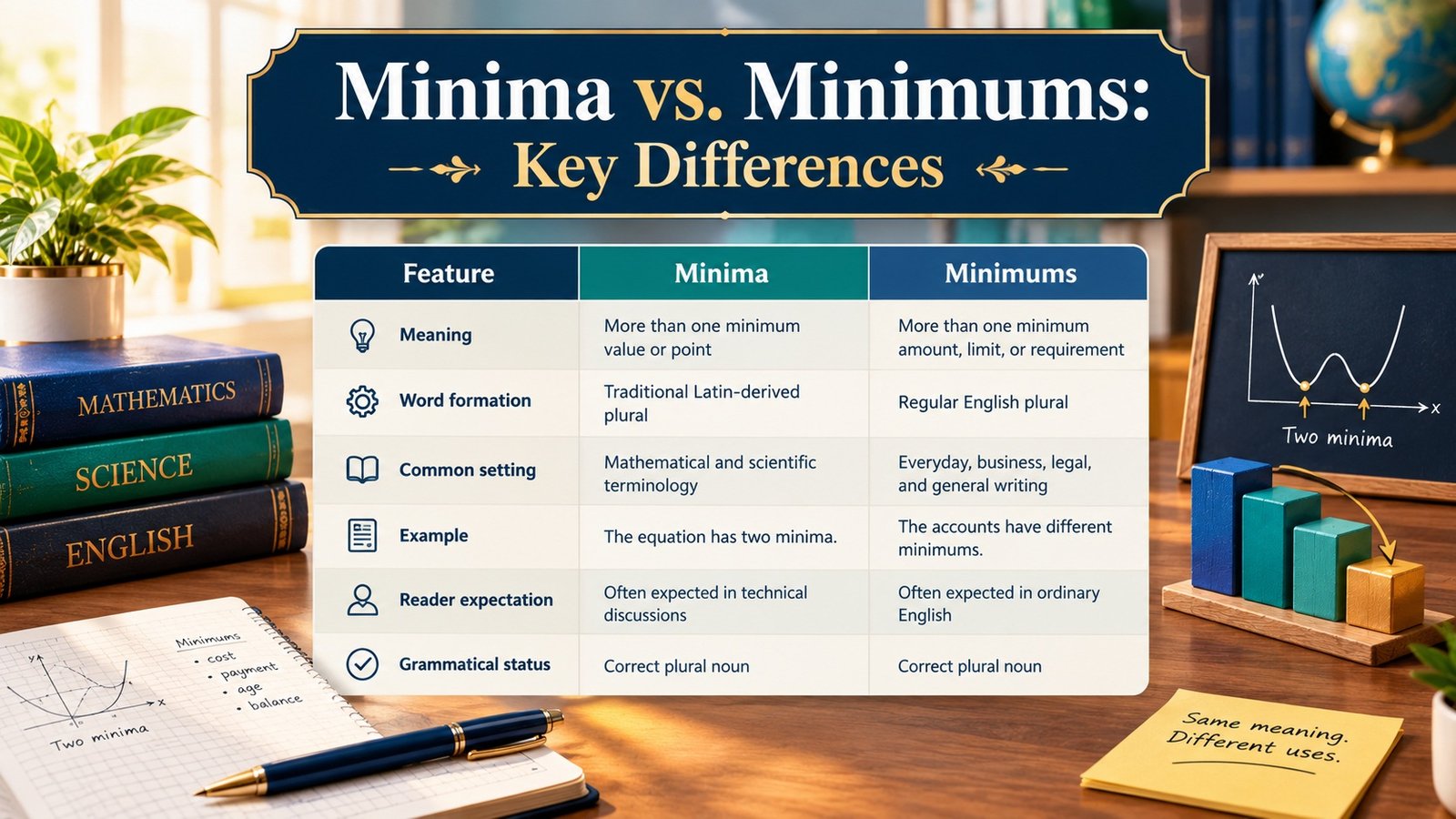
Minima vs. Minimums: Key Differences
The words minima and minimums share the same basic meaning, but their typical uses differ. Understanding those differences makes it easier to choose the right form without overthinking every sentence.
The following table summarizes the most important distinctions.
| Feature | Minima | Minimums |
| Meaning | More than one minimum value or point | More than one minimum amount, limit, or requirement |
| Word formation | Traditional Latin-derived plural | Regular English plural |
| Common setting | Mathematical and scientific terminology | Everyday, business, legal, and general writing |
| Example | The equation has two minima. | The accounts have different minimums. |
| Reader expectation | Often expected in technical discussions | Often expected in ordinary English |
| Grammatical status | Correct plural noun | Correct plural noun |
Neither form is inherently wrong. The choice depends on the meaning you want to express and the conventions your readers expect.
Difference in Word Formation
The two forms reflect different ways English handles words with Latin origins.
Minimum entered English through Latin. Its traditional plural, minima, follows the Latin pattern in which certain nouns ending in -um form plurals ending in -a.
English also allows many borrowed words to take regular English plural endings. That pattern gives us minimums.
Compare these related forms:
| Singular | Traditional Latin-derived plural | Regular English plural |
| Minimum | Minima | Minimums |
| Maximum | Maxima | Maximums |
The same broad pattern appears in other words, although individual plurals have their own histories and conventions.
For example, datum traditionally has the plural data, while medium can have the plural media or mediums, depending on meaning and context.
This doesn’t mean every word ending in -um must use a Latin plural. English usage evolves, and many borrowed words develop regular English forms.
Difference in Context
Context usually provides the clearest clue.
Imagine a mathematician analyzing a curve. The sentence “The function has two minima” uses terminology familiar to readers who study calculus.
Now imagine a manager discussing account requirements. The sentence “The bank introduced new minimums” communicates the intended meaning naturally.
The underlying concept remains similar, but the subject influences the preferred expression.
Use these practical guidelines:
- Choose minima for established expressions such as local minima and global minima.
- Choose minimums for multiple business limits, account thresholds, and general requirements.
- Check established terminology when writing for a specialized audience.
- Prefer the clearest form when no technical convention applies.
Difference in Tone and Readability
Minima can sound technical because readers often encounter it in mathematical or scientific material. That association makes it appropriate in specialized discussions but potentially awkward in casual writing.
Minimums generally feels more familiar to a broad American audience. It works well in emails, business reports, instructions, and everyday explanations.
For example:
- Technical: The optimization routine searches for multiple minima.
- General: The company established minimums for new customers.
Both sentences are clear in their intended settings. The goal isn’t to make one form sound smarter than the other. It’s to select wording that suits the reader and subject.
Minima vs. Minimums: Examples in Sentences
Examples make the distinction easier to remember because they show how each form works in context.
Examples Using Minima
The following sentences illustrate common mathematical and technical uses.
- The graph contains two local minima. The function reaches two local low points.
- Researchers compared the temperature minima recorded during winter. The researchers examined multiple lowest temperature readings.
- The algorithm identified three minima in the function. The calculation found three low points.
- The model has several local minima. The model’s mathematical behavior includes multiple local low points.
- The study examined the minima of the calculated curve. The researchers focused on its lowest points.
- The function reaches its global minimum at two different inputs. Multiple inputs produce the same lowest function value.
The final example uses minimum in the singular because it refers to one lowest value, even though two inputs produce that value. If the discussion instead focuses on the two points themselves, global minimizers may be the more precise mathematical term.
This distinction highlights an important point: the best wording depends not only on singular versus plural but also on exactly what you’re describing.
Examples Using Minimums
These sentences show how minimums works in everyday and professional English.
- The bank revised its minimums for new accounts. Different accounts may have different required thresholds.
- The company established minimums for employee qualifications. Several positions may require different levels of experience or education.
- The retailer introduced minimums for bulk orders. Customers must meet specified purchase quantities.
- The service provider changed its monthly minimums. Several service plans may have different minimum charges.
- The contract specifies minimums for delivery quantities. Each category may have its own lower limit.
- The organization reviewed its staffing minimums. The organization examined required staffing levels across different operations.
In each example, minimums refers to more than one limit or requirement. The word works without requiring the reader to understand mathematical terminology.
Examples Using Both Words
A comparison can make the difference especially clear.
Mathematics: The analyst identified two minima on the graph.
Business: The analyst identified two minimums in the company’s pricing policy.
Both sentences describe two low points or thresholds. However, the first follows familiar mathematical terminology, while the second refers to separate business requirements.
Here’s another comparison:
- Technical: The function contains three local minima.
- General: The organization established three minimums for membership eligibility.
The subject determines which plural form sounds most natural.
Why Does Minimum Have Two Plural Forms?
English includes words that preserve older plural patterns alongside forms that follow ordinary English grammar. Minimum is one example.
Its two plural forms reflect the interaction between Latin word formation and English usage. Neither form needs to be treated as a mistake simply because the other exists.
The Latin Origin of Minima
The word minimum comes from Latin minimum, a form associated with minimus, meaning “smallest” or “least.”
Latin uses different endings depending on a word’s grammatical form. In the traditional pattern relevant here, a noun ending in -um can form its plural with -a.
That’s why minimum has the traditional plural minima.
English retains several Latin-derived plural forms, particularly in formal, academic, and technical settings. Examples include:
- Minimum → minima
- Maximum → maxima
- Datum → data
- Bacterium → bacteria
These examples share historical patterns, but their modern usage isn’t identical. For instance, data commonly functions as a mass noun in contemporary English, while bacteria remains the usual plural of bacterium.
The key point is that minima reflects a traditional plural pattern that English has retained.
The English Plural Minimums
English often forms plural nouns by adding -s or -es. This regular pattern helps speakers use words without memorizing a separate plural for every noun.
For example:
- Limit → limits
- Requirement → requirements
- Threshold → thresholds
- Minimum → minimums
Because minimums follows a familiar pattern, it works naturally in many everyday situations.
A writer discussing several payment limits doesn’t need to adopt the Latin-derived form merely because the word originated in Latin. Regular English plurals are widely accepted for many borrowed words.
This flexibility makes English practical, although it can sometimes leave writers choosing between two valid forms.
Is Minima More Correct Than Minimums?
No. Minima isn’t universally more correct than minimums. Both forms are accepted, and the appropriate choice depends on usage.
In mathematics, minima is conventional in expressions such as local minima. In a business document, minimums may be clearer and more natural.
A Latin origin doesn’t automatically make a word’s traditional plural preferable in every sentence. English speakers routinely use established regular plurals when they fit the context.
Consider these examples:
- Mathematical writing: The function has two minima.
- Business writing: The company raised its minimums.
- General explanation: Both plural forms are correct.
If a publisher, institution, or technical field specifies a preferred form, follow that convention. Otherwise, choose the wording that best serves your audience.
Read more: Scissors: Meaning, Types and Uses
Common Mistakes to Avoid When Using Minima and Minimums
Even though both words are correct, writers can still misuse them. Most problems arise from confusing grammatical roles or ignoring the context.
Assuming Minimums Is Incorrect
Some writers believe that minimum must take the Latin plural minima. That assumption is too restrictive.
English accepts minimums as a plural noun. It works naturally in expressions such as account minimums, payment minimums, and mandatory minimums.
Incorrect assumption: “Minimums isn’t a real word because minima is the correct plural.”
Better explanation: Both forms are correct, but they serve different usage preferences.
Using Minima Everywhere to Sound Formal
A less familiar word doesn’t automatically improve a sentence.
For example, “The store changed its minima for online purchases” may sound unnatural to customers. “The store changed its minimums for online purchases” communicates the intended meaning more directly.
Use specialized terminology when it adds precision. Avoid choosing a word merely because it sounds academic.
Confusing Minimums With Minimum Requirements
The phrase minimum requirements often confuses writers because it describes multiple requirements but doesn’t use minimums.
That’s because minimum functions as an adjective in this expression.
Compare:
- Minimum requirements: The lowest requirements that applicants must meet.
- Minimums for applicants: Separate thresholds established for applicants.
Both phrases can be correct, but their grammatical structures differ.
Here are two complete examples:
- The university published its minimum requirements for admission.
- The university established minimums for different admission pathways.
In the first sentence, minimum modifies requirements. In the second, minimums is a plural noun.
Treating Minima as an Adjective
Minima is a plural noun, not a general-purpose adjective.
For example, “The study recorded several minima values” is awkward because minima already refers to multiple minimum values or points.
Depending on the intended meaning, clearer alternatives include:
- The study recorded several minimum values.
- The function contains several minima.
- The researchers compared several minimum measurements.
Choose the construction that communicates your meaning without unnecessary repetition.
Mixing Plural Forms Without a Reason
Using both forms in the same document isn’t automatically wrong. However, inconsistent usage can distract readers when the context doesn’t justify the switch.
For example, a technical paper might consistently use minima for mathematical low points while using minimums for practical limits. That distinction makes sense because the words serve different purposes.
Problems arise when a writer switches between the forms for the same concept without a clear reason.
To keep your writing consistent:
- Identify the subject and intended meaning.
- Follow established terminology where applicable.
- Use the same form for the same type of concept.
- Review the surrounding sentences for clarity.
Consistency helps readers focus on your ideas rather than your word choices.
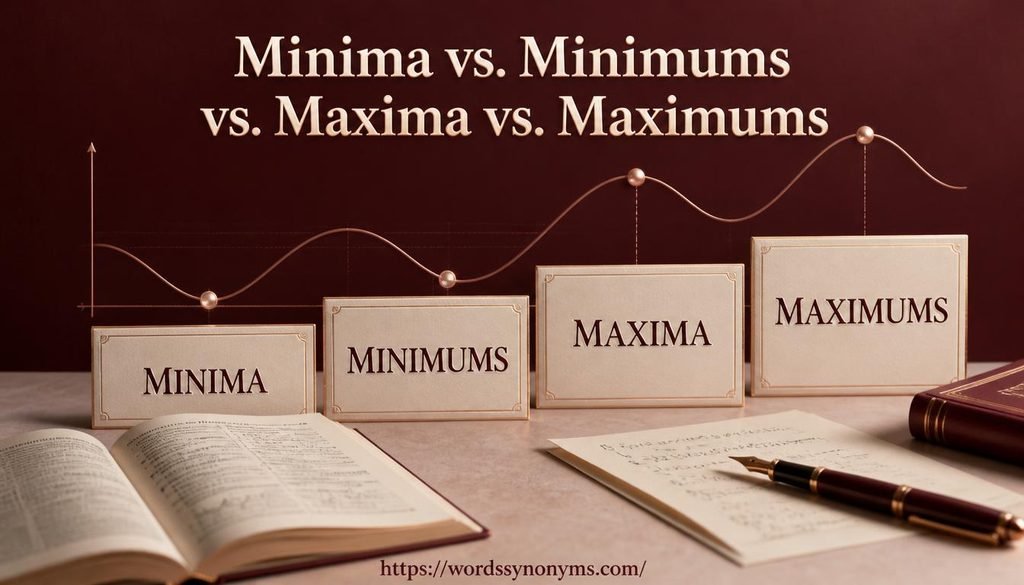
Minima vs. Minimums vs. Maxima vs. Maximums
The words minima and minimums belong to a larger group of nouns with traditional and regular English plural forms. Understanding the related forms maxima and maximums can help you recognize the pattern.
A minimum represents the lowest value or limit. A maximum represents the highest value or limit.
Their plural forms follow a similar pattern:
| Singular | Regular English plural | Traditional Latin-derived plural |
| Minimum | Minimums | Minima |
| Maximum | Maximums | Maxima |
The choice between maxima and maximums also depends on context.
In mathematics, writers commonly use maxima when discussing multiple high points of a function. In everyday English, maximums often describes several upper limits or restrictions.
For example:
- Mathematical: The graph has two local maxima and three local minima.
- Business: The company introduced new minimums and maximums for customer accounts.
- General: The policy specifies maximum amounts and minimum requirements.
These forms follow a related pattern, but you shouldn’t assume that every Latin-derived noun has two equally common plurals. Check established usage whenever you’re unsure.
Read more: Said: Meaning, Definition and Grammar
How to Choose Between Minima and Minimums
Choosing the right word becomes much easier when you consider your audience and subject.
You don’t need to memorize complicated rules. Instead, use the following practical guide.
| Situation | Recommended form | Example |
| Everyday American English | Minimums | The store changed its order minimums. |
| Business and finance | Minimums | The accounts have different balance minimums. |
| Mathematics | Minima | The function has two local minima. |
| Scientific analysis | Depends on context | Researchers compared the observed minima. |
| Formal reports | Follow the relevant convention | The report lists the minimums for each category. |
| Mathematical research papers | Minima when conventional | The algorithm searches for local minima. |
Choose Minimums for General Writing
When writing for a broad audience, minimums is often the most straightforward choice.
It works well in business reports, customer instructions, policy documents, and everyday explanations. Readers can understand the word without knowing anything about Latin grammar.
For example:
The company introduced new minimums for its subscription plans.
This sentence communicates the main idea clearly. There’s no need to use minima unless the subject or terminology calls for it.
Choose Minima for Established Technical Terms
When writing about mathematical functions, optimization, or related technical subjects, minima may be the expected term.
For example:
The algorithm searches for local minima to reduce the model’s error.
The term local minima has a well-established mathematical meaning. Replacing it with a less conventional expression may make the discussion feel unfamiliar to specialists.
However, not every sentence involving a scientific measurement requires minima. A report can refer to minimum temperatures, minimum acceptable concentrations, or minimum operating levels.
The goal is to use the terminology that accurately describes the concept.
Follow Your Style Guide
Professional writers sometimes work with specific editorial requirements. A publisher may prefer regular English plurals, while a scientific journal may follow the terminology customary in its field.
When a style guide provides a clear rule, follow it.
If no rule exists, consider these questions:
- Is the subject mathematical or technical?
- Does the field commonly use minima?
- Would general readers understand minimums more easily?
- Have you already used one form consistently?
- Does the sentence describe separate limits or mathematical low points?
These questions will usually lead you to the right choice.
FAQs
1. What is the difference between minima and minimums?
Minima is the Latin plural of minimum, while minimums is the regular English plural. Both mean more than one minimum, but they often appear in different contexts.
2. Is minima grammatically correct?
Yes, minima is grammatically correct. You’ll often see it in mathematics, science, and technical writing when discussing multiple lowest points or values.
3. When should I use minimums instead of minima?
Use minimums in everyday English, business writing, and general communication. For example, a company might set minimums for order quantities or monthly payments.
4. Is minima singular or plural?
Minima is plural. Its singular form is minimum. For example, “The graph has one minimum and two minima.”
5. Do minima and minimums have the same meaning?
Yes, both words refer to multiple minimum values or limits. The main difference is usage: minima is more common in technical contexts, while minimums is widely used in everyday English.
6. Which plural form is more common in American English?
Minimums is generally more common in American English, especially outside specialized fields. However, minima remains appropriate in mathematics, science, and other technical discussions.
Conclusion
Choosing between minima and minimums becomes easy once you understand where each word fits. Both are correct plural forms of minimum, but they suit different situations. If you’re writing about mathematics, science, or a technical subject, minima may be the better fit.
For everyday conversations, business documents, and general writing, minimums usually sounds more natural. When you’re unsure, think about your readers and the context. The best word is the one that makes your meaning clear without making your sentence sound unnecessarily complicated.

Muhammad Taqi is a content writer interested in English vocabulary and language. He writes clear and useful articles on synonyms, antonyms, word meanings, and English usage, helping readers expand their vocabulary and improve their communication skills.