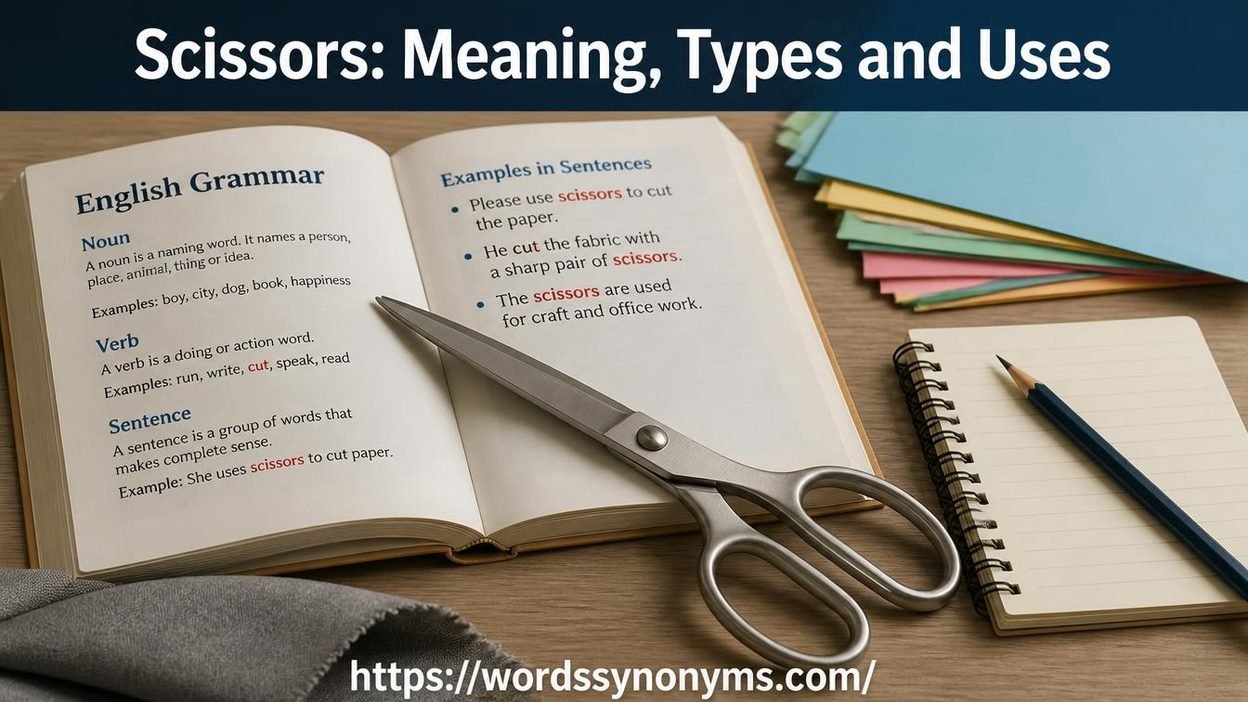
Scissors: Meaning, Types and Uses explains how this cutting tool works in grammar and everyday conversation, including singular and plural forms.
The word scissors refers to a cutting implement used to cut or clip paper, fabric, and other materials. In everyday grammar, scissors is usually plural, so usage authorities recommend the plural form as the safer choice.
For example, “hand me those scissors” is generally preferred to “hand me that scissors.” When you need a singular alternative, use “pair of scissors.” This wording helps prevent confusion for readers and listeners. Some writers use scissor for one item, but it isn’t a dictionary-recognized noun for the cutting tool. However, scissor works as a verb, meaning to cut or clip with scissors.
In sports, the term has a different singular usage: a gymnastic exercise or wrestling hold may be called a scissors movement or scissor movement, depending on the expression. Understanding these differences improves your writing and conversation.
Quick Answer
Scissors are a cutting tool with two blades joined by a pivot. We use them to cut paper, fabric, hair, and other materials. In English, scissors takes a plural verb, as in “These scissors are sharp.” To refer to one tool, say “a pair of scissors,” as in “This pair of scissors is new.”
What Are Scissors?
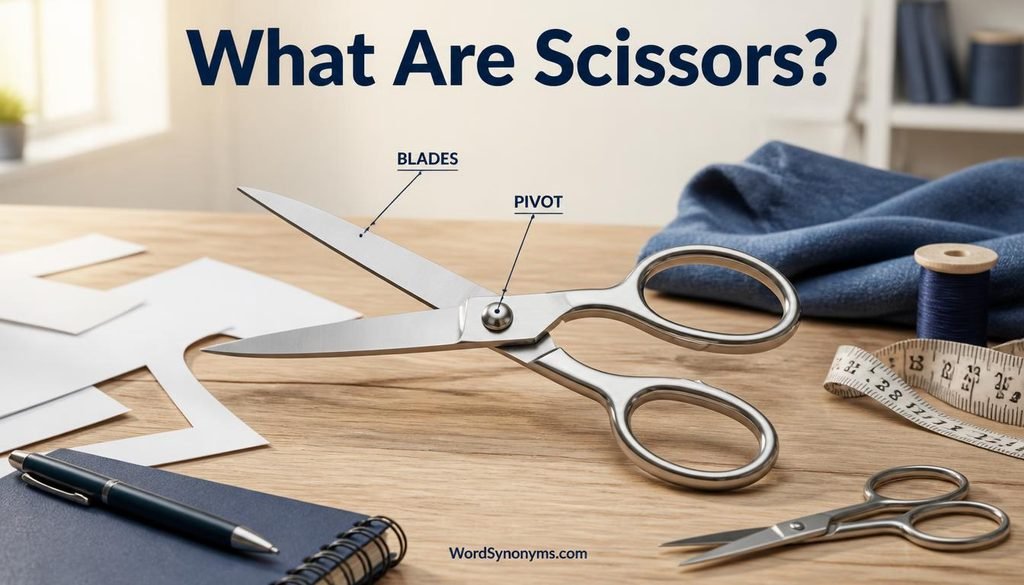
Scissors are a cutting tool made of two blades connected by a central pivot. The blades move against each other when you squeeze the handles, allowing you to cut materials with control and precision.
Most scissors have two handles, two blades, and a screw or rivet that joins the blades. Some designs include special features for particular jobs, such as curved blades, serrated edges, or blunt tips.
People use scissors to cut paper, fabric, thread, hair, packaging, and many other materials. However, not every pair works well for every task. Fabric scissors, for example, generally perform better on cloth than ordinary household scissors.
Main Parts of Scissors
Each part of a pair of scissors plays a role in its performance.
- Blades: The two metal or other suitable cutting components that meet to cut material.
- Cutting edges: The sharpened edges that slice through the material.
- Pivot: The central point where the blades connect and rotate.
- Screw or rivet: The fastener that holds the blades together.
- Handles: The sections you hold to open and close the blades.
- Finger loops: The openings that help you control the scissors during cutting.
The relationship between these parts determines how comfortably and accurately scissors cut. Loose blades may push paper aside, while damaged edges can tear material instead of cutting it cleanly.
What Does Scissors Mean?
The word scissors refers to a hand-operated cutting tool with two blades that move past each other. Its meaning stays consistent across most everyday contexts, although the tool’s design changes depending on its purpose.
For example, household scissors usually handle simple tasks such as opening packages or trimming paper. Sewing scissors help cut fabric, while hair-cutting scissors allow barbers and stylists to shape hair precisely.
Here are a few examples of the word in everyday sentences:
- Please bring the scissors from the kitchen drawer.
- These scissors cut thick paper easily.
- My sewing scissors need sharpening.
- The teacher gave each student a pair of scissors.
- Keep the scissors away from the edge of the table.
In each sentence, scissors names the cutting tool. The surrounding words explain its location, purpose, condition, or use.
Is Scissors Singular or Plural?
Scissors is generally treated as a plural noun when it refers directly to the cutting tool. This grammatical rule explains why standard English normally uses are rather than is with the word.
Consider these examples:
- Correct: The scissors are on the desk.
- Incorrect in standard usage: The scissors is on the desk.
- Correct: These scissors need sharpening.
- Incorrect in standard usage: These scissors needs sharpening.
The rule can feel unusual because one physical tool contains two connected blades. English often uses plural-only nouns for objects that consist of two joined parts or are traditionally viewed as paired.
Other examples include trousers, glasses, and binoculars. These nouns commonly take plural verbs when they refer to the objects themselves.
However, there’s an important exception to remember. When you use pair to count the tool, the verb agrees with pair, not scissors.
- This pair of scissors is sharp.
- That pair of scissors belongs to my sister.
- Two pairs of scissors are missing.
The subject determines the verb. Once you understand that distinction, the grammar becomes much easier.
Why Do We Say a Pair of Scissors?
English speakers commonly use “a pair of scissors” to refer to one cutting tool. The expression follows a familiar pattern used for objects traditionally understood as having two connected or corresponding parts.
Scissors have two blades joined by a pivot. Although those blades work together as one instrument, the noun scissors takes plural agreement in ordinary usage. The word pair gives speakers a convenient way to count the complete tool.
Compare these expressions:
| Expression | Meaning | Example |
| A pair of scissors | One cutting tool | I bought a pair of scissors. |
| Two pairs of scissors | Two cutting tools | We need two pairs of scissors. |
| Several pairs of scissors | Three or more cutting tools | Several pairs of scissors were available. |
| This pair of scissors | One specific cutting tool | This pair of scissors is mine. |
Notice how the verb changes with the quantity. A pair is singular, so it takes is or was. Two pairs is plural, so it takes are or were.
For example, you would write, “A pair of scissors is missing,” but “Three pairs of scissors are missing.”
The same counting pattern appears in expressions such as a pair of trousers and two pairs of glasses.
Read more: Spectra vs. Spectrums: Meaning and Examples
Is It Scissor or Scissors?
Both scissor and scissors are real English words, but they don’t always serve the same purpose.
Scissors is the standard noun for the familiar cutting tool. When you mean one ordinary pair, write a pair of scissors rather than a scissor.
The word scissor can also function as a verb meaning to cut with scissors or make a scissor-like movement. It appears in certain compound terms as well.
Examples include:
- The stylist used scissors to trim the ends.
- The athlete made a scissor-like movement with his legs.
- The gymnast performed a scissor kick.
- The mechanism uses a scissor-shaped design.
In these examples, scissor describes an action, movement, or shape rather than serving as the usual standalone noun for one cutting tool.
Scissor vs. Scissors: Quick Comparison
| Word | Common function | Example |
| Scissors | Noun for the cutting tool | The scissors are sharp. |
| Scissor | Verb meaning to cut with scissors | The blades scissor through the material. |
| Scissor | Modifier describing a shape or movement | He practiced a scissor kick. |
| A pair of scissors | Countable expression for one tool | I need a pair of scissors. |
A simple rule will keep your writing accurate: use scissors for the tool and a pair of scissors when counting one.
What Is the Plural of Scissors?
The usual noun form remains scissors, even when you refer to the tool in a general sense. To count multiple tools, English speakers normally use pairs of scissors.
For instance, “The scissors are clean” refers to a cutting tool or the scissors under discussion. “The three pairs of scissors are clean” clearly identifies three separate tools.
Avoid adding -es to create scissorses. That form isn’t standard English.
Use these constructions instead:
- One tool: a pair of scissors
- Two tools: two pairs of scissors
- Four tools: four pairs of scissors
- An unspecified number: several pairs of scissors
- A group of tools: the scissors or the pairs of scissors, depending on context
The distinction matters most when you write instructions, inventory lists, classroom rules, or shopping notes.
For example, a teacher might write, “Please return all pairs of scissors to the supply cabinet.” This sentence clearly asks students to return multiple tools.
How to Use Scissors in a Sentence
The word scissors appears in many everyday situations. You can use it when discussing an object, describing an action involving the tool, or giving instructions.
Everyday Examples of Scissors
- The scissors are in the top drawer.
- These scissors cut cardboard cleanly.
- Please use the scissors carefully.
- I bought a new pair of scissors yesterday.
- The children used safety scissors during art class.
- Her fabric scissors are reserved for sewing projects.
- Could you pass me those scissors?
- This pair of scissors is easier to handle.
These examples demonstrate how the noun works in ordinary conversation. They also show that scissors can appear with demonstratives such as these and those, as well as possessives such as my and her.
Examples of Scissors in Different Contexts
At school: The students used scissors to cut shapes from colored paper.
At home: My mother keeps a pair of scissors in the kitchen drawer.
In a sewing room: The tailor used fabric scissors to trim the excess cloth.
At a salon: The stylist cleaned the scissors before the next appointment.
In an office: I used the scissors to open a package.
Each sentence connects the tool to a specific purpose. Context makes the meaning clear without requiring a lengthy explanation.
Types of Scissors and Their Uses
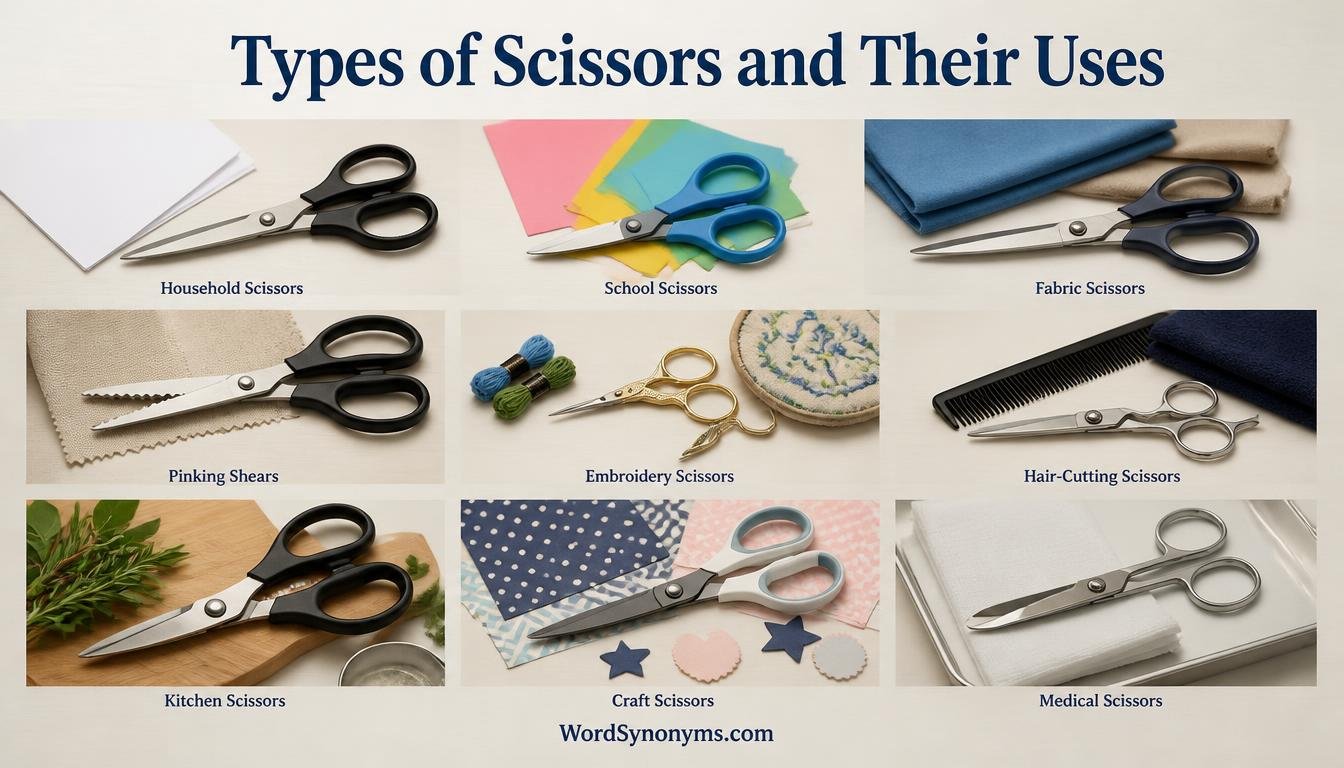
Scissors come in many designs because different materials require different cutting methods. Choosing the right type can improve accuracy, protect the material, and reduce hand strain.
Household Scissors
Household scissors are general-purpose tools for everyday tasks. They work well for cutting paper, opening lightweight packaging, trimming labels, and completing small household projects.
Many homes keep one pair in a drawer for quick jobs. However, using them on thick plastic, wire, or other unsuitable materials can damage the blades.
School Scissors
School scissors are designed for classroom activities, crafts, and basic paper cutting. Many children’s versions have rounded tips to reduce the risk of puncture injuries.
Rounded tips don’t make scissors completely harmless. Children still need age-appropriate tools and suitable supervision.
Fabric Scissors
Fabric scissors are designed to cut cloth cleanly. Their sharp blades help prevent fabric from slipping, bunching, or developing ragged edges during cutting.
Sewing enthusiasts often keep fabric scissors separate from paper-cutting scissors. Paper can dull cutting edges over time, making precise fabric work more difficult.
Pinking Shears
Pinking shears have zigzag cutting edges that create a serrated pattern along fabric. This cut can help reduce fraying in certain woven fabrics, although it doesn’t prevent fraying in every material.
Their distinctive edges also create decorative borders. Tailors and craft makers sometimes use them for both practical and visual purposes.
Embroidery Scissors
Embroidery scissors are small tools designed for detailed thread cutting. Their compact size and fine tips make them useful for trimming loose ends around stitches.
People who sew, knit, embroider, or complete needlework projects often appreciate their precision. They’re less suitable for large cutting jobs because their blades and handles are designed for detail.
Hair-Cutting Scissors
Hair-cutting scissors are professional tools used to trim, shape, and layer hair. Their design supports controlled cuts around the head and along individual sections.
Some models have straight blades, while others feature specialized edges or thinning designs. Professional stylists select scissors according to their cutting techniques and the results they want.
Kitchen Scissors
Kitchen scissors handle suitable food-related tasks and common kitchen jobs. Depending on their design, they may cut herbs, trim packaging, or separate poultry joints.
Not every pair belongs in food preparation. Kitchen scissors should be suitable for the intended material and cleaned properly after contact with food, especially raw meat.
Craft Scissors
Craft scissors support activities such as scrapbooking, paper design, and decorative cutting. Some create patterned edges, while others offer specialized shapes for particular projects.
Choose a pair according to the material and finish you need. Ordinary craft scissors may not handle thick materials or delicate fabric as effectively as specialized tools.
Medical Scissors
Medical scissors are designed for specific clinical tasks. Examples include cutting dressings, trimming materials, and removing certain types of bandages.
Different medical scissors have different blade shapes and safety features. Healthcare professionals select the appropriate design for each procedure and follow relevant infection-control practices.
Safety Scissors
Safety scissors are designed to reduce certain cutting risks. Children’s versions often feature rounded tips, while other designs may have guarded blades or specialized protective features.
The term covers several designs rather than one universal product. Always check the tool’s intended age range and use instructions.
Types of Scissors at a Glance
| Type | Main purpose | Key feature |
| Household scissors | Everyday cutting | General-purpose design |
| School scissors | Classroom crafts | Often have rounded tips |
| Fabric scissors | Cutting cloth | Sharp, precise blades |
| Pinking shears | Decorative fabric edges | Zigzag cutting edges |
| Embroidery scissors | Trimming thread | Small, fine tips |
| Hair-cutting scissors | Styling hair | Controlled, precise cutting |
| Kitchen scissors | Suitable food and kitchen tasks | Designed for kitchen use |
| Craft scissors | Creative projects | May feature decorative edges |
| Medical scissors | Clinical tasks | Specialized blade designs |
| Safety scissors | Tasks requiring added protection | Protective features vary |
What Are Scissors Used For?
The main purpose of scissors is cutting, but the materials and settings vary widely. Their usefulness comes from the control they offer when separating material along a chosen line.
Common uses include:
- Paper cutting: Trimming documents, cutting shapes, and completing school projects.
- Sewing: Cutting cloth, trimming loose threads, and preparing fabric pieces.
- Hair styling: Trimming hair and creating specific shapes.
- Crafting: Making decorations, scrapbook designs, and paper models.
- Food preparation: Cutting suitable ingredients or packaging with kitchen scissors.
- Medical care: Cutting dressings and other appropriate materials.
- Office work: Opening packages, trimming labels, and preparing documents.
- Gardening: Using suitable specialized snips or shears for small plant-cutting tasks.
Although these tools share a basic mechanism, their blades aren’t interchangeable in every situation. Using the right scissors protects both the material and the tool.
For example, household scissors may crush delicate fabric instead of producing a clean edge. Fabric scissors would usually provide better control.
How Do Scissors Work?
Scissors work through a simple mechanical principle involving levers and a pivot. When you squeeze the handles, the blades rotate around the central joint and move against each other.
This movement concentrates force along the cutting edges. As the edges pass through the material, they separate it into two parts.
Several factors affect cutting performance:
- Blade sharpness: Sharp edges generally cut more cleanly with less effort.
- Blade alignment: Proper alignment helps the edges meet effectively.
- Pivot tension: The joint needs suitable tension for smooth movement.
- Handle design: Comfortable handles improve control during repeated use.
- Material thickness: Thick or dense materials may require specialized scissors.
A well-maintained pair should open and close smoothly without excessive looseness. If the blades bend, become damaged, or no longer meet correctly, cutting performance can decline.
The basic mechanism hasn’t changed much in everyday scissors, but manufacturers adapt the shape, material, and joint to suit specialized tasks.
How to Use Scissors Safely
Scissors are common tools, but their sharp edges can cause injuries when handled carelessly. A few sensible habits help keep everyday cutting tasks safer.
Follow these guidelines:
- Hold scissors by their handles rather than their blades.
- Keep your fingers away from the cutting edges.
- Cut away from your body when practical.
- Use scissors on a stable surface when the task allows.
- Carry closed scissors with the points directed downward.
- Pass scissors handle-first so the other person can grip them safely.
- Store scissors closed and away from young children.
- Choose tools designed for the material you’re cutting.
- Avoid running or playing while holding scissors.
- Inspect damaged scissors before deciding whether they remain safe to use.
Children should use scissors suited to their age and abilities. Adult supervision may be necessary, particularly when children are learning proper handling techniques.
A useful rule: Never force scissors through material they weren’t designed to cut. Choose an appropriate tool instead.
Scissors: Pronunciation and Word Origin
Understanding pronunciation and word history can help you recognize the word and use it confidently.
How to Pronounce Scissors
The standard pronunciation of scissors is commonly represented as /ˈsɪzərz/.
A simple pronunciation guide is SIZ-erz. The first syllable receives the main stress, and the opening letters sc sound like /s/, not /sk/.
The middle sound resembles the unstressed vowel in teacher for many American English speakers. The final sound is a voiced /z/.
Try saying the word slowly before using it in a sentence:
- Scissors
- A pair of scissors
- These scissors are sharp.
Practicing the complete phrases helps you connect the pronunciation with natural sentence rhythm.
Where Does the Word Scissors Come From?
The word scissors developed through historical forms of English and French. Its history is connected to older terms for cutting instruments and the evolution of the familiar two-bladed tool.
The spelling may look unusual because the opening letters don’t match the word’s pronunciation directly. English contains many words with spellings inherited from earlier stages of the language.
For modern writers, the most important point is straightforward: spell the tool’s name scissors, even though the initial sc sounds like /s/.
Common Mistakes When Using the Word Scissors
A few recurring errors can make otherwise clear writing sound awkward. The following examples show how to correct them.
| Incorrect or awkward usage | Better usage | Explanation |
| The scissors is sharp. | The scissors are sharp. | Scissors normally takes a plural verb. |
| I need a scissor. | I need a pair of scissors. | This is the standard expression for one tool. |
| She bought two scissors. | She bought two pairs of scissors. | Pairs clearly counts the tools. |
| The scissors needs cleaning. | The scissors need cleaning. | Use a plural verb with scissors. |
| Three pair of scissors are missing. | Three pairs of scissors are missing. | Use pairs after a number greater than one. |
| This scissors is mine. | These scissors are mine. | Use plural agreement with the noun. |
| This pair of scissors are mine. | This pair of scissors is mine. | The subject is the singular noun pair. |
The last two examples reveal an important grammatical distinction. When scissors serves as the subject, use plural agreement. When pair serves as the subject, the verb agrees with pair.
Compare these sentences:
- The scissors are on the shelf.
- The pair of scissors is on the shelf.
- The pairs of scissors are on the shelf.
The meaning remains similar, but the grammatical subject changes.
Scissors vs. Shears: What’s the Difference?
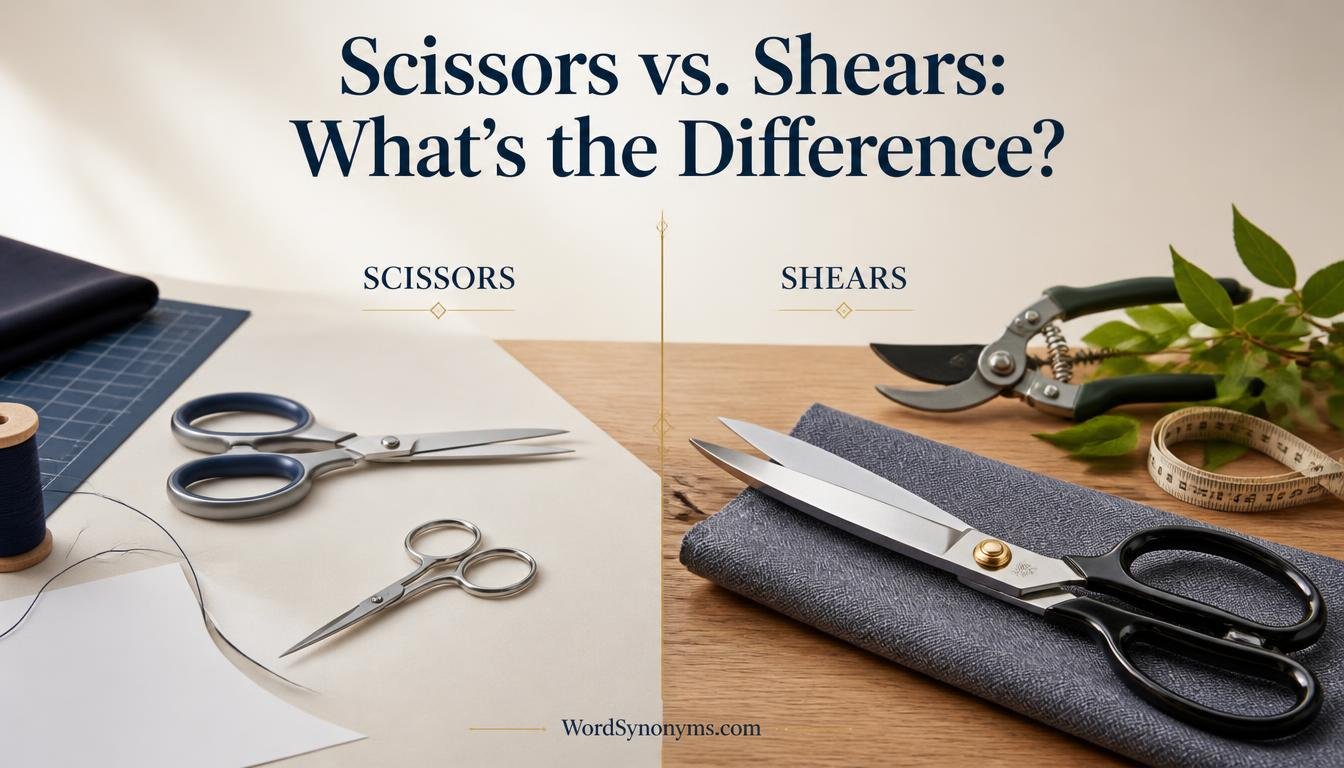
Scissors and shears are closely related cutting tools. Both use opposing blades to cut material, but their designs and intended applications can differ.
Scissors often have two similarly sized handles with finger loops. Household, school, and embroidery scissors are familiar examples.
Shears commonly have longer blades or handles designed to provide leverage for larger or tougher cutting tasks. Examples include garden shears, hedge shears, and sewing shears.
However, the distinction isn’t based on size alone. Some specialized scissors are large, while some shears are relatively compact.
Scissors vs. Shears Comparison
| Feature | Scissors | Shears |
| Common design | Two pivoting blades, often with finger loops | Two pivoting blades, often designed for leverage |
| Typical tasks | Paper, thread, crafts, and general cutting | Fabric, branches, hedges, and other specialized materials |
| Size | Ranges from tiny to large | Often larger, depending on purpose |
| Precision | Frequently used for detailed cutting | Often suited to longer cuts or tougher materials |
| Examples | Household scissors, embroidery scissors | Garden shears, hedge shears, sewing shears |
The names sometimes overlap in professional and commercial use. Sewing tools, for instance, may be marketed as either scissors or shears.
Choose the tool according to its design and intended purpose rather than relying on the name alone.
Scissors Synonyms and Related Words
Finding an exact synonym for scissors can be difficult because many related words describe tools with different designs. The best alternative depends on the task and context.
Shears is the closest broadly used related term, particularly when discussing larger cutting tools or specialized applications. However, scissors and shears aren’t always interchangeable.
Other related terms include:
- Snips: Small cutting tools used for particular tasks, including some craft, sewing, and metalworking applications.
- Trimmers: Tools designed to shorten or shape material, such as hair or plant growth.
- Clippers: Tools commonly used to cut hair, nails, or other specific materials, depending on the design.
- Pruning shears: Garden tools designed to cut stems and small branches.
- Pinking shears: Scissors with zigzag edges used to create patterned fabric cuts.
These terms describe related tools rather than perfect replacements for scissors. A hair trimmer, for example, doesn’t work like ordinary scissors even though both can shorten hair.
When writing, select the word that identifies the actual tool. Precision helps readers picture what you mean.
Read more: Sear vs. Seer vs. Sere: Differences and Examples
Practical Case Studies: Choosing and Using Scissors
Real-world situations show why both the tool and the grammar matter. Consider these everyday examples.
Case Study: Cutting Fabric for a Sewing Project
Maya needs to cut cotton fabric for a simple tote bag. She reaches for the household scissors she uses to open packages.
The blades struggle to produce a clean edge, so the fabric shifts while she cuts. She switches to sharp fabric scissors and gets a smoother result.
Lesson: Use fabric scissors for cloth when possible. Keeping them separate from paper-cutting tools can help preserve their cutting performance.
Case Study: Writing Classroom Instructions
A teacher prepares an instruction sheet for an art project. She writes, “Each student should bring a scissors.”
The sentence sounds unnatural because a scissors isn’t the standard expression. She revises it to “Each student should bring a pair of scissors.”
Later, she writes, “The scissors are available on the supply table.” Both sentences now follow standard usage.
Lesson: Use a pair of scissors to count one tool and scissors are when referring directly to the tool.
Case Study: Managing Shared Office Supplies
An office manager orders three pairs of scissors for a shared workspace. In the inventory spreadsheet, she writes, “Three pairs of scissors is available.”
The quantity is plural, so the verb should also be plural. She changes the sentence to “Three pairs of scissors are available.”
Lesson: The grammatical subject controls agreement. Here, three pairs is plural, so are is correct.
These examples highlight a useful principle: choosing the right tool and choosing the right words both depend on understanding the situation.
FAQs
1. Is the word scissors singular or plural?
The word scissors is usually treated as plural when referring to the cutting tool. For example, you would normally say, “These scissors are sharp.”
2. Can I say “that scissors”?
Although some people use “that scissors” in casual speech, “those scissors” is generally preferred in standard English. You can also say “that pair of scissors” when referring to one item.
3. What is the singular form of scissors?
There isn’t a widely accepted singular noun scissor for the cutting tool in standard English. Instead, use a pair of scissors to refer to one cutting tool.
4. Is scissor a real word?
Yes, scissor is a real word when used as a verb. It means to cut or clip something with scissors. However, it isn’t commonly accepted as a singular noun for the cutting tool.
5. Why do we say “a pair of scissors”?
Scissors have two blades joined at a central point, so English commonly describes the tool as a pair. This expression also lets you use singular grammar, as in “A pair of scissors is on the desk.”
6. Does scissors have a different meaning in sports?
Yes. In sports, scissors can refer to a gymnastic exercise or a wrestling hold. In these contexts, the word may describe a movement or position rather than a cutting tool.
Conclusion
Scissors are everyday tools, but their grammar can sometimes confuse English learners and writers. The easiest way to remember the rule is to treat scissors as a plural noun when referring to the cutting tool. For example, say, “These scissors are sharp,” rather than “This scissors is sharp.” When you want to refer to one tool, “a pair of scissors” is the natural choice.
It’s also worth remembering that scissor has a different role as a verb, meaning to cut or clip with scissors. In sports, the word can describe a gymnastic exercise or a wrestling hold. These different uses show why context matters when choosing the correct word. Whether you’re writing an article, completing a grammar exercise, or speaking in everyday conversation, understanding the meaning and usage of scissors will help you communicate more accurately and confidently.

Samreen Saif is a passionate writer and language enthusiast who contributes informative and engaging content to WordsSynonyms.com. She enjoys exploring English vocabulary, synonyms, antonyms, word meanings, and language usage to help readers understand and use words with confidence.
Samreen focuses on creating clear, accurate, and easy-to-read content for students, writers, professionals, and English learners. Through her articles, she aims to make vocabulary learning simple, practical, and useful for everyday communication.
When she is not writing, Samreen enjoys learning about language, discovering new words, and creating helpful content that makes English learning more accessible to everyone.