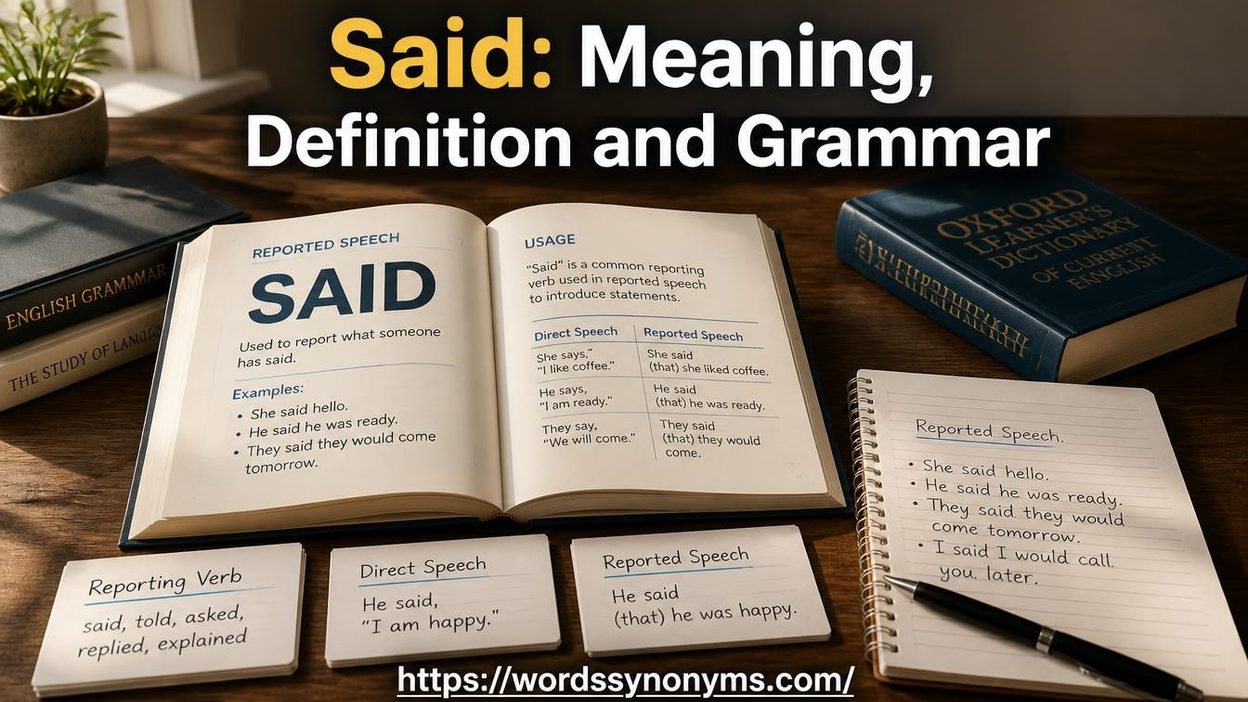
Said: Meaning, Definition and Grammar explains how said means aforementioned in legal writing and business writing.
As an adjective, it identifies a previously mentioned person, item, or matter. In English grammar, its grammatical function connects it to an earlier reference. The word aforesaid has a similar semantic meaning and appears in legal documents and business documents.
Both terms belong to formal language, legal terminology, and business terminology. Their contextual meaning depends on the context, especially in professional communication and written communication.
Although said offers a briefer replacement for a long word or phrase, it may sound awkward to unfamiliar readers. Good word choice and word usage improve clarity, readability, and concise writing. In professional writing, plain language often works better than lengthy expressions or unnecessary words.
Consider alternative words, shorter expressions, or word removal when a sentence feels overly formal. Removing redundant wording can improve sentence structure and writing style. Prioritize reader understanding, appropriate word usage, and clear communication over forced NLP keywords.
Quick Answer
Said is the simple past tense and past participle of say. You use it to report what someone expressed earlier, such as “She said she was tired” or “He has said that before.” In formal or legal writing, said can also mean “previously mentioned,” as in “the said agreement.”

What Does “Said” Mean?
Said means that someone expressed something through speech or communication in the past. It is the past form of say, which describes the act of expressing words, opinions, information, or ideas.
For example:
- Maria said she would arrive at noon.
- The teacher said the answer was correct.
- James said, “I’ll help you tomorrow.”
- The company said it would announce the results on Friday.
In each example, said reports something a person or organization communicated.
However, the precise meaning depends on the surrounding sentence. Sometimes, said introduces an exact quotation. In other cases, it summarizes a statement without repeating the speaker’s original words.
Consider these two examples:
- Direct speech: Daniel said, “I need more time.”
- Reported speech: Daniel said that he needed more time.
The first sentence presents Daniel’s exact words. The second reports his message without quoting him directly.
The Formal Meaning of “Said”
The word said has another meaning in formal, legal, and administrative writing. It can function as an adjective meaning previously mentioned or referred to.
For example:
- The said property belongs to the applicant.
- The parties agreed to revise the said document.
- The said employee must submit the required paperwork.
In these sentences, said points back to a person, object, or document already mentioned.
This usage can sound old-fashioned or unnecessarily formal in everyday English. Instead of writing “the said document,” you can usually write “the document” or “that document.”
Is “Said” a Verb?
Yes. Said is a verb form of say, and it serves two main grammatical purposes: the simple past tense and the past participle.
Although these forms look identical, their grammatical roles differ depending on how you use them.
Said as the Simple Past Tense
Use said when describing something someone expressed in the past.
Examples:
- Olivia said she enjoyed the movie.
- My father said the train was late.
- The manager said the meeting would begin at nine.
- They said they couldn’t attend the event.
The simple past tense presents the statement as a past event. You don’t need an auxiliary verb such as did to make an ordinary affirmative sentence.
Said as the Past Participle
The past participle appears with auxiliary verbs such as has, have, and had. These combinations form perfect tenses.
Examples:
- She has said everything she needed to say.
- They have said they will support the proposal.
- He had said he was leaving before the meeting started.
Notice the difference between these sentences:
- She said she was ready.
- She has said she is ready.
The first sentence uses the simple past. The second uses the present perfect, connecting a past statement with the present situation.
Can “Said” Be an Adjective?
Yes. In formal English, said can modify a noun to indicate something mentioned earlier.
For example, “The said amount must be paid within 30 days” uses said as an adjective.
However, this construction often sounds stiff. In most everyday situations, “The amount must be paid within 30 days” communicates the same idea more naturally.
What Is the Past Tense of “Say”?
The past tense of say is said. The verb is irregular because it doesn’t form its past tense by adding the usual -ed ending.
You should write “She said hello,” not “She sayed hello.”
The same form, said, also serves as the past participle. This makes the verb easier to remember once you learn its basic forms.
| Verb form | Correct form | Example |
| Base form | Say | I say what I mean. |
| Third-person singular | Says | He says hello every morning. |
| Simple past | Said | She said hello yesterday. |
| Past participle | Said | They have said enough. |
| Present participle | Saying | He is saying goodbye. |
How to Choose the Correct Form
The time of the action and the sentence structure determine which form you need.
1. Use say for the base form, including after modal verbs such as can, will, and should.
- I will say something at the meeting.
- You can say whatever you think.
- We should say thank you.
2. Use says with a third-person singular subject in the simple present tense.
- She says she feels better.
- The report says the project is complete.
3. Use said for past statements or with auxiliary verbs that require a past participle.
- He said he was busy.
- He has said he was busy before.
4. Use saying when the sentence requires the present participle or gerund.
- She is saying goodbye.
- Saying thank you shows appreciation.
Learning these forms helps you avoid errors when writing about conversations, past events, and ongoing communication.
How to Use “Said” in a Sentence
You can use said in several sentence structures. The most common patterns involve reported speech, direct quotations, and statements addressed to another person.
Using “Said” in Reported Speech
Reported speech communicates what someone said without necessarily repeating their exact words.
For example:
- Emma said that she needed a break.
- The coach said the team was improving.
- My brother said he would call later.
In these examples, said introduces a reported statement.
You can often omit that without changing the meaning.
- With that: Rachel said that she was hungry.
- Without that: Rachel said she was hungry.
Both sentences are grammatically correct. The version without that often sounds more natural in everyday conversation.
Understanding Tense Changes in Reported Speech
When you report something later, you may need to adjust the original speaker’s tense. This change is commonly called backshifting.
For example:
| Direct speech | Reported speech |
| “I am tired.” | She said she was tired. |
| “I work here.” | He said he worked there. |
| “I will call you.” | She said she would call me. |
| “I have finished.” | He said he had finished. |
Backshifting isn’t always necessary. If the statement remains true or describes a general fact, the present tense may still work.
For example, “The teacher said that water boils at 100°C at standard atmospheric pressure” is correct. The scientific fact remains true.
The important point is to preserve the intended meaning and maintain a consistent timeline.
Using “Said” Before a Direct Quotation
Use said to introduce the exact words someone spoke. Place the quoted words inside quotation marks in standard American English.
Examples:
- Maya said, “I’ll meet you after work.”
- “This is a wonderful opportunity,” David said.
- “Please close the door,” the teacher said.
When a dialogue tag introduces a quotation, place a comma before the opening quotation mark.
When the dialogue tag follows a statement, the comma usually goes inside the closing quotation mark in American English.
For example:
- “I finished the assignment,” Alex said.
- “We need more supplies,” the supervisor explained.
However, a question mark or exclamation point replaces the comma when the quotation ends with that punctuation.
- “Are you ready?” Nina asked.
- “Watch out!” he shouted.
These rules help readers identify the speaker’s words without confusing them with the surrounding narration.
Using “Said” With an Indirect Object
One of the most common mistakes involves using said as though it followed the same pattern as told.
In standard English, you generally say something to someone, but you tell someone something.
Correct examples:
- She said something to me.
- He said to his manager that he needed help.
- She told me the truth.
- He told his manager that he needed help.
Incorrect example:
- He said his manager the truth.
The corrected version is “He told his manager the truth” or “He said the truth to his manager,” although the latter sounds less natural than “He told his manager the truth.”
Remember these patterns:
- Say + something
- Say + something + to someone
- Tell + someone + something
- Tell + someone + that-clause
These structures are reliable guides when you’re unsure which verb to choose.
Using “Said” in Formal and Academic Writing
Writers frequently use said to report statements from people, companies, government agencies, and other organizations.
Examples:
- The director said the department would review the proposal.
- The company said its new policy would take effect in January.
- The researcher said the results required further analysis.
In formal writing, said can be a useful neutral reporting verb. It tells readers that someone made a statement without suggesting whether the statement was true, false, convincing, or controversial.
However, more specific reporting verbs can communicate additional information.
For example:
- Explained: The researcher explained why the results differed.
- Claimed: The company claimed the product was safe.
- Confirmed: The spokesperson confirmed the appointment.
- Denied: The official denied making the statement.
- Suggested: The report suggested a possible connection.
Choose these alternatives carefully. Claimed, for instance, can imply that a statement remains disputed or unverified. Don’t replace said with a stronger verb unless the context supports that meaning.
Using “Said” as an Adjective
In legal documents and formal notices, said can refer to something already identified.
Examples:
- The said contract remains in effect.
- The said property must be inspected.
- The parties must comply with the said requirements.
Although grammatically correct, these expressions often add unnecessary formality.
In modern business writing, simpler alternatives usually work better:
- The contract remains in effect.
- The property must be inspected.
- The parties must comply with these requirements.
Use the adjective said when a legal or established drafting convention calls for it. Otherwise, choose clearer wording.
Read more: Summary vs. Summery: Difference and Examples
“Said” Sentence Examples
The best way to understand said is to see how it works in different situations. The following examples cover everyday speech, questions, negative statements, dialogue, and formal communication.
Simple Sentences With “Said”
- She said hello when she entered the room.
- He said the food tasted delicious.
- They said the store was closed.
- My friend said she would visit on Sunday.
- The teacher said the exam would be difficult.
- Daniel said he had already completed the assignment.
- The children said they wanted to play outside.
- Our neighbor said the package had arrived.
Each sentence reports a past statement without repeating the speaker’s exact words.
Questions Using “Said”
You can use said in questions about earlier conversations or statements.
Examples:
- What did you say?
- Who said that?
- Did she say when she would arrive?
- What did the manager say about the schedule?
- Have they said whether the event is canceled?
- Had he said anything about the problem?
Notice that questions with did use the base verb say, not said.
Correct: “What did you say?”
Incorrect: “What did you said?”
The auxiliary did already marks the past tense. Adding said would mark the same tense twice.
Negative Sentences With “Said”
Negative statements often use didn’t followed by the base form say.
Examples:
- I didn’t say that.
- She didn’t say anything about the meeting.
- He never said he was leaving.
- They didn’t say when the package would arrive.
- We haven’t said anything about the proposed changes.
The last example uses the present perfect tense. It combines haven’t with the past participle said.
You can also use said nothing for a concise statement.
For example, “He said nothing during the discussion” means he made no verbal contribution during that period.
Examples of “Said” in Dialogue
Dialogue tags help readers identify speakers in stories, interviews, and conversations.
1. Dialogue tag before the quotation:
- Maria said, “I’ll bring the documents tomorrow.”
2. Dialogue tag after the quotation:
- “I’ll bring the documents tomorrow,” Maria said.
3. Dialogue tag between parts of a quotation:
- “I’ll bring the documents,” Maria said, “before the meeting begins.”
When a dialogue tag interrupts one continuous sentence, commas usually separate the tag from the quoted words. If the second quoted portion begins a new sentence, use the appropriate punctuation.
For example:
- “I’ll bring the documents,” Maria said. “You can review them tomorrow.”
Notice that said doesn’t need an elaborate synonym every time a character speaks. In fiction, repeating clear dialogue tags can keep the conversation easy to follow.
Examples of “Said” in Formal Writing
Here are several realistic examples from professional settings.
Business email:
“The revised schedule will be available on Monday,” the project manager said.
News reporting:
The spokesperson said the agency would release additional information later.
Academic discussion:
The author said the available evidence supported further investigation.
Workplace meeting:
The supervisor said employees should submit their reports before Friday.
Legal context:
The agreement refers to the said property in its second section.
Each example uses said for a different purpose. The first four report statements, while the final example demonstrates the formal adjective.
“Said” vs. “Say”: What’s the Difference?
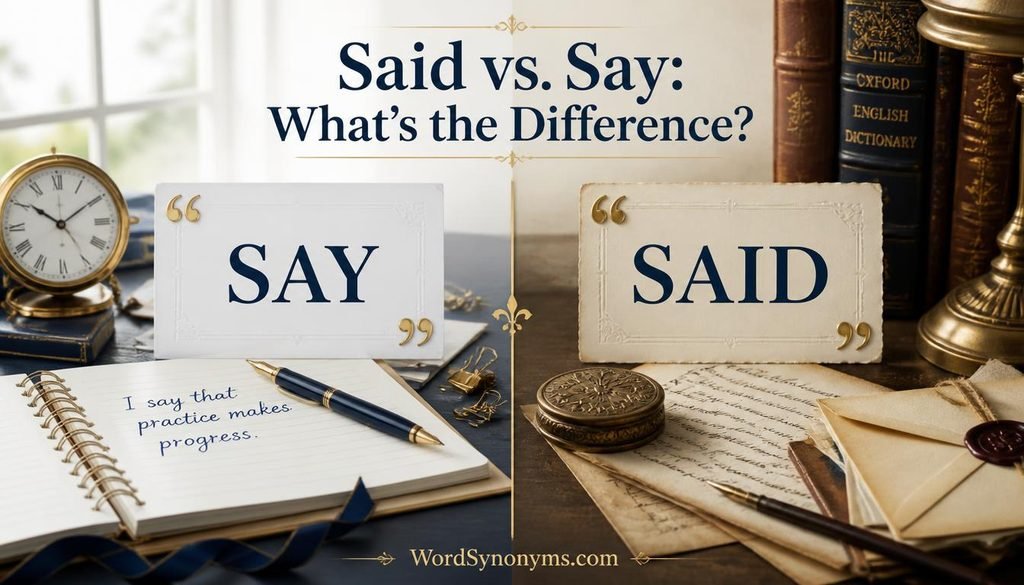
The main difference between said and say is grammatical tense and form.
Say is the base form of the verb. Said is its simple past tense and past participle.
| Say | Said |
| I say what I think. | I said what I thought. |
| She says hello every morning. | She said hello yesterday. |
| They say the road is closed. | They said the road was closed. |
| I will say something later. | I have said everything necessary. |
Use say when the sentence calls for the base form, including after modal verbs such as will, can, and should.
Use said when reporting a past statement or forming a perfect tense.
Compare these examples:
- Present: “He says he is ready.”
- Past: “He said he was ready.”
- Present perfect: “He has said he is ready.”
The correct choice depends on the sentence’s grammar and intended timeline.
“Said” vs. “Told”: What’s the Difference?
Although said and told both describe communication, they follow different grammatical patterns.
Said emphasizes the words or message expressed. Told commonly identifies the person who received the information.
Compare the following examples:
- She said she was tired.
- She said to me that she was tired.
- She told me that she was tired.
- She told me the truth.
All four sentences communicate information, but their structures differ.
| Pattern | Example | Correct? |
| Said + statement | He said he was busy. | Yes |
| Said + to + person | He said to me that he was busy. | Yes |
| Told + person + statement | He told me that he was busy. | Yes |
| Told + person + information | He told me the answer. | Yes |
| Said + person directly | He said me the answer. | No |
When Should You Use “Said”?
Use said when you want to report a statement without focusing on who received it.
For example, “The manager said the office would close early” sounds natural and direct.
You can include the listener by adding to:
“The manager said to us that the office would close early.”
However, the sentence often sounds smoother as “The manager told us that the office would close early.”
When Should You Use “Told”?
Use told when the person receiving the information matters.
Examples:
- My friend told me a secret.
- The teacher told the students to open their books.
- She told her parents that she had arrived safely.
Remember that tell can also introduce instructions or commands.
For example, “He told me to wait outside” is correct. You wouldn’t normally write “He said me to wait outside.”
“Said” vs. “Spoke”: What’s the Difference?
1. Said and spoke both relate to verbal communication, but they emphasize different things.
Said focuses on words or a message. Spoke often emphasizes the act of speaking, the language someone uses, or a conversation.
Examples:
- She said she needed help.
- She spoke to the manager about the problem.
- He said he knew the answer.
- He spoke French during the interview.
Use said when the specific statement matters. Use spoke when the communication itself or the language matters.
| Said | Spoke |
| She said she was leaving. | She spoke to her supervisor. |
| He said the answer was correct. | He spoke clearly during the presentation. |
| They said they were ready. | They spoke Spanish at home. |
The verbs also have different base forms: said comes from say, while spoke is the simple past of speak.
Their past participles differ too. You write “has said” and “has spoken,” not “has spoke.”
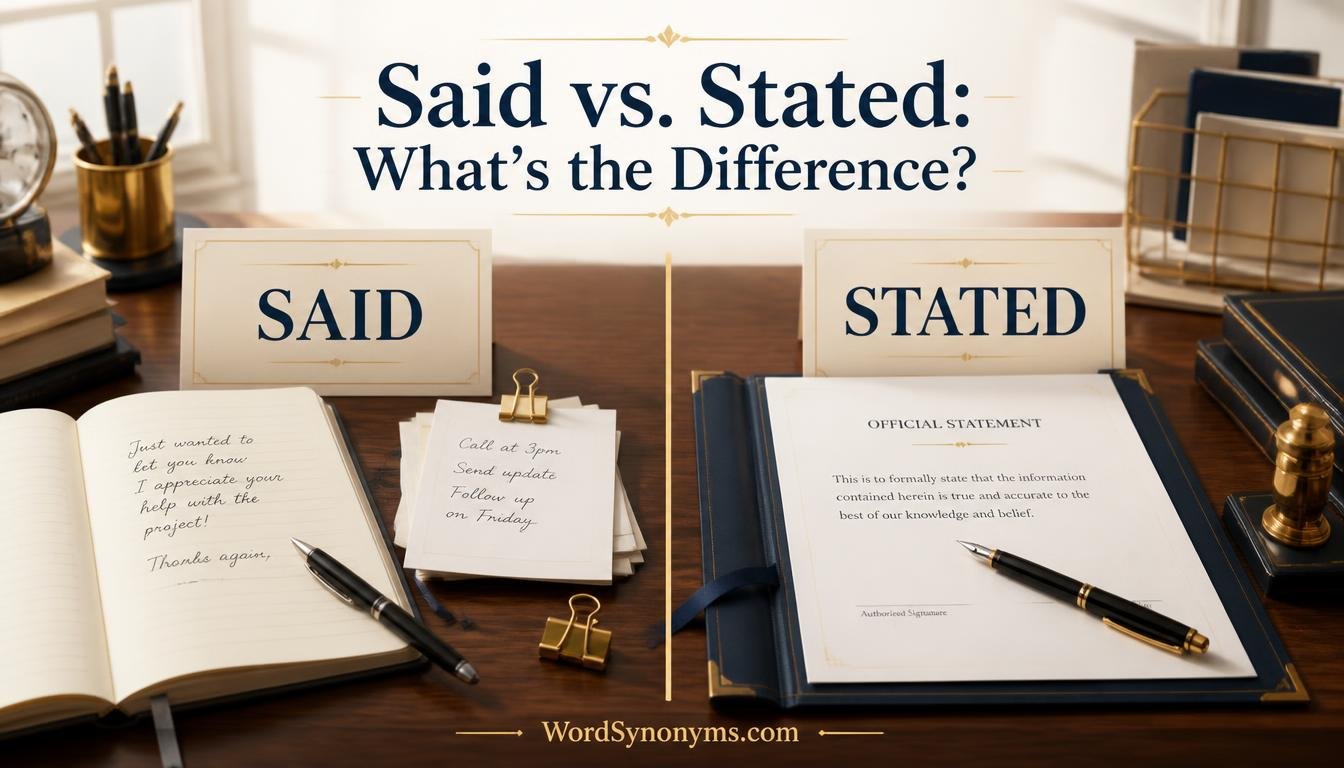
“Said” vs. “Stated”: What’s the Difference?
Both words can introduce information, but their tone and typical uses differ.
Said is a neutral, everyday reporting verb. Stated often sounds more formal and emphasizes that someone expressed a position, fact, or declaration explicitly.
Consider these examples:
- The manager said the deadline had changed.
- The manager stated that the deadline had changed.
- The report said the results were inconclusive.
- The report stated that the results were inconclusive.
Both versions can be correct. However, stated may suit a formal report, policy document, or official announcement better.
When Is “Stated” More Appropriate?
Use stated when the formality of the situation matters or when you want to emphasize an explicit declaration.
Examples:
- The contract states that payment is due within 30 days.
- The applicant stated that all information was accurate.
- The policy states that employees must follow safety procedures.
Notice that documents can state information directly. You don’t always need to write that a person said something.
When Is “Said” More Appropriate?
In most everyday conversations and general writing, said is the simpler option.
For example, “The teacher said the test would begin at ten” sounds natural. “The teacher stated that the test would begin at ten” sounds more formal.
Neither word is universally better. Choose the one that matches your tone and the context.
Common Grammar Mistakes With “Said”
Even experienced writers occasionally confuse said with other verb forms. These common errors are easy to fix once you understand the underlying rules.
Using “Sayed” Instead of “Said”
The past tense of say is irregular.
Incorrect: She sayed she was tired.
Correct: She said she was tired.
Because say doesn’t follow the regular -ed pattern, you must memorize its past form.
Writing “Did You Said?” Instead of “Did You Say?”
Questions with did require the base form of the main verb.
Incorrect: What did you said?
Correct: What did you say?
The same rule applies to negatives.
Incorrect: He didn’t said anything.
Correct: He didn’t say anything.
The auxiliary verb did already indicates past tense.
Using “Said” Instead of “Told”
Remember that said generally doesn’t take a person as its direct object in the same way as told.
Incorrect: She said me the answer.
Correct: She told me the answer.
You can also write, “She said the answer to me,” although “She told me the answer” usually sounds more natural.
Confusing Direct Speech With Reported Speech
Direct speech preserves the speaker’s exact words. Reported speech communicates the message indirectly.
Direct speech: Liam said, “I am hungry.”
Reported speech: Liam said that he was hungry.
The first sentence quotes Liam directly. The second reports his statement and adjusts the pronoun and tense to fit the new sentence.
Misplacing Quotation Marks and Commas
American English generally places commas and periods inside closing quotation marks.
Incorrect: “I am ready”, she said.
Correct: “I am ready,” she said.
Questions and exclamations follow their own punctuation needs:
- “Are you ready?” she asked.
- “I’m ready!” he exclaimed.
Use punctuation that reflects the quoted sentence’s structure.
Using the Adjective “Said” Too Often
Although “the said document” is grammatically acceptable, it often sounds unnecessarily formal.
Instead of writing “Please review the said document,” write “Please review the document.”
Clear writing doesn’t need legal-sounding language unless the context requires it.
Read more: Take Over vs. Takeover: Meaning and Difference
Synonyms for “Said”
Several verbs can replace said, but no synonym fits every situation. The right choice depends on the speaker’s intention, tone, and manner of communication.
Common Synonyms for “Said”
| Synonym | Meaning or use | Example |
| Told | Communicated information to someone | She told me the news. |
| Mentioned | Referred to something briefly | He mentioned the deadline. |
| Replied | Responded to someone | She replied that she was busy. |
| Answered | Responded to a question | He answered that he was ready. |
| Added | Provided extra information | She added that more time was needed. |
These words help you avoid repetition while preserving the intended meaning.
Formal Synonyms for “Said”
Formal reporting often benefits from a more specific verb.
| Synonym | Typical meaning | Example |
| Stated | Expressed something explicitly | The report stated that costs had increased. |
| Declared | Announced a position or decision | The committee declared the proposal approved. |
| Announced | Shared news publicly or formally | The company announced a new policy. |
| Reported | Presented information or findings | The agency reported a rise in demand. |
| Asserted | Expressed a claim firmly | The witness asserted that the statement was accurate. |
These alternatives aren’t interchangeable in every situation. For example, announced often suggests sharing news, while asserted emphasizes a firmly expressed claim.
Synonyms That Express Emotion or Intent
Sometimes, the way someone speaks matters more than the words themselves.
| Synonym | Meaning | Example |
| Whispered | Spoke very quietly | She whispered that the baby was asleep. |
| Shouted | Spoke very loudly | He shouted that the door was open. |
| Suggested | Put forward an idea | She suggested taking another route. |
| Explained | Made something easier to understand | He explained why the plan had changed. |
| Admitted | Acknowledged something, often reluctantly | She admitted that she had made a mistake. |
Choose a reporting verb that reflects what actually happened. If someone merely made a statement, said may be more accurate than a synonym that implies emotion, disagreement, or certainty.
Case Studies: Choosing “Said” Correctly
Looking at practical situations makes the grammar easier to remember. These examples show how a small verb choice can affect clarity and tone.
Case Study: A Workplace Conversation
Imagine a supervisor tells an employee that a deadline has changed.
Original statement: “The report is due Friday.”
A natural report of the conversation would be:
“The supervisor said the report was due Friday.”
You could also write, “The supervisor told the employee that the report was due Friday.”
Both sentences are correct. The second identifies the recipient of the information, which may matter in a workplace record.
However, “The supervisor said the employee the deadline” is incorrect because said doesn’t follow the same direct-object pattern as told.
Case Study: Reporting a News Statement
Suppose a company spokesperson says that a service will return the following morning.
You might write:
“The spokesperson said the service would return the next morning.”
This sentence reports the statement without claiming that the service actually returned. That distinction matters in journalism and professional communication.
If the spokesperson formally confirmed the restoration time, confirmed might be appropriate. However, that verb should only be used when the context supports it.
Case Study: Writing Dialogue in a Story
Consider a short conversation between two characters.
“Are we leaving now?” Emma asked.
“Yes,” Daniel said. “The train arrives in twenty minutes.”
The dialogue tags help readers follow the exchange. The first identifies Emma’s question, while the second attributes Daniel’s response.
You don’t need to replace every instance of said with an unusual synonym. Clear dialogue often benefits from simple, unobtrusive tags.
FAQs
1. What does “said” mean in English grammar?
In English grammar, said is the past tense and past participle of say. It can also function as an adjective meaning “aforementioned” in formal legal and business writing.
2. Is “said” an adjective or a verb?
Said can be both. As a verb, it describes something someone expressed, such as “She said hello.” As an adjective, it refers to something already mentioned, as in “the said agreement.”
3. What does “the said” mean in legal documents?
In legal documents, the said refers to a person, object, or matter previously identified in the text. For example, “The said property belongs to the buyer” refers to property already discussed.
4. Is “said” a formal word?
Yes, said is formal when used to mean “aforementioned.” You’ll often find it in contracts, legal notices, and official documents. In everyday writing, simpler expressions usually sound more natural.
5. What is the difference between “said” and “aforesaid”?
Both words can refer to something mentioned earlier. Said is shorter and generally more familiar, while aforesaid sounds more traditional and formal. Both appear in legal and business contexts.
6. Can I remove “said” from a sentence?
Yes, when the word adds no useful information. For example, “the said document” can often become “the document” without changing the meaning. Removing unnecessary words makes your writing clearer and easier to understand.
Conclusion
Understanding the different uses of said helps you write with greater confidence. As a verb, it describes something someone expressed, while as an adjective, it refers to a person or thing mentioned earlier. You’ll mainly encounter the adjective form in legal documents, contracts, and formal business writing. Although this usage is grammatically correct, it can sound stiff in everyday communication.
When you write, consider your audience and purpose before choosing formal expressions. Often, replacing said with a simple phrase or removing it entirely makes your sentences clearer. The goal isn’t to use complicated vocabulary but to communicate your meaning naturally and accurately.

Syeda Naalain Zahra is a content writer with an interest in English vocabulary and language. She creates simple and informative articles about synonyms, antonyms, word meanings, and everyday English usage. Her aim is to help readers build better vocabulary and communicate more confidently.