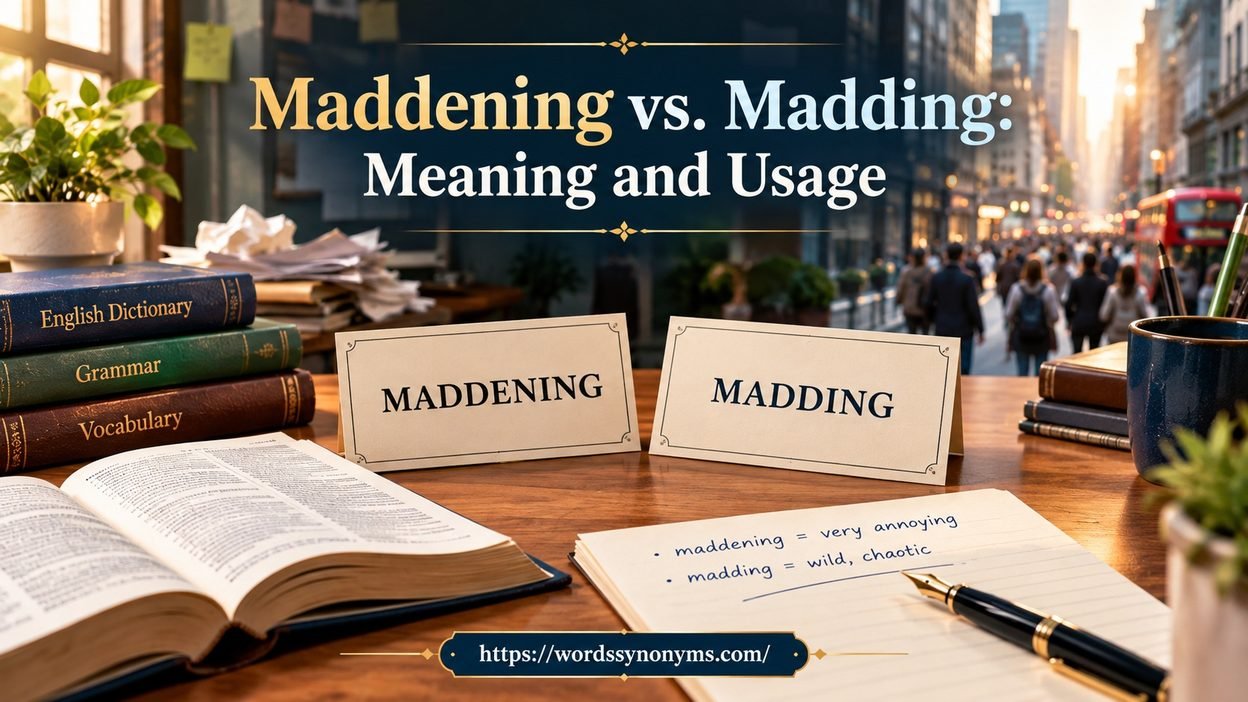
Maddening vs. Madding: Meaning and Usage explains why one word describes frustration while the other belongs to an older expression about crowds.
Crowds can cause noise, confusion, and frustration. In modern English, maddening is an adjective and descriptive word for something that annoys you. However, the traditional form of the idiom is madding crowd, a traditional expression and idiomatic phrase. The archaic word madding has an archaic sense of being frenzied or behaving wildly.
A frenzied crowd suggests restless behavior and chaotic behavior, rather than simply describing something as annoying. This phrase meaning reflects its historical usage and offers linguistic context for understanding the English expression.
When comparing madding vs. maddening, the main vocabulary distinction involves word usage, contextual meaning, and semantic meaning. In contemporary English, madding rarely appears outside this idiom; writers generally choose other words elsewhere.
For example, a noisy gathering may be a maddening crowd if it frustrates you, while madding crowd refers to the established literary expression. From an editorial perspective, the correct expression depends on the intended meaning and tone.
This usage difference shows how English vocabulary, English grammar, language usage, and word choice shape clear writing. Understanding word replacement and idiom usage helps readers distinguish a modern adjective from an older expression.
Quick Answer
The simplest way to distinguish these words is to consider what you want to describe. Use maddening when something makes you feel frustrated. Use madding when discussing a literary description of frenzied activity or a crowd.
| Feature | Maddening | Madding |
| Part of speech | Adjective | Adjective |
| Main meaning | Extremely annoying or frustrating | Becoming frenzied or associated with madness |
| Modern usage | Common | Rare |
| Typical context | Everyday speech and writing | Literary or poetic writing |
| Common examples | Maddening delay, maddening noise | The madding crowd |
| Tone | Conversational and expressive | Literary and old-fashioned |
| Best use | Describing something frustrating | Referring to frenzy in an appropriate literary context |
Quick rule: If something annoys you, call it maddening. If you’re discussing the traditional literary phrase the madding crowd, retain madding.
What Does Maddening Mean?
The word maddening describes something that causes intense irritation, frustration, or anger. It expresses a stronger reaction than ordinary annoyance and often suggests that a situation tests someone’s patience.
For example, imagine waiting for an important email that never arrives. You’ve checked your inbox repeatedly, but nothing appears. You might describe the endless wait as maddening.
The word works in many everyday situations, including workplace problems, technical difficulties, confusing instructions, and irritating habits.
Maddening Definition and Meaning
Maddening is an adjective formed from the verb madden and the suffix -ing. The verb madden means to make someone angry, frustrated, or frantic.
When you describe something as maddening, you emphasize the effect it has on a person. The situation itself may be small, but its repeated or persistent nature can make it especially frustrating.
Consider these examples:
- The maddening delay forced us to reschedule the meeting.
- His maddening habit of interrupting made conversations difficult.
- I spent an hour trying to solve that maddening computer problem.
- The instructions were so maddeningly unclear that nobody knew what to do.
- It was maddening to discover that I had forgotten my keys again.
Notice how maddening describes the source of frustration rather than simply naming the emotion.
You could say, “I was angry about the delay.” However, “The delay was maddening” focuses on the situation that caused your frustration.
How Maddening Works in a Sentence
The adjective maddening commonly appears before a noun or after a linking verb such as be, seem, or become.
Before a noun:
- The maddening noise continued throughout the night.
- We faced a maddening series of technical errors.
- She found his maddening behavior difficult to tolerate.
After a linking verb:
- The constant interruptions were maddening.
- Waiting for the final decision became maddening.
- The entire situation seemed maddening.
You can also use maddeningly, the adverbial form, to describe how something happens or appears.
For example, “The website loaded maddeningly slowly.” Here, maddeningly modifies slowly and emphasizes how frustrating the delay felt.
Synonyms for Maddening
Several English words express meanings similar to maddening. However, their emotional intensity and typical contexts can differ.
| Synonym | Meaning | Example |
| Annoying | Causing irritation | The annoying sound kept distracting me. |
| Frustrating | Making something difficult or preventing progress | The frustrating error stopped the installation. |
| Irritating | Causing discomfort or displeasure | His irritating habit disrupted the meeting. |
| Exasperating | Making someone increasingly impatient | Her exasperating delays tested everyone’s patience. |
| Infuriating | Causing intense anger | The infuriating decision affected the entire team. |
| Aggravating | Making a problem or situation more troublesome | The aggravating delay made us late. |
| Vexing | Causing worry, confusion, or annoyance | The vexing question remained unanswered. |
Maddening often falls between general irritation and intense exasperation, depending on context. If something makes you furious, infuriating may be more precise. If it simply gets on your nerves, annoying may be enough.
What Does Madding Mean?
The word madding is an uncommon adjective associated with becoming mad, frenzied, or wildly excited. Unlike maddening, it doesn’t usually describe an irritating situation in contemporary English.
Instead, madding appears mainly in literary contexts, especially in the expression the madding crowd. This phrase evokes the noise, confusion, bustle, or frantic activity associated with crowds and busy social life.
You may encounter the word in poetry, literary criticism, historical writing, or discussions of older English expressions.
Madding Definition and Origin
Madding comes from the verb madden, with the suffix -ing. In its traditional literary sense, it conveys the idea of becoming frantic or behaving as though driven by madness.
The distinction depends on how the word functions:
- Maddening: Something causes frustration or irritation.
- Madding: Something is becoming frenzied or is associated with frenzy in a literary sense.
Modern writers rarely use madding as a general replacement for maddening. For example, “The madding delay frustrated us” sounds unnatural if you simply mean that the delay was irritating.
The word’s survival in familiar literary language makes it worth recognizing, even though most everyday conversations don’t require it.
What Does “The Madding Crowd” Mean?
The phrase the madding crowd is best known from Thomas Gray’s poem Elegy Written in a Country Churchyard, published in 1751.
Gray uses the expression in a passage contrasting a quiet rural setting with the restless world of public life. The phrase became a lasting literary expression for the bustle, pressures, and distractions of society.
In everyday explanations, the madding crowd often refers to a noisy, busy, or hectic social environment. It can also suggest the demands and distractions that come with public attention or city life.
For example:
- After months in the city, he longed to escape the madding crowd.
- She preferred a quiet cottage far from the madding crowd.
- The writer left the busy capital to find peace away from the madding crowd.
In each sentence, the phrase suggests a contrast between a hectic social world and a quieter place.
Important distinction: The expression doesn’t necessarily mean that every person in a crowd is literally impulsive. Instead, it uses literary language to convey the intensity and restlessness of crowded social life.
Madding in a Sentence
Because madding is rare in modern English, writers should use it carefully. Its meaning is clearest when the surrounding context supports a literary or poetic tone.
Examples include:
- The poet sought solitude far from the madding crowd.
- He escaped the madding streets to enjoy the silence of the countryside.
- Her retreat offered peace from the madding rush of public life.
The first example uses the established expression directly. The other examples extend its traditional sense to describe hectic surroundings.
However, these constructions can sound old-fashioned or deliberately poetic. In ordinary writing, alternatives such as hectic, frantic, crowded, or chaotic may communicate the intended meaning more naturally.
For example, instead of writing, “The madding city streets overwhelmed her,” you could write, “The city’s chaotic streets overwhelmed her.”
Both sentences convey a busy environment, but the second sounds more natural in contemporary prose.
Read more: Stadia vs. Stadiums: Which Plural Form Is Correct?
Maddening vs. Madding: Key Differences Explained
Although these words share the same root, their meanings aren’t entirely interchangeable. Understanding their differences makes it easier to choose the right word for your audience.
Difference in Meaning
The main difference lies in what each adjective describes.
Maddening emphasizes the effect something has on a person. It tells readers that a situation, behavior, or experience causes frustration.
Madding traditionally emphasizes frenzy or wild activity. It often describes the restless atmosphere of crowds or busy social environments.
Compare these sentences:
- The maddening traffic made us miss the appointment.
- He moved to the countryside to escape the madding crowd.
The first sentence describes traffic that causes frustration. The second describes a busy social world from which someone wants distance.
Difference in Grammar
Both words can function as adjectives, but their grammatical roles reflect different meanings and usage patterns.
| Grammatical feature | Maddening | Madding |
| Attributive adjective | A maddening mistake | The madding crowd |
| Predicative adjective | The delay was maddening. | The word sounds literary in this context. |
| Common collocations | Maddening noise, delay, habit, problem | Madding crowd, madding streets |
| Typical register | Everyday English | Literary or archaic English |
An attributive adjective appears before a noun, as in “a maddening problem.” A predicative adjective follows a linking verb, as in “the problem was maddening.”
You can use maddening in both positions naturally. By contrast, madding has a much narrower range in contemporary English.
Difference in Modern Usage
In everyday American English, maddening is the natural choice when describing something that causes frustration. You might use it in a conversation, an email, a review, or a workplace report.
Madding appears far less often outside literary expressions. Dictionaries identify it as a literary or archaic adjective, particularly in the phrase far from the madding crowd.
For example:
- Natural: The maddening delay affected our entire schedule.
- Literary: They lived far from the madding crowd.
- Unnatural for the intended meaning: The madding delay affected our schedule.
The final example isn’t impossible in every historical or poetic context. However, if you mean that a delay is frustrating, maddening communicates that idea much more clearly.
Difference in Tone and Context
Word choice affects not only meaning but also the mood of your writing.
Maddening sounds direct and emotionally expressive. It works well when you want readers to understand how irritating something feels.
Madding sounds more literary and can evoke an older style of writing. It may suit poetry, literary analysis, or a deliberate reference to traditional English expressions.
Consider these examples:
- “The maddening noise kept everyone awake.” This sounds like ordinary conversation.
- “She sought refuge far from the madding crowd.” This sounds more literary and reflective.
Neither style is automatically better. The right choice depends on your purpose, audience, and intended tone.
Maddening vs. Madding Examples
Examples make the distinction easier to remember because they show how each word behaves in context.
Examples of Maddening in Sentences
Here are eight examples of maddening in everyday American English.
- The maddening traffic added forty minutes to our journey.
- His maddening habit of arriving late frustrated the entire team.
- I found the website’s constant error messages absolutely maddening.
- The maddening silence made everyone wonder what had happened.
- She faced a maddening series of delays while completing the paperwork.
- It was maddening to lose the document after working on it all afternoon.
- The instructions were maddening because they contradicted each other.
- Waiting for a simple answer became a maddening experience.
In each sentence, maddening describes something that causes irritation, impatience, or frustration.
Notice that the word doesn’t require a major problem. Even a small inconvenience can become maddening when it persists or repeatedly interrupts your plans.
Examples of Madding in Sentences
The following examples demonstrate the literary meaning of madding.
- They built a secluded home far from the madding crowd.
- The poet longed for silence beyond the madding city’s restless streets.
- He left public life behind to escape the madding crowd.
- The quiet village offered shelter from the madding rush of urban life.
- She preferred the solitude of the mountains to the madding world below.
The first and third examples use the established expression or its familiar construction. The other examples adopt a more poetic tone.
In ordinary informational writing, you could replace madding with hectic, frantic, or chaotic. Those alternatives sound more familiar to most modern readers.
Incorrect or Unnatural Usage of Maddening and Madding
Confusion usually occurs when writers treat these words as interchangeable.
Here are some examples that show the difference.
| Awkward or incorrect choice for the intended meaning | Better choice | Reason |
| The madding delay ruined our plans. | The maddening delay ruined our plans. | Maddening describes frustration. |
| His madding habit annoyed everyone. | His maddening habit annoyed everyone. | The sentence describes an irritating habit. |
| The madding instructions confused me. | The maddening instructions confused me. | The intended meaning concerns frustration. |
| She escaped the maddening crowd. | She escaped the madding crowd. | The madding crowd is the established literary expression. |
The last example deserves special attention. Writers sometimes use maddening crowd because the crowd seems irritating. However, the traditional expression is the madding crowd, especially in the phrase far from the madding crowd.
If you want to describe a crowd that irritates you, you can still write something like, “The maddening crowd noise made it difficult to concentrate.” Here, maddening describes the effect of the noise rather than reproducing the literary expression.
Why Do People Confuse Maddening and Madding?
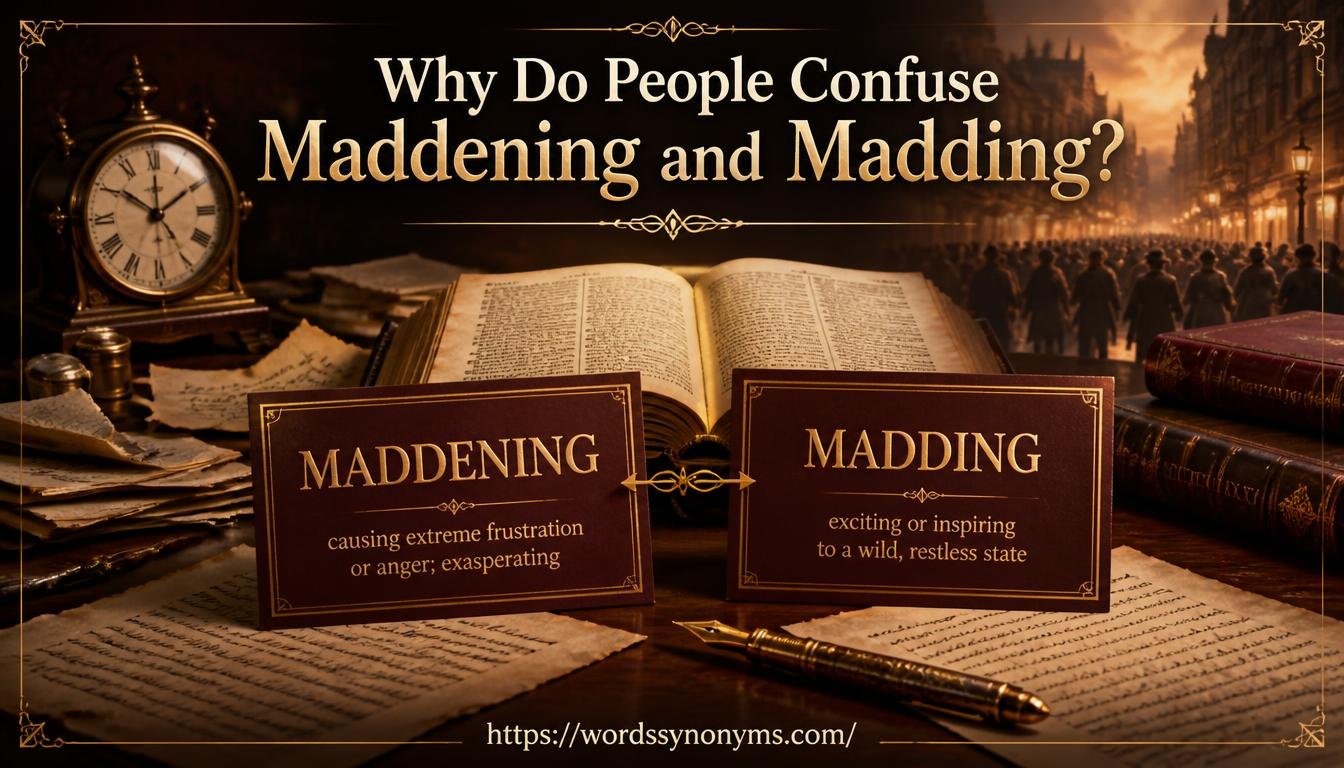
The confusion makes sense. Both words look similar, share a linguistic root, and relate to the idea of madness.
However, their meanings have developed into different patterns of use.
Their Shared Root
Both words relate to mad and the verb madden. In contemporary English, mad can mean angry or mentally unwell, depending on the context and variety of English.
The verb madden means to make someone angry or frantic, or to cause someone to become mad. Adding -ing creates forms that can describe an ongoing action or its effect.
For example:
- Madden: Repeated delays madden the passengers.
- Maddening: The repeated delays are maddening.
- Madding: The madding crowd filled the streets with restless activity.
The first sentence uses a verb. The second uses an adjective to describe the delays. The third uses a literary adjective to describe a crowd.
The Role of the -ing Suffix
English often uses -ing to form present participles and adjectives. However, words with the same suffix don’t always carry identical meanings.
Consider the difference between confusing and confused. The first describes something that causes confusion, while the second describes the person experiencing it.
Similarly, maddening usually emphasizes the effect something has on someone. Madding, in its familiar literary sense, emphasizes frenzied behavior or activity.
This distinction offers a useful clue, but context still matters. Dictionary definitions also record a less common sense of madding meaning “making mad” or “maddening.”
Read more: Take Over vs. Takeover: Meaning and Difference
How to Choose Between Maddening and Madding
Choosing the right word becomes simple when you identify the meaning you want to convey.
Use Maddening for Frustrating Situations
Choose maddening when something annoys, irritates, or exasperates you.
It works particularly well with nouns that describe repeated problems, delays, or unwanted behavior.
Common combinations include:
- Maddening delays
- Maddening mistakes
- Maddening noise
- Maddening behavior
- Maddening confusion
- Maddening uncertainty
- Maddening interruptions
- Maddening technical problems
For example, you could write, “The maddening uncertainty surrounding the deadline made planning difficult.”
This sentence clearly communicates the emotional effect of not knowing when something will happen.
Use Madding in Literary Contexts
Choose madding when you’re discussing a literary expression or intentionally adopting a poetic tone.
The most familiar example is far from the madding crowd, which describes a place away from the bustle and turmoil of social life.
For example, “After years in the city, he settled in a quiet village far from the madding crowd.”
The phrase creates a particular atmosphere. It suggests more than physical distance; it can also imply relief from public pressure, social competition, and constant activity.
If you’re writing a straightforward travel article, however, “a quiet village away from the crowds” might be clearer.
An Easy Memory Trick
Remember this simple distinction:
- Maddening makes you mad. It describes something frustrating or infuriating.
- Madding belongs mainly to literary language. Think of the madding crowd.
You can also ask yourself one question: Am I describing frustration or a frenzied social environment?
If you’re describing frustration, maddening will usually fit. If you’re referring to the established literary expression, use madding.
A Practical Case Study
Imagine you’re writing about a traveler who leaves a crowded city for a peaceful mountain village.
You want to describe three things: the traffic, the noisy streets, and the traveler’s desire for solitude.
Sentence one: Describing traffic
“The maddening traffic delayed the traveler for hours.”
Why it works: The traffic causes frustration.
Sentence two: Describing the city
“The city’s chaotic streets remained crowded long after sunset.”
Why it works: Chaotic gives a clear, modern description without forcing a literary word into the sentence.
Sentence three: Describing the escape
“He finally found peace far from the madding crowd.”
Why it works: The established phrase conveys a retreat from the hectic world.
Together, these sentences show how the two words can serve different purposes within the same piece of writing.
Related Words and Forms
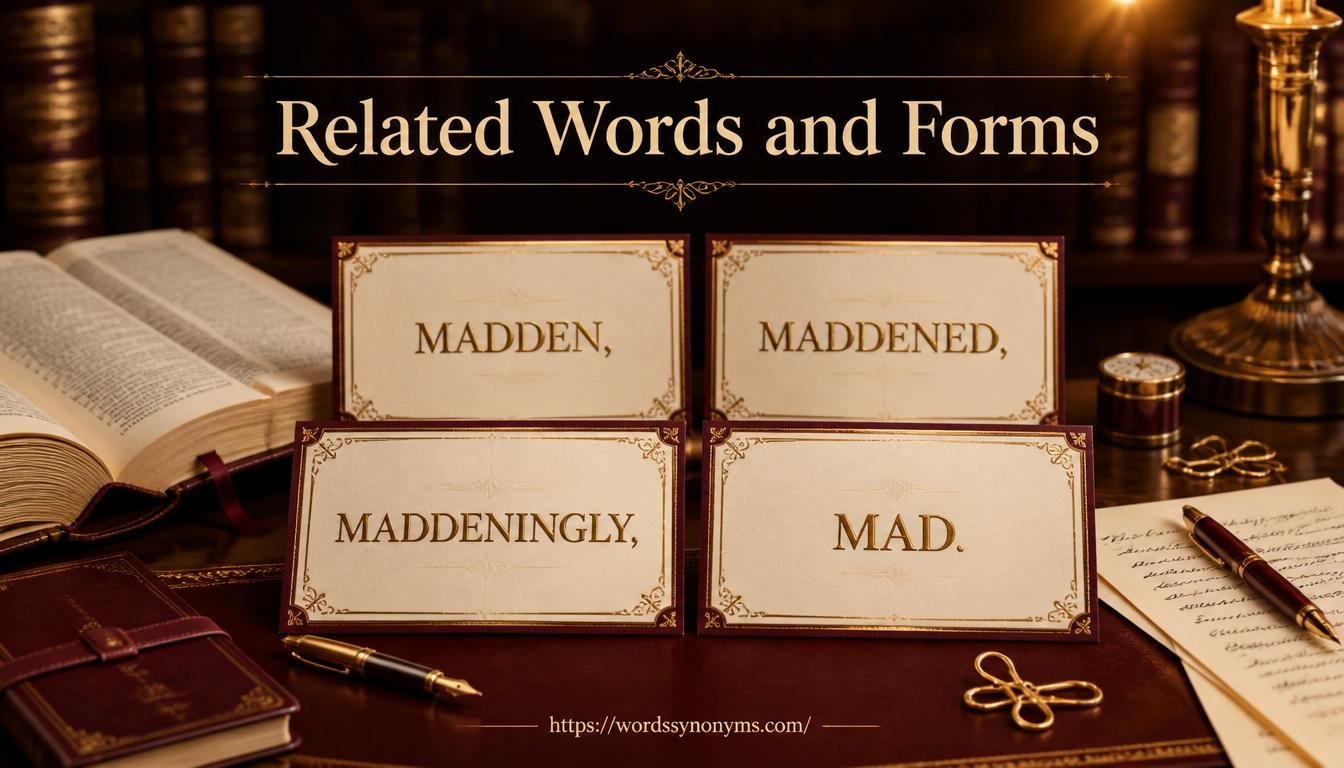
Understanding related words helps you recognize how maddening and madding fit into the wider English vocabulary.
Madden
Madden is a verb meaning to make someone angry or frustrated, or to drive someone into a frenzy.
Examples:
- Constant interruptions madden her.
- The unfair decision maddened the employees.
- It maddens me when people ignore clear instructions.
The verb focuses on the action or effect that produces the reaction.
Maddened
Maddened is the past tense and past participle of madden. It can also function as an adjective describing someone who has become extremely angry or frantic.
Examples:
- The repeated failures maddened the team.
- He was maddened by the unfair treatment.
- The maddened crowd surged toward the gates.
The meaning depends on the sentence. In the first example, maddened describes a completed action. In the third, it describes the crowd’s agitated state.
Maddeningly
Maddeningly is the adverb formed from maddening. It describes an action, quality, or situation in a way that emphasizes frustration.
Examples:
- The application loaded maddeningly slowly.
- The answer remained maddeningly vague.
- He was maddeningly calm during the argument.
The word adds an emotional judgment to the description. It tells readers that the slow loading, vague answer, or calm behavior frustrates the speaker.
Mad
Mad has several meanings in American English. It commonly means angry, although it can also mean mentally unwell or wildly enthusiastic in informal expressions.
Examples:
- I’m mad about the delay.
- The maddening noise made everyone impatient.
- She is mad about classical music.
In the first example, mad means angry. In the third, mad about means very enthusiastic or passionate about something.
Because mad has several meanings, context is essential. The same word can describe anger, excitement, or other states depending on how you use it.
FAQs
1. What is the difference between maddening and madding?
Maddening describes something that causes annoyance or frustration. Madding is an old-fashioned word mainly found in the phrase “madding crowd,” which suggests a wild, restless crowd.
2. What does the phrase “madding crowd” mean?
A madding crowd refers to a noisy, restless, or frenzied group of people. The phrase is often used in literary contexts to describe the busy, chaotic nature of society.
3. Is maddening a modern English word?
Yes, maddening is a common adjective in modern English. You can use it to describe anything that makes you feel irritated, such as a persistent noise, a long delay, or a frustrating situation.
4. Is madding still used in everyday English?
No, madding is rarely used in everyday conversation. Most people encounter it in the traditional expression “madding crowd” or in literary writing.
5. Can I write “maddening crowd” instead of “madding crowd”?
Yes, but the meanings differ slightly. Maddening crowd describes a crowd that annoys or frustrates you, while madding crowd is the established literary expression for a restless or frenzied crowd.
6. Is “madding crowd” grammatically correct?
Yes, madding crowd is grammatically correct as a traditional expression. Although madding is archaic, the phrase remains recognizable in literary and formal contexts.
Conclusion
Understanding maddening vs. madding becomes easier when you focus on how each word works in a sentence. Use maddening for something that irritates, frustrates, or tests your patience. Reserve madding crowd for the traditional expression describing a restless, frenzied crowd.
Although madding rarely appears in everyday English, it still has a place in literature and familiar expressions. When choosing between these words, consider your meaning and audience. The right word makes your writing clearer and helps you avoid an awkward or outdated expression where a simple, modern alternative would work better.

Samreen Saif is a passionate writer and language enthusiast who contributes informative and engaging content to WordsSynonyms.com. She enjoys exploring English vocabulary, synonyms, antonyms, word meanings, and language usage to help readers understand and use words with confidence.
Samreen focuses on creating clear, accurate, and easy-to-read content for students, writers, professionals, and English learners. Through her articles, she aims to make vocabulary learning simple, practical, and useful for everyday communication.
When she is not writing, Samreen enjoys learning about language, discovering new words, and creating helpful content that makes English learning more accessible to everyone.