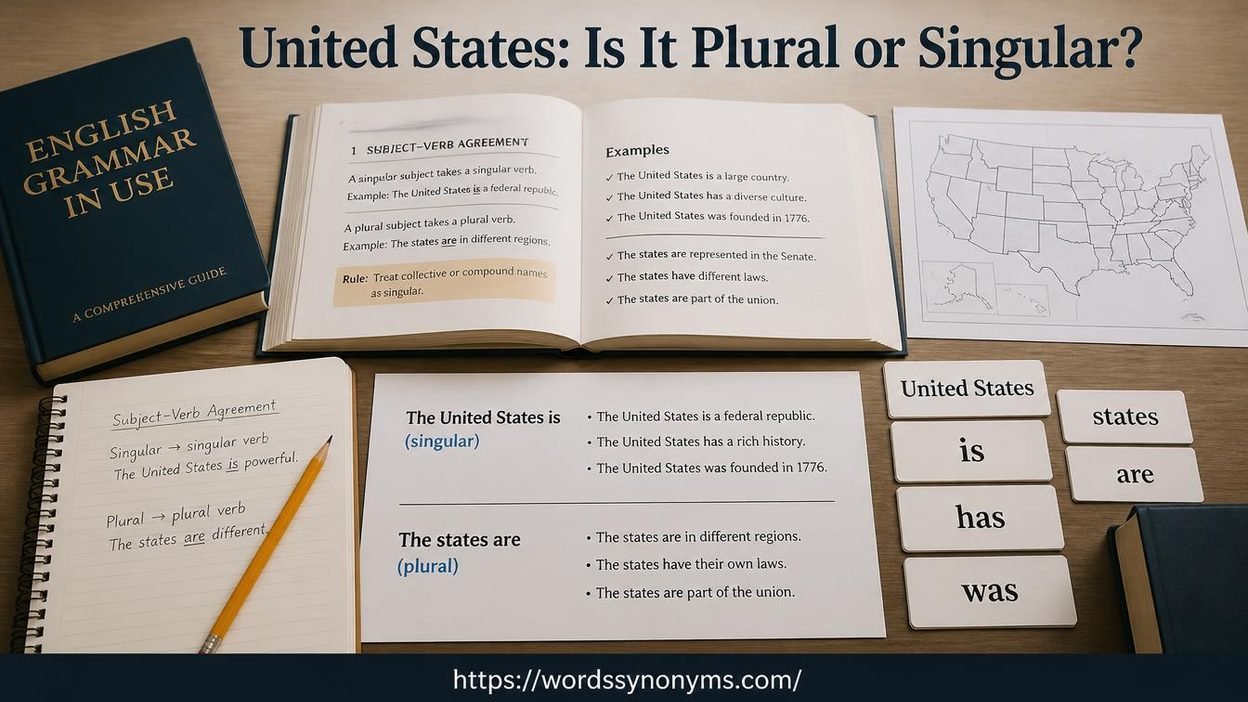
In United States: Is It Plural or Singular?, the name is a singular noun, although its plural form can make the grammar seem confusing to readers. The United States is the name of a country and is treated as singular, so United States is correct with singular verb forms.
For example, “The United States is in the Western Hemisphere” works, but “The United States are in the Western Hemisphere” does not. Although the word states has a plural appearance, the full expression refers to one nation and therefore takes singular verb forms.
The same pattern applies to England, China, and Bahrain, which are singular nouns when they identify countries.
In my experience, thinking of the United States simply as one country makes this rule much easier to remember. Its usage has been standard for more than a century, so the grammatical rule is firmly established.
Quick Answer
“The United States” is singular when it refers to the country.
Use:
- The United States is
- The United States has
- The United States was
- The United States does
- The United States can
- The United States and its…
Use plural agreement when you change the subject to the states:
- The states are
- The states have
- The states were
- The states do
- The states and their…
The easiest rule is simple:
One country = singular. Individual states = plural.
Even though States looks plural, the United States is one nation in modern English grammar.
Is “United States” Singular or Plural?
The United States is singular when it refers to the country.
Although states has a plural form, the United States names one nation. Therefore, modern American English normally uses singular verbs and pronouns with it.
Consider these examples:
- The United States is a federal republic.
- The United States has 50 states.
- The United States was founded as an independent nation.
- The United States does not have a federal official language.
- The United States announced its decision.
The pattern is consistent. When the phrase means the country as a whole, use is, has, was, does, and its.
The confusion comes from the grammatical appearance of the name. States is plural in form, but the complete proper name has singular meaning.
A useful comparison is the Philippines. The name looks plural, yet it refers to one country. Similarly, the United States refers to one country even though its name contains the plural noun states.
The Basic Rule
Remember this simple rule:
When “the United States” means the country, treat it as singular.
For example:
Correct: The United States is one of the world’s largest economies.
Incorrect: The United States are one of the world’s largest economies.
The distinction becomes especially important when you choose between is/are, has/have, was/were, and does/do.
Why Does “United States” Look Plural?
The answer lies in the meaning of the word states.
A state is a political subdivision. The United States contains 50 states, including California, Texas, Florida, New York, and many others.
The country’s name originally emphasized those separate political units. In other words, the expression described states that had united.
That structure explains why the name still looks plural:
United + States
The word united describes the relationship among the states. The states themselves remain plural.
However, the full name doesn’t simply mean “several states.” It identifies one sovereign country.
Think of the difference this way:
| Expression | What it refers to | Number |
| a state | One state | Singular |
| states | More than one state | Plural |
| the states | Multiple individual states | Plural |
| the United States | One country | Singular |
| the United States government | One national government | Singular |
This distinction prevents most agreement errors.
You can say:
The states are different in many ways.
Here, states genuinely refers to multiple political units.
But you would say:
The United States is made up of 50 states.
Here, the United States refers to one country.
The two uses sit comfortably in the same sentence because they perform different grammatical roles.
Why Does “The United States” Take a Singular Verb?
A proper name can have a plural-looking form while referring to one entity.
That’s exactly what happens with the United States.
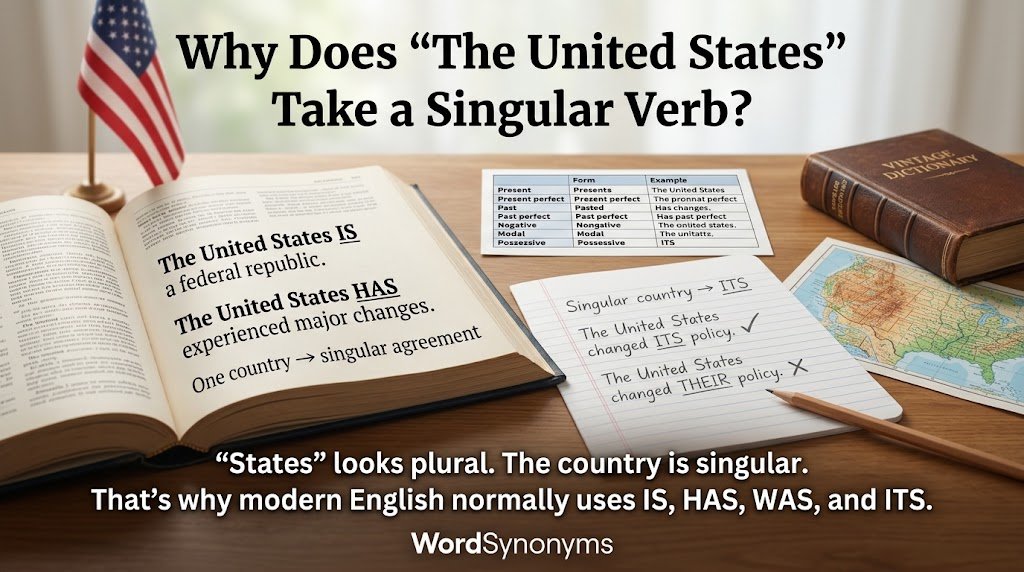
When the phrase serves as the subject of a sentence, the verb agrees with the entity being named. The country acts as one nation in the sentence, so modern English normally uses singular agreement.
For example:
The United States has a federal system of government.
The subject isn’t the 50 states acting separately. It’s the country as a whole.
Likewise:
The United States is located in North America.
The country occupies one geographic and political position. The singular verb makes that relationship clear.
This principle also explains why we use its rather than their when referring to the country:
The United States changed its policy.
Not:
The United States changed their policy.
The plural-looking States doesn’t change the grammatical behavior of the complete country name.
Singular Agreement in Different Tenses
The rule applies across different verb forms.
| Tense or construction | Correct example |
| Present | The United States is a federal republic. |
| Present perfect | The United States has experienced major changes. |
| Past | The United States was involved in the conflict. |
| Past perfect | The United States had already established diplomatic relations. |
| Negative | The United States does not have a parliamentary system. |
| Modal | The United States can influence international affairs. |
| Possessive | The United States has announced its position. |
Notice that modal verbs such as can don’t visibly distinguish singular from plural. The distinction becomes obvious with verbs such as is/are and has/have.
“The United States Is” or “The United States Are”?
In contemporary American English, “The United States is” is the standard choice when referring to the country.
Examples include:
- The United States is a federal republic.
- The United States is located between Canada and Mexico.
- The United States has 50 states.
- The United States has a federal government.
- The United States was one of the founding members of the United Nations.
- The United States does not have a single official language at the federal level.
By contrast, “The United States are” sounds archaic or historically marked in modern American writing.
That doesn’t mean the plural construction never existed. It did.
The interesting part is that the singular form became increasingly dominant over time.
Can “The United States” Ever Take a Plural Verb?
Historically, yes.
In earlier American English, writers sometimes treated the United States as a plural collection of states. They could therefore write sentences using plural verbs.
For example, older texts might use constructions such as:
The United States are responsible…
Today, that wording generally sounds old-fashioned.
Historical research shows that both singular and plural agreement appeared during earlier periods. The shift toward singular agreement developed over time rather than occurring through one simple grammatical event. Scholars have also connected the changing usage with changing ideas about national sovereignty and the relationship between the individual states and the federal nation.
So, the common story that the Civil War instantly transformed “are” into “is” makes a memorable linguistic anecdote. The actual history is more gradual.
By the late 19th century, singular agreement had become increasingly common, and modern English settled firmly on the singular form for ordinary references to the country.
Historical Grammar Was Different
Older documents can therefore surprise modern readers.
You might encounter:
- The United States are…
- The United States have…
- The United States were…
Those examples shouldn’t automatically be labeled grammatical errors.
Instead, consider their historical context.
Language changes as speakers’ understanding of institutions changes. The grammatical treatment of the United States provides a fascinating example because the name itself refers to a union of political units.
Modern writers don’t normally need to imitate historical usage. For contemporary American English, singular agreement is the safe and standard choice.
The Difference Between “The United States” and “The States”
Here’s where the distinction becomes especially useful.
The United States refers to the country.
The states refers to multiple individual states.
Compare these sentences:
The United States is a federal republic.
The states are responsible for many areas of government.
The first sentence has a singular subject.
The second has a plural subject.
You can also combine both ideas:
The United States is divided into 50 states, and the states are not identical in their laws.
The grammar changes because the meaning changes.
| Phrase | Meaning | Correct agreement |
| The United States | One country | Singular |
| The states | Multiple states | Plural |
| Individual states | Separate states | Plural |
| A state | One state | Singular |
| The United States government | National government | Singular |
| State governments | Multiple governments | Plural |
This distinction is more useful than simply memorizing “United States takes a singular verb.”
You want to understand why the verb changes.
Examples of Singular Agreement With “The United States”
The easiest way to master the rule is to see it in different contexts.
Present-Tense Examples
Use is, has, and does when the country functions as the subject.
- The United States is a constitutional federal republic.
- The United States has 50 states.
- The United States has a population exceeding 340 million.
- The United States does not use a parliamentary system at the federal level.
- The United States is geographically diverse.
- The United States has a federal government with three branches.
The same principle applies whether you’re writing casually or formally.
Past-Tense Examples
Past-tense agreement follows the same pattern.
- The United States was founded after the American Revolution.
- The United States was involved in both World Wars.
- The United States had already expanded significantly by the 19th century.
- The United States was admitted to the United Nations in 1945.
The word States doesn’t force the verb into the plural.
Possessive Examples
Possessive pronouns provide another useful test.
When the United States refers to the country, use its.
- The United States changed its immigration policy.
- The United States announced its position.
- The United States protects its constitutional framework.
- The United States expanded its diplomatic relationships.
Using their can suggest that you’re treating the states as separate entities.
That distinction matters because possessive agreement follows the same underlying interpretation as verb agreement.
Is “United States” a Collective Noun?
It’s tempting to call the United States a collective noun. However, that description doesn’t tell the whole story.
Ordinary collective nouns include words such as:
- team
- committee
- family
- government
- audience
- class
These words describe groups.
The United States, by contrast, is a proper name for a country. Its plural-looking form comes from the noun states within the name.
This difference matters because you shouldn’t assume that every group-like expression follows identical grammar.
For example:
The committee is meeting today.
Here, committee is a singular collective noun.
But:
The members of the committee are meeting today.
Now the subject is members, which is plural.
With the United States, the grammatical behavior is more directly tied to the fact that the proper name identifies one country.
Chicago’s current style guidance specifically recognizes the interesting feature here: United States has a plural form but singular meaning. That same grammatical pattern affects its possessive form.
“United States” vs. “United States of America”
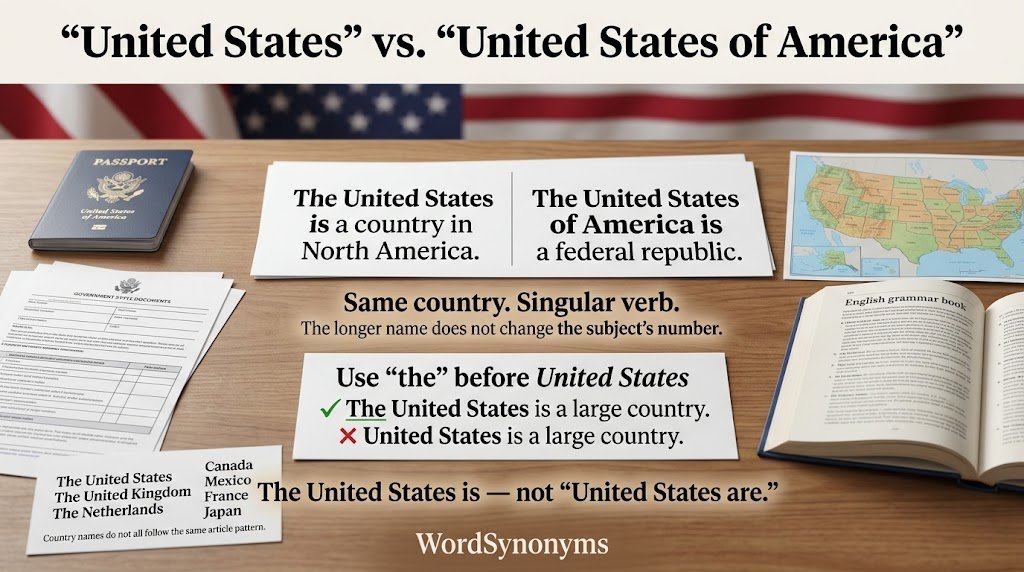
United States and United States of America refer to the same country.
The longer name doesn’t change the number of the subject.
You can write:
The United States is a country in North America.
Or:
The United States of America is a federal republic.
Both take singular verbs.
The longer form can be useful when you want the country’s full official name or when additional clarity matters.
In ordinary prose, the United States is usually enough.
Is “The” Required Before “United States”?
In ordinary sentences, use the before the country’s name:
The United States is a large country.
Not:
United States is a large country.
The definite article makes sense because the expression identifies a particular political union.
You can compare this with other country names:
- The United States
- The United Kingdom
- The Netherlands
- Canada
- Mexico
- France
- Japan
Country names don’t all follow the same article pattern.
That’s why it’s better to learn the standard form of each name rather than assume that every country needs the.
Common Grammar Mistakes With “United States”
The confusion surrounding this name produces several recurring errors.
Mistake: “The United States Are”
This is the most obvious mistake in modern American English.
❌ The United States are a powerful country.
✅ The United States is a powerful country.
Use is when the country is the subject.
Mistake: “The United States Have”
The same issue appears with have.
❌ The United States have 50 states.
✅ The United States has 50 states.
The country has the states. The individual states themselves don’t collectively form the grammatical subject in this sentence.
Mistake: Using “Their” for the Country
You might also see:
❌ The United States changed their policy.
For standard contemporary usage, write:
✅ The United States changed its policy.
Again, the country functions as one entity.
Mistake: Dropping “The”
Another common error appears at the beginning of sentences:
❌ United States is one of the world’s largest countries.
✅ The United States is one of the world’s largest countries.
The article belongs with the standard country name.
A Quick Test for Choosing the Correct Verb
When you’re unsure whether to use a singular or plural verb, replace the United States mentally with the country.
For example:
The United States is geographically diverse.
Replace the subject:
The country is geographically diverse.
The answer becomes obvious.
Try another:
The United States has 50 states.
Replace it:
The country has 50 states.
Again, singular agreement works naturally.
Now try:
The states are geographically diverse.
Replace the states with the individual states:
The individual states are geographically diverse.
That’s clearly plural.
This substitution trick works surprisingly well.
United States Grammar in Questions and Negative Sentences
The singular rule doesn’t disappear when you form a question.
Use does with the country:
- Does the United States have 50 states?
- Does the United States share a border with Mexico?
- Does the United States use a federal system?
Don’t use do when the United States means the country:
❌ Do the United States have 50 states?
✅ Does the United States have 50 states?
The same principle applies to negative sentences:
- The United States does not have a parliamentary system.
- The United States doesn’t use a single federal system for every area of law.
However, if the subject becomes plural, the verb changes:
- The states do not all use identical laws.
- The states have different regulations.
- The states are responsible for certain governmental functions.
The subject determines the agreement.
Read more: Waist vs. Waste: Meaning and Usage
United States vs. US vs. U.S. vs. USA
The abbreviation question creates another layer of confusion.
Several forms appear in English:
- United States
- US
- U.S.
- United States of America
- USA
- U.S.A.
Different style guides make different recommendations about punctuation and when to abbreviate the name. For example, the 18th edition of the Chicago Manual of Style allows US as a noun when the meaning is clear, while other style systems continue to favor U.S. in particular contexts.
The important grammatical point is simpler:
The abbreviation still refers to one country.
Therefore:
- The US is a major economy.
- The U.S. has 50 states.
- The USA is located in North America.
Don’t let the abbreviation distract you from subject-verb agreement.
Which Form Should You Use?
Your choice should follow the style requirements of your publication.
For general writing, spelling out United States is perfectly clear.
In some editorial environments, US is preferred. Other publications use U.S. The difference concerns style rather than whether the country is singular.
The Possessive Form: “United States’”
The possessive form creates an especially interesting grammatical detail.
Because States is plural in form, the possessive commonly appears as:
the United States’ economy
rather than:
the United States’s economy
The Chicago Manual of Style explains that names with plural forms but singular meanings can take the apostrophe-only possessive construction.
Compare:
- the United States’ economy
- the United States’ government
- the United States’ history
- the United States’ borders
- the United States’ foreign policy
The country remains singular in meaning even though its name ends in a plural-form noun.
This is one of those English grammar quirks that makes more sense once you separate form from meaning.
Why “The United States Are” Sounds So Strange Today
Modern readers have become accustomed to treating the country as one national entity.
Consequently, phrases such as these sound natural:
1. The United States is changing.
2. The United States has announced new measures.
3. The United States was involved in the negotiations.
The plural versions sound markedly different:
1. The United States are changing.
2. The United States have announced new measures.
3.The United States were involved in the negotiations.
The second set may appear in historical quotations or deliberately old-fashioned writing. In contemporary American prose, however, singular agreement is the normal choice.
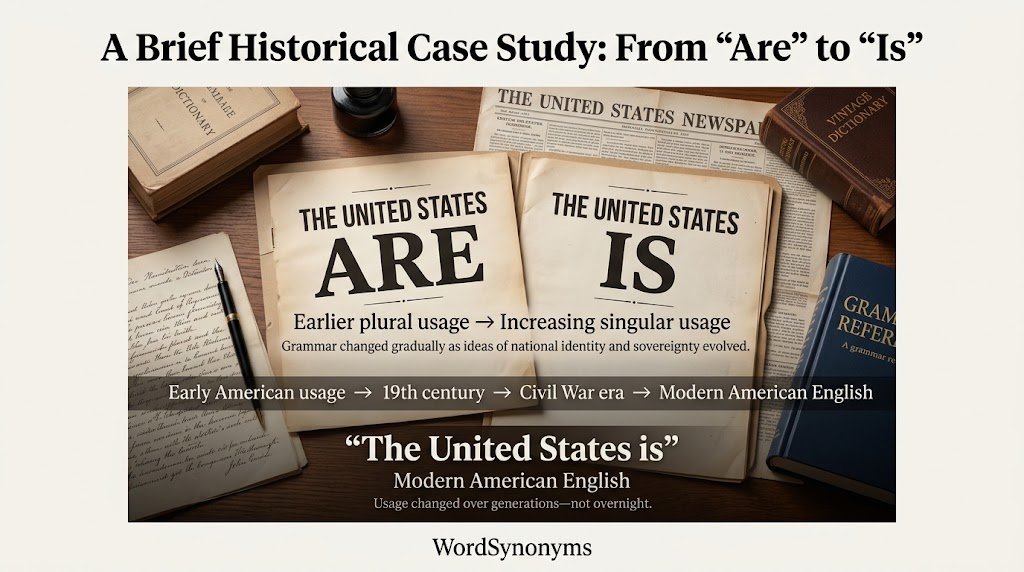
A Brief Historical Case Study: From “Are” to “Is”
The history of this expression provides a useful lesson in how grammar can reflect changing political concepts.
During earlier periods of American history, writers sometimes understood the United States more strongly as a union of individual states. That interpretation encouraged plural agreement.
In the 19th century, both singular and plural forms appeared. Historical scholarship has found that the use of singular agreement increased substantially during the century. By its later decades, singular treatment had become increasingly dominant.
The shift wasn’t simply a matter of someone announcing a new grammar rule.
Instead, language evolved alongside changing ideas about national identity and sovereignty.
The Civil War is often presented as the decisive turning point in popular explanations of this story. Historian Shelby Foote famously described the change by contrasting “the United States are” with “the United States is.” Yet linguistic evidence suggests that the transition was more gradual than that neat story implies.
That’s an important distinction.
Grammar didn’t suddenly change overnight. Usage changed over generations.
Today, singular agreement is firmly established in ordinary American English.
Read more: Veracity vs. Voracity: Difference and Examples
Why This Grammar Rule Matters
At first glance, the difference between is and are might seem tiny.
It isn’t.
Subject-verb agreement signals how readers should interpret the subject. With the United States, singular agreement immediately tells the reader that the sentence concerns the nation as one entity.
Compare:
The United States is changing its energy policy.
The country acts as one national entity.
Now compare:
The states are changing their energy policies.
The sentence shifts attention toward individual states.
The grammatical difference helps establish the scope of the statement.
That’s particularly important in journalism, academic writing, government documents, history, economics, and political analysis.
United States Grammar: A Practical Comparison
The following table provides a quick reference.
| If you mean… | Use | Example |
| The country | Singular | The United States is large. |
| The country | Singular | The United States has 50 states. |
| The country’s possession | Its | The United States changed its policy. |
| Individual states | Plural | The states are different. |
| Individual states’ possession | Their | The states changed their policies. |
| One individual state | Singular | The state is responsible for the program. |
| Multiple states | Plural | Several states are involved. |
The most important question isn’t “Does the word States look plural?”
Ask instead:
“What exactly does my subject refer to?”
If it refers to the country, use singular agreement.
If it refers to multiple individual states, use plural agreement.
Real-World Sentence Patterns
Here are several useful patterns you can adapt to your own writing.
Talking About the Country
- The United States is located in North America.
- The United States has 50 states.
- The United States is a federal republic.
- The United States has a federal government.
- The United States was founded in the 18th century.
- The United States maintains diplomatic relations with many countries.
Talking About Individual States
- The states are responsible for many local matters.
- Several states have adopted different regulations.
- The states were represented at the meeting.
- Individual states maintain their own governments.
- The states have different laws and policies.
Comparing Both
- The United States is one country, but its states are politically diverse.
- The United States has 50 states, and those states have their own governments.
- The United States sets federal policy, while individual states manage many local matters.
These examples show why meaning matters more than the appearance of the word States.
Is “United States of America” Singular or Plural?
United States of America is singular when it refers to the country.
The extra words don’t change the grammatical number.
Correct:
The United States of America is a federal republic.
Incorrect in contemporary standard usage:
The United States of America are a federal republic.
The same rule applies to possessive pronouns:
The United States of America has changed its policy.
Not:
The United States of America has changed their policy.
Whether you use the shorter or longer country name, the grammatical principle remains unchanged.
FAQs
Is “United States” singular or plural?
United States is grammatically singular when it refers to the country. Use a singular verb, such as “The United States is.”
Why does “United States” sound plural?
The word “states” is plural because the country consists of multiple states. However, United States functions as the name of one country, so it takes singular verbs.
Should I say “the United States is” or “the United States are”?
Say “the United States is.” For example, “The United States is in North America.” The phrase “the United States are” is incorrect in standard modern English when referring to the country.
Is “United States” a proper noun?
Yes. United States is a proper noun because it names a specific country. In normal usage, it appears as the United States.
Do other country names work the same way?
Yes. Country names such as England, China, and Bahrain are treated as singular nouns. Even when a country name contains a plural-looking word, the country itself represents one entity.
Has “United States” always used singular verbs?
Modern standard English has treated the United States as singular for well over a century. Older historical usage can vary, but singular agreement is the normal choice today.
Conclusion
The easiest way to remember the rule is to focus on what United States represents, not simply how the word “states” looks. It refers to one country, so it takes a singular verb. That means “The United States is” is correct, while “The United States are” is not. The plural-looking ending can certainly cause hesitation, especially when you’re writing quickly, but the meaning of the complete name settles the issue.
Think of United States as one name for one nation. You wouldn’t normally describe the country as several separate grammatical subjects when you use its official name. Instead, you treat it like other country names such as England or China. Once that idea becomes familiar, choosing the right verb becomes almost automatic. So, the next time you pause over United States: Is It Plural or Singular?, remember one simple point: one country, one singular subject, and a singula

Syeda Naalain Zahra is a content writer with an interest in English vocabulary and language. She creates simple and informative articles about synonyms, antonyms, word meanings, and everyday English usage. Her aim is to help readers build better vocabulary and communicate more confidently.