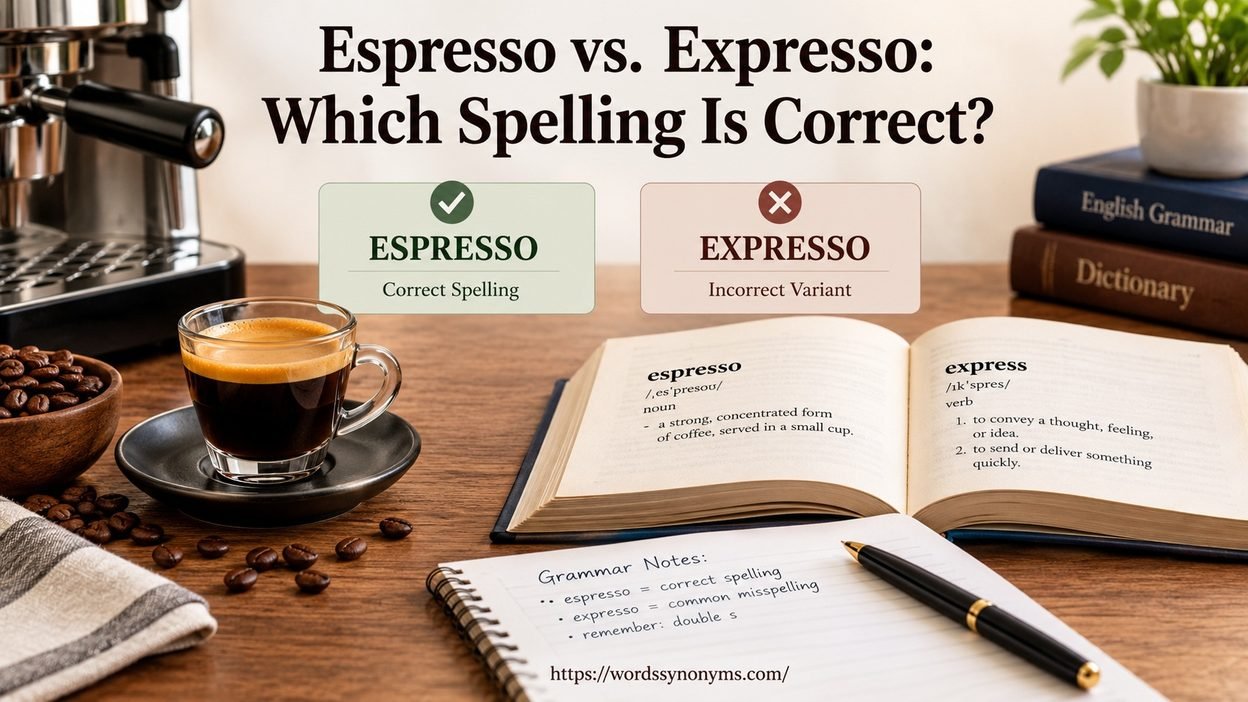
Espresso vs. Expresso: Which Spelling Is Correct? is mainly a question of spelling and English usage.
Espresso is the standard word for a strong coffee made through pressure brewing. The term comes from Italian and is now firmly established in English, coffee terminology, and coffee vocabulary. Although expresso began as a misspelling, its common usage has led some dictionaries to recognize it as a variant.
Still, many English speakers consider it wrong, so espresso with an s remains the safer choice, especially when placing a coffee order in public. This small difference can matter to coffee lovers and coffee drinkers who care about both taste and terminology.
There’s also a French connection. Expresso is a French word for this coffee, and French usage may have had some influence on English usage. This helps explain why the alternative form is still used and appears in some dictionary usage records.
Even so, espresso spelling remains the familiar choice in standard English. In everyday coffee language, choosing espresso avoids confusion, unwanted judgment, and unnecessary terminology debate.
Quick Answer
Espresso is the standard and preferred spelling for the concentrated coffee drink made by forcing hot water through finely ground coffee. Expresso is a documented variant that refers to the same drink, but it’s less standard in modern English. If you’re writing a menu, article, assignment, or professional document, choose espresso. An easy way to remember it is: espresso has no X.
| Feature | Espresso | Expresso |
| Meaning | A concentrated coffee beverage | Variant spelling for the same beverage |
| Standard spelling | Yes | No |
| Common usage | Widely preferred | Less common |
| Pronunciation | ess-PRESS-oh | ik-PRESS-oh |
| Origin | Italian espresso | English variant influenced by familiar spelling patterns |
| Use in formal writing | Recommended | Usually avoid |
| Easy memory tip | No X in espresso | X appears in the variant |
Espresso vs. Expresso: Quick Difference
The difference can be summarized in one table.
| Word | Meaning | Standard usage | Pronunciation |
| Espresso | A concentrated coffee made by forcing hot water through finely ground coffee | Standard spelling | ess-PRESS-oh |
| Expresso | A variant spelling referring to the same coffee | Less standard | ik-PRESS-oh |
Cambridge gives the US pronunciation of espresso as /esˈpres.oʊ/. It gives expresso as /ɪkˈpres.oʊ/, which includes the initial k sound.
So, when you mean the familiar coffee drink, the safest rule is simple:
Write espresso, not expresso, when you want the standard spelling.
That doesn’t mean expresso has never existed. It appears in English usage and is identified as a variant in etymological references. The important distinction is between a form that exists and the form that standard usage prefers.
What Does Espresso Mean?
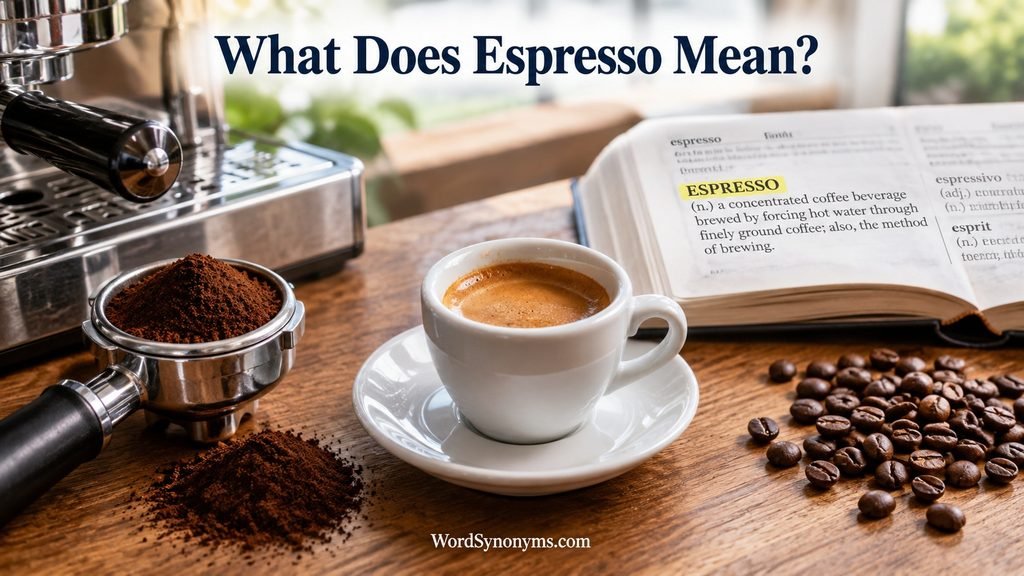
Espresso is a concentrated coffee beverage prepared by forcing hot water through finely ground coffee under pressure. It is normally served in a small portion and forms the foundation of many familiar coffee drinks.
Cambridge defines espresso as strong coffee made by forcing hot water through crushed coffee beans and serving it without milk. It also lists espressos as the plural form.
The word can refer to both the drink and a serving of that drink.
For example:
- “She ordered an espresso after dinner.”
- “He drinks two espressos every morning.”
- “This café makes excellent espresso.”
- “We bought a new espresso machine.”
- “Would you like a double espresso?”
Notice that the word doesn’t necessarily describe a particular coffee bean. That’s an important distinction.
Espresso Is a Brewing Method and Beverage
People sometimes assume that espresso refers to a special species of coffee bean. It doesn’t.
Coffee labeled for espresso can use different varieties, origins, blends, roast profiles, and processing methods. What makes espresso distinctive is primarily the brewing process.
A typical espresso preparation uses finely ground coffee and forces hot water through the coffee under pressure. The result is a small, concentrated beverage with a characteristic aroma, body, and layer of crema when properly extracted.
That’s why you can have:
- espresso made from Arabica beans
- espresso made from blends
- light-roasted espresso
- medium-roasted espresso
- dark-roasted espresso
- single-origin espresso
- decaffeinated espresso
The beans can vary considerably. The term espresso still refers to the style of preparation and the resulting beverage.
What Does Expresso Mean?
Here’s where the espresso vs. expresso question gets interesting.
Expresso is commonly used as an alternative spelling of espresso. It isn’t normally intended to describe a different drink. When someone says, “I ordered an expresso,” they almost certainly mean an espresso.
Etymological references identify expresso as a variant of espresso.
However, that doesn’t put both spellings on equal footing.
In standard English writing, espresso remains the conventional form. Some dictionary resources explicitly distinguish expresso as a nonstandard or variant form. Cambridge’s English-Portuguese dictionary, for example, identifies expresso as “not standard” in its treatment of the English word.
That distinction matters because dictionaries record how language is actually used. A dictionary may document a form without recommending it as the preferred choice in every context.
Is Expresso a Real Word?
Yes, with an important qualification.
Expresso is an attested English variant, so calling it completely nonexistent would be inaccurate. The form appears in real English usage and is recorded by reference sources.
At the same time, espresso is the standard spelling for the coffee beverage.
Think of it this way:
- Espresso = standard and conventional
- Expresso = established variant found in English
- Meaning = generally the same coffee drink
- Recommended spelling in formal writing = espresso
This is why simply saying “expresso isn’t a word” misses an important part of the story.
Espresso vs. Expresso: Are They Different in Meaning?
For the coffee drink, there is generally no meaningful difference in what the two forms refer to.
If someone says:
“I’ll have an espresso.”
and another person says:
“I’ll have an expresso.”
both speakers are normally referring to the same type of coffee.
The difference lies mainly in spelling, pronunciation, and standardness, rather than the beverage itself.
| Feature | Espresso | Expresso |
| Refers to coffee | Yes | Yes, when used as the English variant |
| Standard spelling | Yes | No |
| Common in standard English | Yes | Less common |
| Initial /k/ sound | No | Typically yes |
| Italian origin | Directly connected | Variant influenced by English usage |
| Preferred in formal writing | Yes | Usually no |
Cambridge’s main English entry uses espresso and gives espressos as the plural. Its pronunciation entry gives the standard US pronunciation without an initial /k/ sound.
Why Do People Say Expresso Instead of Espresso?
The spelling expresso doesn’t appear out of nowhere. English speakers have a very strong reason to find it visually and phonetically tempting.
Consider these familiar words:
- express
- expression
- expressly
- expressway
- express train
They all begin with ex- and generally carry a recognizable /ɪkˈspr…/ or /ɛkˈspr…/ pattern.
Now look at:
espresso
The word begins with es-, followed by the consonant cluster in -spresso. For speakers who already know express, the spelling expresso can feel more intuitive.
It’s almost as if the brain says, “This looks like express, so it must begin with ex-.”
Language doesn’t always follow the neatest logical path. Familiar spelling patterns can influence how speakers pronounce and spell borrowed words.
The Influence of Express
There is also a genuine historical connection between espresso and express, although it isn’t the simple relationship that the spelling expresso might suggest.
The Italian espresso is related to esprimere, while English express ultimately traces back through French and Latin roots connected with the idea of pressing out. Etymological sources connect both words to Latin exprimere, meaning “press out” or “squeeze out.”
That shared historical background makes the resemblance between the words especially interesting.
However, the modern spelling expresso isn’t the standard Italian form of the coffee word in English. It developed as a variant in English usage.
Espresso Origin and Etymology
The history of espresso provides one of the clearest answers to the spelling question.
The English noun espresso comes from Italian caffè espresso. The Italian word espresso is associated with the past participle of esprimere, meaning “to press out.” Ultimately, the word traces back to Latin exprimere, also carrying the sense of pressing or squeezing out.
That meaning fits the traditional coffee-making process.
Coffee grounds sit in a brewing chamber. Hot water passes through them under pressure. The finished coffee is essentially extracted by pressing water through the grounds.
So the historical meaning isn’t based on the English adjective express, even though English speakers can easily make that association.
When Did Espresso Enter English?
Etymological records date the English noun espresso to around 1945. The term came into English from Italian caffè espresso.
That relatively recent entry into English helps explain why the word still retains a strong sense of being a borrowed culinary term.
English has absorbed thousands of foreign words over centuries. Some retain their original spelling almost intact. Others get reshaped by English speakers.
Espresso has largely kept its Italian spelling in standard English. Expresso represents one example of how speakers can adapt a borrowed word to familiar English patterns.
Espresso Pronunciation vs. Expresso Pronunciation
Spelling and pronunciation are closely connected in this particular comparison.
How to Pronounce Espresso
In US English, espresso is pronounced approximately:
ess-PRESS-oh
Cambridge gives the pronunciation as:
/esˈpres.oʊ/
The key point is that standard espresso doesn’t begin with the /ɪk/ sound heard in expresso.
How to Pronounce Expresso
In US English, Cambridge gives expresso as:
/ɪkˈpres.oʊ/
An easy approximation is:
ik-PRESS-oh
The extra k sound comes from the x in the spelling.
Here’s the difference:
| Spelling | Approximate US pronunciation |
| espresso | ess-PRESS-oh |
| expresso | ik-PRESS-oh |
This pronunciation difference doesn’t create two different coffee beverages. It simply reflects the different spellings.
Which Is Correct: Espresso or Expresso?
If the question is “Which spelling should be used in standard English?”, the answer is espresso.
That’s the form to choose when you’re writing:
- a school paper
- a professional article
- a restaurant menu
- a recipe
- a product description
- an email
- a book
- a news article
- a formal report
For example:
Preferred:
“The restaurant serves freshly prepared espresso.”
Less standard:
“The restaurant serves freshly prepared expresso.”
The second sentence remains understandable. The spelling simply doesn’t match the conventional standard form.
Is Expresso Wrong?
The most accurate answer is not completely.
Calling expresso “wrong” without qualification can oversimplify the evidence. The form is documented in English and appears in dictionaries and etymological references as a variant.
However, if you’re asking which form you should use, the answer is clear:
Use espresso.
This distinction between existence and standard usage is useful far beyond coffee vocabulary. English contains many words that appear in variant forms, regional forms, historical spellings, and nonstandard forms.
A form can exist without being the best choice for formal writing.
Common Espresso vs. Expresso Mistakes
The spelling issue becomes easier when you see the mistakes in context.
Mistake 1: Writing Expresso on a Formal Menu
Less standard:
“Our expresso is made from freshly roasted beans.”
Preferred:
“Our espresso is made from freshly roasted beans.”
The second version follows the conventional English spelling.
Mistake 2: Pronouncing Espresso With an X Sound
Some speakers pronounce espresso as though it were spelled expresso.
That creates:
ik-PRESS-oh
instead of:
ess-PRESS-oh
If you’re trying to use the standard pronunciation, remember the first syllable:
es-press-o
Mistake 3: Assuming Espresso Means “Express Coffee”
The visual similarity between espresso and express can encourage this assumption.
However, the etymological story is more closely tied to the Italian idea of pressed out and the Latin root exprimere.
So the “express coffee” explanation is a tempting shortcut, but it doesn’t accurately explain the word’s origin.
Mistake 4: Treating Espresso as a Specific Bean
Espresso isn’t simply the name of a particular coffee bean.
A roaster can create espresso blends from different origins and varieties. The defining feature lies in the preparation rather than a single botanical type of bean.
Espresso in Common Coffee Drinks
Once the spelling is settled, it’s useful to understand where espresso fits into the broader coffee vocabulary.
| Coffee drink | Basic description |
| Espresso | Concentrated coffee served on its own |
| Americano | Espresso combined with hot water |
| Latte | Espresso with a larger amount of steamed milk |
| Cappuccino | Espresso with steamed milk and milk foam |
| Macchiato | Espresso with a relatively small amount of milk or foam |
| Mocha | Espresso combined with chocolate and milk |
These drinks aren’t interchangeable. Each has its own preparation and proportions.
The common thread is that espresso can serve as the base for many coffee beverages.
That’s another reason spelling matters. You may see the word in compound expressions such as:
- espresso machine
- espresso shot
- espresso cup
- espresso bar
- espresso blend
- espresso roast
- espresso drink
In each case, the conventional spelling is espresso.
Is Espresso a Type of Coffee?
Yes, but the phrase needs some care.
In everyday conversation, people often call espresso a type of coffee. That’s perfectly understandable. More precisely, espresso refers to a concentrated coffee beverage produced through a particular brewing method.
A useful comparison is tea.
Saying “espresso is a type of coffee” works in casual conversation. Saying “espresso is a particular brewing style and beverage” gives you a more precise description.
The distinction matters because coffee beans themselves can be used in several brewing methods. The same general bean origin could potentially appear in espresso, drip coffee, pour-over, French press, or other preparations.
Read more: Drop Off vs. Drop-Off vs. Dropoff: Difference Explained
What Is an Espresso Shot?
An espresso shot is a serving of espresso.
The exact volume can vary depending on the coffee shop, recipe, equipment, and regional convention. That’s why it’s better not to treat one universal milliliter figure as a permanent definition.
You may encounter terms such as:
- single shot
- double shot
- ristretto
- lungo
These describe different espresso preparations or serving styles.
A double espresso, for example, uses a larger dose and produces a larger amount of espresso than a traditional single shot.
The important language point remains unchanged: the word is spelled espresso.
What Is the Plural of Espresso?
The standard English plural is:
espressos
For example:
“The café served three espressos.”
Cambridge lists espressos as the plural form.
You don’t need to invent a complicated Italian plural in ordinary American English. When espresso functions as an English noun, espressos is a clear and accepted plural.
Espresso in Singular and Plural Sentences
Singular:
“I ordered an espresso.”
Plural:
“We ordered two espressos.”
Uncountable use:
“This blend produces excellent espresso.”
The form depends on how you’re using the noun in the sentence.
Espresso vs. Expresso in Everyday Examples
Seeing both forms side by side can make the distinction stick.
Example: Ordering Coffee
Preferred:
“Could I have an espresso, please?”
The sentence uses the conventional spelling.
Example: Talking About a Machine
Preferred:
“She bought a new espresso machine.”
Not:
“She bought a new expresso machine.”
Example: Describing a Drink
Preferred:
“The espresso has a rich aroma.”
Example: Talking About Several Drinks
Preferred:
“Four espressos were served after dinner.”
Example: Discussing the Variant
You can legitimately write:
“Expresso is a variant spelling of espresso.”
In this sentence, expresso is the subject of discussion, so using the variant itself is completely appropriate.
That distinction is worth remembering. Writing about a nonstandard or variant spelling doesn’t mean you should adopt that spelling in ordinary usage.
Why Espresso Is the Better Choice for Formal Writing
Formal writing rewards consistency.
When readers encounter espresso, they immediately recognize the conventional spelling. When they encounter expresso, many will understand the intended meaning but may notice the variant.
That difference can matter in edited content.
If you’re writing for a broad audience, espresso avoids unnecessary distraction.
Use espresso when:
- accuracy matters
- you’re writing educational content
- you’re publishing professionally
- you’re creating a menu
- you’re writing a recipe
- you’re preparing marketing copy
- you’re teaching English
- you’re editing a publication
The goal isn’t to pretend expresso doesn’t exist. The goal is to choose the form that best fits standard usage.
A Simple Memory Trick for Espresso
Here’s an easy way to remember the spelling:
Espresso has no X.
Think of it as:
E + SPRESSO
not:
E + XPRESSO
Another useful trick is to connect the word with press:
espresso → pressed out
The etymology connects the Italian term with the idea of pressing out, which also helps explain why the word looks so close to express.
If you remember “espresso has no X,” you can avoid the most common spelling mistake.
Espresso vs. Expresso: What Dictionary Evidence Shows
Dictionary evidence makes the situation more nuanced than the simple statement “one word is real and the other isn’t.”
Cambridge’s main English dictionary entry treats espresso as the standard noun and defines it as strong coffee or a cup of that coffee. It also gives the plural espressos.
Cambridge’s pronunciation resource records expresso as an English pronunciation with an initial /ɪk/ sound.
Etymological references describe expresso as a variant of espresso.
Together, these sources support a useful distinction:
| Question | Answer |
| Is espresso a standard English word? | Yes |
| Does espresso refer to the coffee drink? | Yes |
| Is expresso found in English? | Yes |
| Does expresso generally refer to the same drink? | Yes |
| Is expresso the preferred standard spelling? | No |
| Should formal writing normally use espresso? | Yes |
This is more accurate than treating the issue as a simple right-versus-wrong spelling test.
Espresso vs. Expresso: The Key Facts
Here are the essential facts to remember:
- Espresso is the standard spelling.
- Expresso is a documented variant.
- Both forms can refer to the same coffee beverage.
- Espresso comes into English from Italian.
- The Italian term is connected with the idea of pressed out.
- The deeper historical connection reaches the Latin exprimere.
- The English word express has a related Latin root.
- The spelling expresso likely feels natural partly because of the familiar pattern in express.
- Standard US pronunciation of espresso begins with an ess sound.
- Expresso commonly begins with an ik sound.
- The standard plural is espressos.
- Espresso is the form to use in formal and edited writing.
Espresso vs. Expresso: Case Study in Everyday English
Imagine a coffee shop has two signs.
Sign A:
Fresh Espresso
Double Espresso
Espresso Latte
Espresso Machine
Sign B:
Fresh Expresso
Double Expresso
Expresso Latte
Expresso Machine
Most English speakers can understand both signs. Nothing about the coffee suddenly changes because the spelling changes.
However, Sign A follows conventional English spelling. Sign B uses a recognized variant that many readers will perceive as nonstandard.
Now imagine the same distinction in an English-learning textbook.
The textbook would almost certainly teach:
espresso
rather than:
expresso
That’s because language instruction normally prioritizes the standard form learners can use confidently across formal and informal settings.
The case illustrates an important principle of English usage: understanding a variant doesn’t necessarily mean choosing it yourself.
FAQs
Is “expresso” ever an acceptable spelling?
Yes. Expresso is widely used, and some dictionaries recognize it as a variant. However, espresso is the established spelling in standard English.
Why do people say “expresso” instead of “espresso”?
The spelling may be influenced by pronunciation, repeated everyday usage, or the French word expresso. Over time, the alternative form became familiar to many English speakers.
Does espresso mean a specific type of coffee?
Yes. Espresso refers to coffee prepared by forcing pressurized water through finely ground coffee. It produces a concentrated drink with a distinctive taste.
Is “espresso” an Italian word?
Yes. Espresso comes from Italian and entered English as the name for this style of coffee. Its Italian origin explains the spelling used in English.
Will people understand me if I say “expresso”?
Most people will understand what you mean. Still, espresso is the more familiar spelling and pronunciation in standard English, especially when ordering coffee.
Is “expresso” considered wrong in English?
It depends on the dictionary and context. Some dictionaries list expresso as a variant, while many English speakers still prefer
Conclusion
When it comes to espresso vs. expresso, the difference is mostly about spelling, usage, and language history. Espresso remains the standard form in English, while expresso has gained recognition through common use and its connection with French. You may still see or hear both forms, but they don’t have the same status in every context.
If you’re writing an article, ordering coffee, or simply want to use the familiar English form, espresso is the straightforward choice. Once you know where both spellings come from, the debate becomes much easier to understand—and your next coffee order can stay focused on the drink rather than the spelling.

Syeda Naalain Zahra is a content writer with an interest in English vocabulary and language. She creates simple and informative articles about synonyms, antonyms, word meanings, and everyday English usage. Her aim is to help readers build better vocabulary and communicate more confidently.