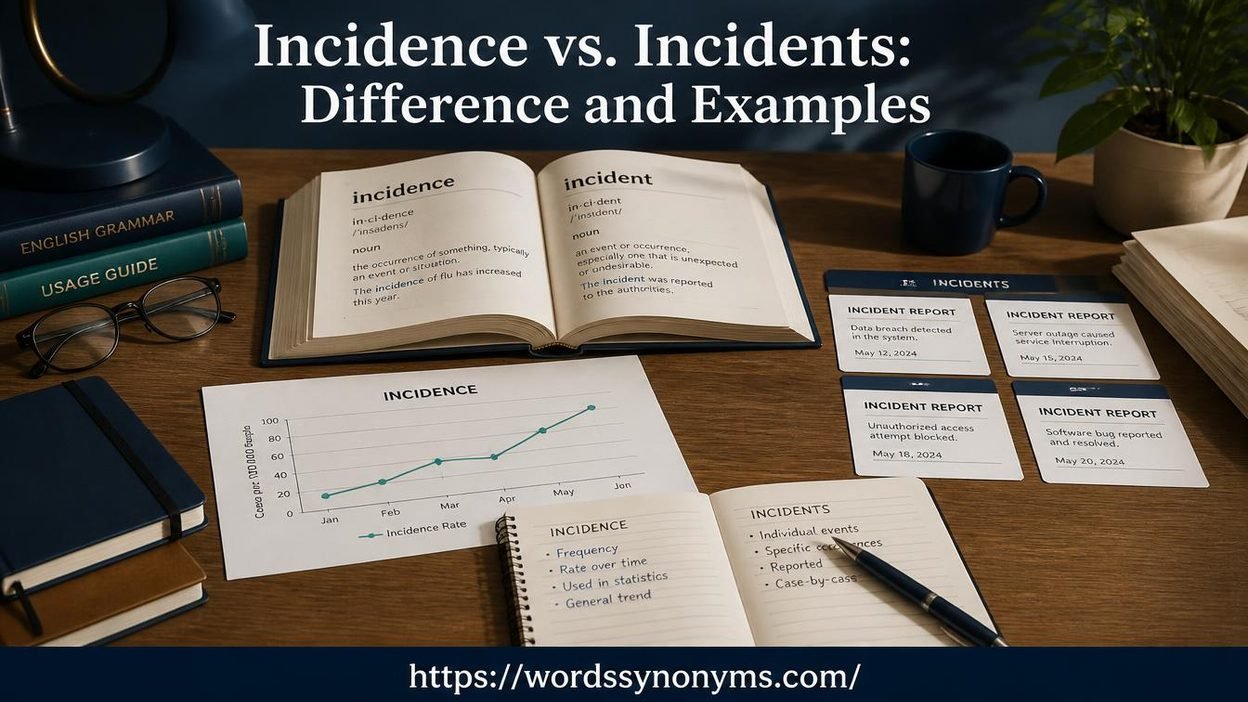
Incidence vs. Incidents: Difference and Examples explains how these closely related words differ in meaning, grammar, and everyday usage. Both can express similar ideas, but context determines the correct choice.
Incidence is a singular mass noun and an uncountable noun that describes the frequency, occurrence, or rate of occurrence of something. It usually cannot be plural in this sense and takes singular verb forms. For example, “The incidence of theft in the neighborhood has increased this year.”
This sentence describes an increase in the frequency of incidents, crime rate, or theft rate. In contrast, incidents is a plural, countable noun that refers to individual events. You might write, “The incidents of theft in the neighborhood have become more numerous this year.” Understanding noun forms, verb forms, and subject-verb agreement improves your English grammar, sentence structure, and writing.
In most cases, incidence and incidents are the best choices, but incidences can be useful in rare instances when comparing the incidences of something in two different areas. For example, a researcher might compare the incidence of something across different areas or examine the number of occurrences recorded at each location.
When discussing separate events, incidents or incidents of something usually sounds clearer. The grammatical difference becomes easier to recognize when you consider meaning, word choice, and correct usage. Although these related words have similar meanings, they are not always interchangeable.
In English vocabulary and everyday language usage, use incidence to describe how frequently something happens and incidents to identify separate events. These alternative expressions make your writing more precise when discussing neighborhood theft, an increase in reported events, or a comparison of the frequency of incidents over a year or during this year.
Quick Answer
Incidence refers to how often something occurs or its rate of occurrence, especially in statistics, healthcare, and research. Incidents is the plural of incident and describes two or more separate events.
For example, “The incidence of workplace injuries decreased” describes a trend, while “The company investigated three workplace incidents” refers to specific events.
Easy way to remember: Incidence describes a pattern or rate; incidents counts individual events.

What Does Incidence Mean?
Incidence is a noun that refers to the occurrence or rate of something happening. Writers often use it when discussing diseases, accidents, crimes, social problems, and other events that researchers can measure or study.
In everyday English, incidence often appears in formal, scientific, medical, and statistical writing. It helps readers understand how frequently something occurs within a particular group or over a specific period.
For example:
- The incidence of diabetes has increased among adults.
- Researchers examined the incidence of workplace injuries.
- The incidence of new infections declined during the summer.
- The report investigated the incidence of theft in the neighborhood.
In each sentence, incidence describes the occurrence or frequency of a particular problem. It doesn’t simply identify one specific event.
Definition of Incidence
The word incidence has several related meanings, depending on its context.
Common definition: The occurrence, frequency, or rate of something happening.
Statistical definition: The occurrence of new cases of a condition or event within a defined population over a specified period.
General usage: The extent to which something occurs in a particular situation or group.
Consider this example:
“The incidence of road accidents increased during the holiday season.”
This sentence describes a change in how frequently road accidents occurred. It doesn’t identify individual accidents or explain what happened during each one.
Now consider another example:
“The incidence of food poisoning was higher among people who attended the event.”
Here, incidence describes the occurrence of food poisoning within a particular group. In a formal epidemiological study, researchers would define the population, observation period, and criteria for counting new cases.
Is Incidence Singular or Plural?
In its common statistical meaning, incidence is a singular, generally uncountable noun. You usually don’t add -s when discussing the rate or occurrence of something.
Examples:
- The incidence of infection is increasing.
- The incidence of workplace injuries has declined.
- A high incidence of errors was reported.
- The incidence of the disease remains low.
Notice that the verb agrees with incidence, not with the plural noun that follows it.
For example, in “The incidence of workplace injuries has declined,” the subject is incidence. The word injuries appears inside a prepositional phrase and doesn’t determine the verb’s number.
Although incidences can appear when writers mean distinct instances or types of occurrence, it is much less common in statistical writing. In most situations, use incidence for a rate and incidents for separate events.
Incidence in Statistics and Public Health
Public health professionals use incidence to measure new cases of a disease or health condition over a defined period. This measure helps researchers track emerging health problems and evaluate prevention efforts.
For example, imagine a town with 10,000 residents. During one year, health officials identify 50 new cases of a particular disease.
The annual incidence proportion would be 50 divided by 10,000, or 0.5%, assuming the full population was initially at risk and the figures meet the study’s criteria.
This information can help public health teams compare trends across years or populations. However, researchers must consider factors such as population size, observation time, and who was actually at risk.
It’s also important to distinguish incidence from prevalence.
- Incidence focuses on new cases arising during a specified period.
- Prevalence measures existing cases within a population at a particular time or over a defined period.
Suppose a city reports 200 new cases of a condition during a year. That figure describes new cases, but it doesn’t tell you how many residents currently live with the condition. Prevalence provides the broader picture of existing cases.
This distinction matters because a disease can have low incidence but high prevalence when people live with it for many years.
Example Sentences With Incidence
The following examples show how incidence works in different contexts.
| Sentence | Meaning |
| The incidence of heart disease varies by age group. | The occurrence or rate differs among age groups. |
| Researchers measured the incidence of new infections. | They counted new cases within a defined period. |
| The incidence of workplace injuries fell last year. | Workplace injuries occurred less frequently according to the measure used. |
| The study examined the incidence of anxiety among college students. | Researchers investigated how often anxiety occurred in the study population. |
| Officials monitored the incidence of malaria in the region. | They tracked new cases or the occurrence of malaria. |
| The incidence of errors increased after the software update. | Errors occurred more frequently after the change. |
These examples share one important feature: incidence describes an occurrence, frequency, or rate rather than listing separate events.
Synonyms and Related Words for Incidence
Several words can sometimes replace incidence, but their meanings aren’t always identical.
- Occurrence: The fact that something happens.
- Frequency: How often something happens.
- Rate: A measure of occurrence relative to a population, amount, or period.
- Prevalence: The proportion or number of people who have a condition within a defined population and period.
- Extent: The degree or range to which something exists or occurs.
For example, “the frequency of errors” and “the incidence of errors” may communicate similar ideas. However, frequency emphasizes how often something happens, while incidence often appears in formal discussions of occurrence or measured rates.
Don’t treat incidence and prevalence as interchangeable in medical writing. Each term describes a different aspect of a condition.
What Does Incidents Mean?
Incidents is the plural form of the noun incident. It refers to two or more separate events or occurrences.
An incident can be minor, serious, accidental, unexpected, or noteworthy. The word doesn’t automatically mean that someone was injured or that a crime occurred.
For example:
- The manager documented three incidents of workplace misconduct.
- Police investigated several traffic incidents.
- The school reviewed recent incidents of bullying.
- The IT department reported two cybersecurity incidents.
Each sentence refers to multiple events that someone can identify, count, investigate, or document.
Unlike incidence, which commonly describes a rate or occurrence, incidents points to individual happenings.
Definition of Incidents
An incident is an event or occurrence, particularly one that attracts attention because of its circumstances or consequences. Incidents is its plural form.
Consider these examples:
- One incident occurred during the meeting.
- Two incidents disrupted the morning commute.
- Several incidents were reported during the football game.
The singular and plural forms follow a straightforward pattern:
| Singular | Plural |
| Incident | Incidents |
| One incident | Two incidents |
| An incident | Several incidents |
| This incident | These incidents |
Because incident is a countable noun, you can use numbers and quantity words with it.
You can say “one incident,” “three incidents,” or “several incidents.” In contrast, when discussing a statistical rate, you would normally say “a high incidence” or “an increased incidence.”
Common Types of Incidents
The word incidents appears in many fields. Its precise meaning depends on the event being described.
Workplace incidents: These include events involving safety hazards, injuries, equipment problems, or violations of workplace rules.
Example: The safety officer reviewed four incidents reported during the night shift.
Security incidents: These involve events that threaten the safety of people, property, systems, or information.
Example: The security team investigated several unauthorized access incidents.
Traffic incidents: These include events on roads, such as collisions and other disruptions.
Example: Heavy rain contributed to multiple traffic incidents on the highway.
Cybersecurity incidents: These involve events that compromise or threaten the confidentiality, integrity, or availability of computer systems and information.
Example: The IT department documented two cybersecurity incidents during the quarter.
School incidents: These can involve bullying, misconduct, disputes, or safety concerns.
Example: School administrators addressed several incidents involving student misconduct.
Diplomatic incidents: These involve events that create tension or require a response between governments or political representatives.
Example: Officials held talks after a series of diplomatic incidents.
These examples demonstrate why incidents is useful in reports and everyday communication. The word allows you to discuss individual events without implying that they all have the same cause or seriousness.
Example Sentences With Incidents
Here are additional examples of incidents in different situations.
| Sentence | Meaning |
| Two incidents disrupted the morning commute. | Two separate events affected traffic. |
| The company recorded several security incidents. | The company documented multiple security-related events. |
| Police responded to three incidents near the stadium. | Officers dealt with three separate events. |
| The school reviewed recent incidents of misconduct. | Administrators examined multiple cases of inappropriate behavior. |
| The IT team resolved several incidents last month. | The team addressed multiple reported problems. |
| Witnesses described the incidents to investigators. | Witnesses explained what happened during the separate events. |
Notice how incidents works with numbers, plural verbs, and plural demonstratives such as these and those.
For instance, “These incidents were serious” is grammatically correct because incidents is plural. By contrast, “The incidence was serious” uses a singular subject to describe a rate or occurrence.
Synonyms and Related Words for Incidents
You can sometimes use these words instead of incidents, depending on the context.
- Events: Things that happen, whether ordinary or unusual.
- Occurrences: Things that take place.
- Episodes: Distinct periods or events, often within a larger situation.
- Cases: Individual examples or instances of a problem.
- Situations: Sets of circumstances that may involve several events.
For example, “several incidents occurred at the office” could become “several events occurred at the office.”
However, case may be more suitable when discussing individual examples of a condition or problem. Episode may work better when describing a distinct period of conflict or disruption.
Choose a synonym that preserves the original meaning instead of replacing words simply to avoid repetition.
Incidence vs. Incidents: Key Differences
Although incidence and incidents share similar spellings and pronunciations, they aren’t interchangeable in most sentences. The main difference comes down to what you want to describe: a rate or pattern of occurrence, or several separate events.
The following table summarizes their most important differences.
| Feature | Incidence | Incidents |
| Base word | Incidence | Incident |
| Part of speech | Noun | Plural noun |
| Main meaning | Occurrence or rate of occurrence | Two or more separate events |
| Grammatical number | Usually singular | Plural |
| Countability | Generally uncountable when describing a rate | Countable |
| Common contexts | Research, medicine, statistics, social studies | Safety reports, news, security, everyday events |
| Example | The incidence of flu increased. | Several incidents occurred at school. |
| Typical question | How frequently does something occur? | What events happened? |
Incidence Describes a Rate or Pattern
Use incidence when you want to discuss how frequently something happens or how new cases develop within a population. The word often appears when writers compare trends across groups, locations, or periods.
For example:
“The incidence of workplace injuries decreased after the company introduced new safety procedures.”
This sentence focuses on the overall pattern of workplace injuries. It doesn’t identify every injury or describe individual cases.
Incidents Identifies Separate Events
Use incidents when you want to identify multiple happenings. Each event can usually be counted, described, or investigated separately.
For example:
“The company investigated four workplace incidents during the previous month.”
This sentence identifies four distinct events. Readers know how many incidents the company investigated, although they don’t yet know what happened during each one.
Can Incidence and Incidents Appear in the Same Report?
Absolutely. In fact, using both words can make a report more precise.
Consider this example:
“The company recorded 24 workplace incidents last year. After reviewing its safety records, management found that the incidence of injuries had increased.”
The first sentence identifies individual events. The second describes a broader pattern involving injuries.
The distinction is useful because counting events and measuring their occurrence aren’t always the same task. A company might record several incidents without every incident resulting in an injury. Conversely, an injury report might track new injuries across a large workforce.
When to Use Incidence
Choose incidence when your sentence focuses on occurrence, frequency, or a measured pattern. The word is especially useful when discussing research findings, public health information, and changes over time.
Use Incidence for Rates and Frequencies
When you want to describe how frequently something occurs, incidence may be the right choice.
Examples:
- The incidence of respiratory infections increased during winter.
- Researchers examined the incidence of errors in financial reports.
- The incidence of traffic-related injuries declined over five years.
- The incidence of equipment failure remained low.
Each sentence describes a pattern rather than listing specific events.
However, don’t assume that incidence always requires a numerical rate. In general writing, it can also describe the occurrence or extent of something without providing an exact figure.
For example, “The incidence of complaints was unusually high” communicates a pattern even though the sentence gives no numerical measurement.
Use Incidence in Research and Reports
Research reports often use incidence to explain how frequently a particular outcome develops. Researchers may compare new cases across different groups or examine whether an intervention changes the pattern.
For example:
“The researchers measured the incidence of new infections among hospital patients over six months.”
This sentence tells readers that the researchers studied new infections within a defined population and period. A detailed report would also explain how researchers defined an infection and calculated the measure.
The US Centers for Disease Control and Prevention explains incidence in terms of new cases arising during a specified period. Its epidemiology guidance also distinguishes an incidence proportion from an incidence rate.
Common Phrases With Incidence
Certain expressions frequently appear with incidence.
| Phrase | Example |
| Incidence rate | The incidence rate rose during the study. |
| Incidence of disease | Researchers tracked the incidence of disease. |
| High incidence | The region reported a high incidence of infection. |
| Low incidence | The condition has a low incidence in this group. |
| Increased incidence | The report noted an increased incidence of errors. |
| Reduced incidence | New procedures helped reduce the incidence of injuries. |
| Incidence over time | The researchers examined incidence over time. |
These phrases work well in formal writing because they clearly describe the occurrence or frequency of a particular outcome.
One important detail: use incidence rate when you mean a rate, and make sure the data supports that wording. Some studies report an incidence proportion rather than a person-time rate.
When to Use Incidents
Use incidents when your sentence refers to multiple events. The word works in everyday conversation, workplace documents, news stories, safety reports, and technical writing.
Use Incidents for Separate Events
If you can count the events individually, incidents will often fit your sentence.
Examples:
- Three incidents occurred near the railway station.
- The teacher discussed two incidents with the students.
- Several incidents delayed the delivery schedule.
- Investigators reviewed all reported incidents.
Each example refers to separate occurrences. The reader can reasonably ask what happened during each event.
You can also use incident in the singular when discussing one event.
For example, “The manager investigated an incident involving damaged equipment.”
If the report later identifies two additional events, the sentence might become “The manager investigated three incidents involving damaged equipment.”
Use Incidents in Reports and News Stories
Writers often use incidents to describe events that require attention, documentation, or investigation.
For example:
“Local authorities investigated several incidents near the shopping center.”
This sentence tells readers that multiple events occurred in the same area. However, it doesn’t reveal whether those events involved theft, traffic problems, disputes, or something else.
For clarity, add details when they’re available:
“Local authorities investigated three theft incidents near the shopping center.”
The more specific version gives readers a clearer picture of the events being discussed.
Common Phrases With Incidents
| Phrase | Example |
| Series of incidents | A series of incidents disrupted the event. |
| Several incidents | Several incidents required further investigation. |
| Reported incidents | The report listed all reported incidents. |
| Security incidents | The security team investigated two security incidents. |
| Recent incidents | Managers reviewed recent incidents at the facility. |
| Incidents of violence | Officials discussed incidents of violence in the area. |
| Workplace incidents | The company documented workplace incidents. |
These expressions help you describe multiple occurrences without confusing individual events with a statistical measure.

Incidence vs. Incidents in Real-World Contexts
Sometimes the easiest way to understand a word is to see how people use it in a specific situation. The following examples show how incidence and incidents work across several fields.
Incidence vs. Incidents in Healthcare
Healthcare professionals use both words, but they describe different things.
Incidence: The incidence of a disease describes new cases developing within a population during a specified period.
Incidents: Medical incidents are individual events that may involve patient safety, medication errors, equipment problems, or other concerns.
Compare these sentences:
- The incidence of measles increased in the region.
- The hospital investigated several incidents involving medication errors.
The first sentence describes a trend in new disease cases. The second refers to specific events that required review.
For medical statistics, researchers must define the population and observation period carefully. Otherwise, comparisons between groups can become misleading.
Incidence vs. Incidents in Workplace Safety
Workplace safety reports provide another useful example. Companies often track both individual events and broader injury patterns.
Consider a company that operates a warehouse. During one month, employees report five safety incidents, including equipment damage and two minor injuries.
The safety manager might write:
“The company recorded five workplace incidents during the month.”
This sentence counts the events. If the manager wants to discuss how often employees sustain injuries across the workforce, the report might instead state:
“The incidence of workplace injuries increased compared with the previous month.”
The second statement requires appropriate injury data to support the comparison. The five incidents alone wouldn’t necessarily establish an increase in injury incidence because some events may not have caused injuries.
Incidence vs. Incidents in Crime Reporting
Crime reports frequently distinguish between the frequency of a problem and individual cases.
For example:
- The incidence of burglary declined in the district.
- Police investigated five burglary incidents during the weekend.
The first sentence describes a broader trend. The second identifies five events.
However, a careful writer should consider the data behind each statement. A report that counts five incidents during one weekend cannot establish a long-term trend by itself.
To compare crime incidence meaningfully, researchers need a suitable time period and consistent data. Depending on the question, they may also need population figures or another appropriate denominator.
Incidence vs. Incidents in Technology
Technology teams use incidents when documenting specific system failures, outages, or security events. They may use incidence when studying how frequently a particular type of problem occurs.
Examples:
- The incidence of software failures increased after the update.
- The IT department resolved three service incidents on Monday.
- Researchers examined the incidence of network interruptions across several offices.
- The security team documented multiple cybersecurity incidents.
The first and third examples describe broader patterns. The second and fourth identify individual events.
This distinction can improve technical reports because it separates the number of recorded events from the frequency of a particular problem.
A Practical Case Study: Incidence vs. Incidents
Imagine a fictional manufacturing company called Northstar Manufacturing. Its safety team reviews workplace records at the end of each quarter.
During the latest quarter, the team documents six incidents. Two involve minor employee injuries, three involve equipment damage, and one involves a blocked emergency exit.
The team then compares injury records with those from the previous quarter.
| Safety measure | Previous quarter | Latest quarter |
| Total recorded incidents | 4 | 6 |
| Incidents involving employee injuries | 1 | 2 |
| Equipment-related incidents | 2 | 3 |
| Emergency-exit obstruction incidents | 1 | 1 |
These figures are illustrative and do not represent a real company.
The safety manager can accurately write:
“Northstar Manufacturing recorded six workplace incidents during the latest quarter.”
The sentence describes the number of separate events.
The manager could also write:
“The number of recorded incidents increased from four to six.”
This sentence compares the event counts across two quarters.
However, if the manager wants to claim that the incidence of workplace injuries increased, the company must consider the relevant injury measure and workforce exposure. For example, the number of employees and the hours they worked may affect the interpretation.
If the company employed twice as many workers during the latest quarter, the raw injury count alone might not provide a fair comparison of injury risk.
The lesson is straightforward: use incidents to count events and incidence to discuss occurrence or a measured pattern. Make sure the data supports any statistical claim.
Read more: Spectra vs. Spectrums: Meaning and Examples
Common Mistakes When Using Incidence and Incidents
Even experienced writers sometimes confuse these words because they look and sound alike. Fortunately, a few simple rules can help you avoid the most common errors.
Using Incidence When You Mean Separate Events
The first mistake occurs when someone uses incidence after a number to describe countable events.
Incorrect: The police investigated three incidence last night.
Correct: The police investigated three incidents last night.
The word incidents is correct because the sentence refers to three separate events. The noun incident is countable, so its plural form works naturally with the number three.
Here are more examples:
- Incorrect: The manager reported two incidence of misconduct.
- Correct: The manager reported two incidents of misconduct.
- Incorrect: Several incidence occurred during the conference.
- Correct: Several incidents occurred during the conference.
Remember that incidence generally describes occurrence or frequency rather than a count of separate events.
Using Incidents When You Mean a Rate
The opposite mistake happens when a writer uses incidents to describe a general rate or trend.
Less suitable: The incidents of diabetes increased among adults.
Better: The incidence of diabetes increased among adults.
The second sentence works because it describes a change in the occurrence of diabetes within a population.
However, if you’re discussing specific events involving diabetes care, incidents might be appropriate.
For example: “The hospital investigated two incidents involving incorrect insulin doses.”
The correct word depends on what the sentence means, not simply which topic it discusses.
Confusing Incidence With Incident
Although the words share a linguistic connection, they don’t have the same meaning.
- Incident: A particular event or occurrence.
- Incidence: The occurrence, frequency, or rate of something happening.
Compare these sentences:
“The incident caused a temporary delay.”
“The incidence of delays increased during the winter.”
The first sentence refers to one event. The second describes a broader pattern involving delays.
Assuming Incidences Always Means Incidents
The plural form incidences does exist, but it can sound awkward when you mean separate events. In many contexts, incidents or instances is the clearer choice.
For example:
Less natural: The company investigated several incidences of fraud.
Clearer: The company investigated several incidents of fraud.
You may encounter incidences in published writing, especially when authors discuss separate rates or types of occurrence. However, for ordinary countable events, incidents is generally the safer choice.
Incidence vs. Incidents: A Quick Grammar Guide
Understanding the grammar behind these words makes the distinction easier to remember. Pay attention to the noun form, the verb, and the quantity word in each sentence.
| Expression | Correct example | Why it works |
| Incidence | The incidence remains low. | The singular noun takes a singular verb. |
| Incidence of | The incidence of infection has declined. | The sentence describes a pattern of occurrence. |
| An incident | An incident occurred yesterday. | An introduces one countable event. |
| One incident | One incident was reported. | The singular noun matches the number one. |
| Several incidents | Several incidents were documented. | Several requires a plural countable noun. |
| Many incidents | Many incidents remain under investigation. | Many refers to multiple events. |
| These incidents | These incidents require attention. | These agrees with a plural noun. |
| High incidence | The area has a high incidence of theft. | Incidence describes the frequency or occurrence of theft. |
How Subject-Verb Agreement Works
One useful grammar rule concerns the subject of the sentence.
Consider this example:
“The incidence of workplace injuries has declined.”
The subject is incidence, which is singular. The phrase of workplace injuries adds information about the incidence but doesn’t change the subject’s grammatical number.
Now compare it with this sentence:
“Several workplace incidents have been reported.”
Here, incidents is plural, so the sentence uses the plural verb phrase have been reported.
These examples show why you should identify the main subject before choosing a verb.
Can You Say a Number of Incidents?
Yes. Because incident is a countable noun, you can use numbers and quantity expressions with it.
Correct examples include:
- One incident was reported.
- Two incidents occurred.
- A few incidents remain unresolved.
- A large number of incidents were recorded.
You can also write “a high incidence of workplace injuries” when describing how frequently injuries occur.
However, avoid writing “a high incidents of workplace injuries.” The phrase combines a singular article with an unsuitable plural noun.

Incidence vs. Incidents: More Examples in Sentences
The following examples provide additional practice. Each pair highlights a different use of the words.
Examples Using Incidence
Medical research
“The incidence of asthma increased among children in the study.”
This sentence describes a pattern involving asthma cases in a defined group.
Workplace safety
“The incidence of occupational injuries declined after the new training program.”
The sentence focuses on the occurrence of injuries rather than listing specific accidents.
Education
“The report examined the incidence of absenteeism among high school students.”
Here, incidence describes how frequently absenteeism occurred within the group.
Technology
“The incidence of system failures decreased after engineers replaced the faulty component.”
The sentence describes a change in the occurrence of system failures.
Public safety
“Officials monitored the incidence of road injuries throughout the holiday season.”
The sentence emphasizes the frequency or occurrence of injuries over time.
Examples Using Incidents
Workplace safety
“Supervisors investigated three incidents involving damaged machinery.”
The sentence identifies three separate events.
Education
“The principal met with parents after several incidents of bullying.”
The word refers to individual occurrences that required attention.
Technology
“The cybersecurity team responded to two incidents involving unauthorized access.”
The sentence identifies two separate security events.
Transportation
“Several incidents caused delays on the highway this morning.”
The sentence refers to multiple events that disrupted traffic.
Customer service
“The company reviewed recent incidents involving incorrect orders.”
The word refers to individual cases that the company examined.
Can You Use Both Words in One Sentence?
Yes, and doing so can make a comparison especially clear.
Consider these examples:
- The company recorded several safety incidents and reviewed the incidence of injuries.
- Researchers counted individual incidents before calculating the incidence rate.
- The report listed recent incidents and examined the incidence of similar problems over time.
- Managers investigated three incidents while monitoring the incidence of equipment failure.
Each sentence uses incidents for separate events and incidence for a broader occurrence pattern or measure.
Read more: Subtle vs. Subtil: What is the difference?
Easy Ways to Remember the Difference Between Incidence and Incidents
If you often mix up these words, use a simple memory trick: incidence is about occurrence; incidents are events.
Think of incidence as a chart showing how frequently something happens. Think of incidents as individual entries in an event log.
For example, a chart might show that the incidence of workplace injuries has declined over several years. The company’s incident log might list six specific injuries reported during the latest quarter.
Use these quick questions when writing:
- Are you discussing a rate or pattern? Choose incidence.
- Are you counting separate events? Choose incidents.
- Are you referring to one particular event? Choose incident.
- Are you discussing existing cases of a condition? Consider whether prevalence is the more accurate term.
A simple comparison makes the difference even clearer:
| If you mean… | Use… | Example |
| A rate of occurrence | Incidence | The incidence of infection increased. |
| Several separate events | Incidents | Several infection-related incidents were reported. |
| One particular event | Incident | The incident required further investigation. |
| Existing cases in a population | Prevalence | The prevalence of the condition remained high. |
The last distinction is especially useful in medical and scientific writing, where precise terminology matters.
FAQs
1. What is the main difference between incidence and incidents?
Incidence describes how often something happens, while incidents refers to individual events. For example, the incidence of theft may rise when more theft incidents occur.
2. Is incidence singular or plural?
Incidence is generally a singular, uncountable noun when discussing the frequency or rate of something. It usually takes a singular verb, as in “The incidence of accidents is increasing.”
3. When should you use incidents instead of incidence?
Use incidents when you mean separate events or occurrences. For example, “Three incidents were reported at the school yesterday” identifies three distinct events.
4. Is incidences a correct word in English?
Yes, incidences is a valid plural form of incidence. However, it is less common and is generally used when referring to separate types, cases, or instances of occurrence rather than an overall rate.
5. Should I write “the incidence of theft has increased” or “the incidents of theft have increased”?
Both sentences are grammatically correct, but they emphasize different things. The first describes a rising rate of theft, while the second highlights an increase in individual theft events.
6. Can incidence and incidents be used interchangeably?
Not always. Although the words are related, incidence usually describes frequency or prevalence, whereas incidents identifies individual events. Choosing the right word makes your meaning clearer and improves grammatical accuracy.
Conclusion
Understanding incidence vs. incidents becomes much easier when you focus on what you want to describe. Use incidence when discussing how often something happens or its overall rate. Choose incidents when referring to separate events that you can count. For example, a rising incidence of theft describes a trend, while several theft incidents refer to individual cases.
Although incidences is also a correct word, it fits less common contexts involving distinct instances or comparisons. Once you recognize this simple difference, you can choose the right word, maintain subject-verb agreement, and make your everyday writing clearer and more accurate.

Syeda Naalain Zahra is a content writer with an interest in English vocabulary and language. She creates simple and informative articles about synonyms, antonyms, word meanings, and everyday English usage. Her aim is to help readers build better vocabulary and communicate more confidently.