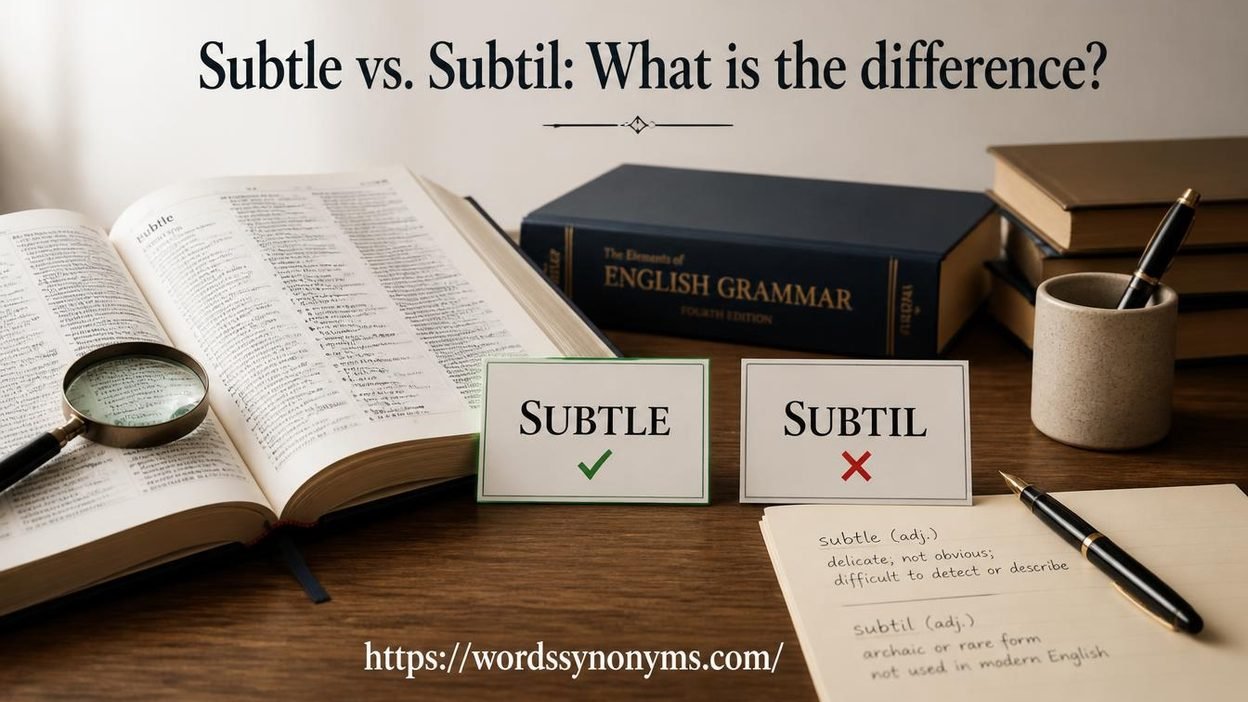
Subtle is the standard spelling in modern English, while subtil is an archaic spelling that is no longer used in contemporary English. In Subtle vs. Subtil: What is the difference? the main difference involves spelling, meaning, and linguistic usage. Subtle is an adjective that describes something slight, difficult to notice, or not immediately obvious.
For example, “She made a subtle change to the design.” The change was small but meaningful. Although subtil is an obsolete spelling in English, it remains a word in French and German. Therefore, always choose subtle as the correct spelling in modern English writing.
The related grammatical forms of subtle include subtlety, subtleness, and subtly. Subtlety describes the quality of being subtle, while subtleness is a less common noun with a similar meaning. Subtly is the adverb form, as in, “He subtly changed the subject.”
Understanding these word variations helps you avoid spelling mistakes and communicate your intended meaning clearly. Remember that subtle is the accepted English adjective, subtlety and subtleness are nouns and subtly is the adverb.
Quick Answer
Subtle is the correct spelling in modern English. It describes something delicate, indirect, or difficult to notice, such as a subtle change in someone’s voice or a subtle difference in color. Subtil is an obsolete spelling that may appear in older texts but isn’t used in everyday writing. Remember that the b in subtle is silent, so it’s pronounced “SUT-ul.”
Subtle vs. Subtil: The Key Difference
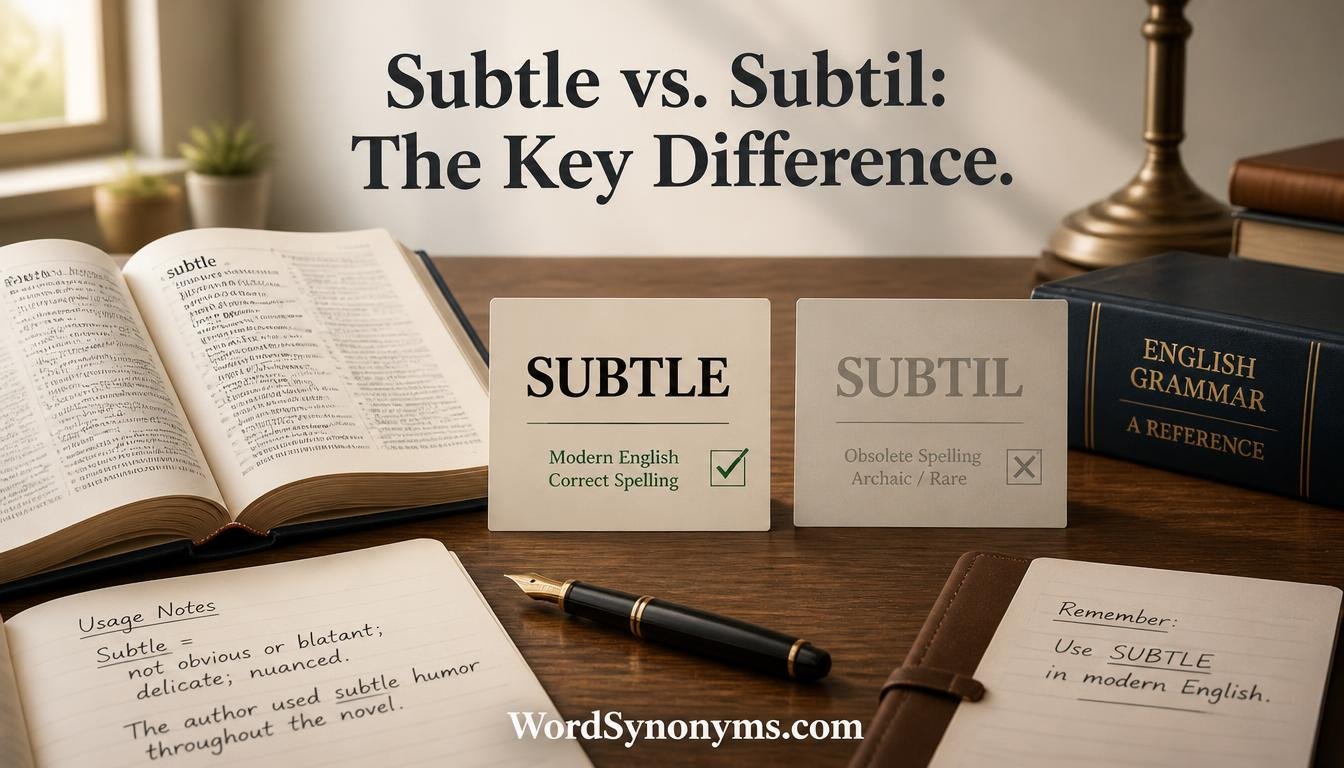
The main difference between subtle and subtil concerns their status in modern English. Subtle is the standard spelling, while subtil is an obsolete form that readers may encounter in historical writing.
Although the two forms share a historical relationship, they aren’t equally suitable for contemporary communication. Modern dictionaries recognize subtle as the ordinary spelling for the adjective used to describe delicate distinctions, indirect behavior, and things that are difficult to detect.
Consider these examples:
- Correct: She noticed a subtle change in his expression.
- Outdated: She noticed a subtil change in his expression.
The first sentence follows modern English spelling conventions. The second uses a historical spelling that would look unusual in contemporary writing.
Here’s a quick comparison.
| Feature | Subtle | Subtil |
| Modern status | Standard spelling | Obsolete spelling |
| Part of speech | Adjective | Historical adjective form |
| General meaning | Delicate, indirect, or difficult to notice | Historically similar to subtle |
| Everyday usage | Common | Rare |
| Professional writing | Recommended | Generally avoided |
| Pronunciation | The b is silent | Historical pronunciation may vary |
| Best choice today | Yes | Only when historical context requires it |
Remember: When you mean something is understated, nuanced, or difficult to notice, write subtle.
What Does Subtle Mean?
The word subtle describes something that isn’t immediately obvious or easy to recognize. It can refer to a small difference, an indirect message, a delicate flavor, or an idea that requires careful thought.
For example, imagine entering a room where someone has changed the lighting. You may not notice the adjustment immediately, but the room feels warmer and more inviting. That small, almost unnoticeable difference is a subtle change.
The word can describe physical details, emotions, communication styles, artistic choices, and complex ideas. Its exact meaning depends on the context.
Subtle Meaning: Slight or Difficult to Notice
One common meaning of subtle is so slight that it takes attention to recognize it.
A subtle change doesn’t necessarily escape notice forever. Instead, someone might need to look, listen, or think carefully before identifying it.
Examples include:
- The painting contains subtle shades of green.
- I noticed a subtle difference between the two photographs.
- The perfume has a subtle floral scent.
- A subtle smile appeared on her face.
- The weather brought a subtle change in temperature.
In these sentences, subtle highlights details that aren’t bold, strong, or immediately noticeable.
For instance, a bright red wall creates an obvious visual impression. A pale red wall that blends gently with its surroundings creates a subtler effect.
Subtle Meaning: Indirect or Not Expressed Openly
The word can also describe communication that conveys a message without stating it directly.
A subtle hint allows someone to understand an idea without hearing an explicit request or explanation. People often use subtle communication when they want to remain polite, avoid conflict, or express an uncomfortable thought gently.
Examples:
- He gave me a subtle hint that it was time to leave.
- Her subtle criticism made everyone reconsider the proposal.
- The manager subtly encouraged the team to finish early.
- She made a subtle reference to their earlier disagreement.
Suppose your friend says, “It’s getting late, and we both have work tomorrow.” Your friend may not directly ask you to leave, but the message is clear.
That indirect suggestion is a subtle hint.
Subtle Meaning: Complex or Difficult to Understand
Sometimes, subtle describes an idea that requires careful thought because it contains fine distinctions.
A subtle argument might depend on a small difference between two concepts. A subtle joke might rely on wordplay, context, or an unexpected connection.
Examples:
- The professor explained a subtle distinction between the two theories.
- The novel explores subtle differences between loyalty and obedience.
- Her argument contained a subtle but important point.
- The film uses subtle symbolism to develop its central theme.
Here, subtle doesn’t simply mean small or faint. It suggests complexity that rewards closer attention.
Subtle Meaning: Clever or Skillfully Indirect
A subtle action can also demonstrate intelligence, restraint, or careful planning.
Instead of attracting attention, a person may influence a situation through a quiet, well-timed decision.
Examples:
- The negotiator used a subtle strategy to reach an agreement.
- His subtle humor made the presentation more engaging.
- The author used a subtle reference to an earlier chapter.
- She made a subtle adjustment that improved the entire design.
This meaning often appears in discussions of strategy, literature, humor, and persuasion.
What Does Subtil Mean?
Subtil is an obsolete spelling historically associated with subtle. It appears in older English usage, but it isn’t the normal spelling in contemporary American English.
Historical spellings can survive long after modern writers stop using them. English has changed considerably over the centuries, and spelling conventions haven’t always remained consistent.
The word subtil belongs to that older linguistic history. Depending on the period and passage, it may describe something delicate, ingenious, cunning, or difficult to perceive.
Today, however, writers generally use subtle to express these meanings.
Why You Might Encounter Subtil
Although subtil rarely appears in ordinary modern writing, it may occur in several situations.
Historical books: Older literary works may preserve spellings that differ from current conventions.
Historical documents: Original manuscripts and early printed texts often retain period-specific spelling.
Language research: Dictionaries and linguistic studies may discuss subtil when explaining how English words developed.
Historical quotations: A writer may preserve subtil when quoting an original source rather than silently modernizing its spelling.
These examples don’t make subtil the preferred modern form. They simply show why the spelling can still appear in certain contexts.
Should You Use Subtil in Modern Writing?
In most situations, no. Choose subtle when writing for contemporary readers.
For example:
- Modern: The author uses subtle imagery throughout the novel.
- Modern: We noticed a subtle difference in the results.
- Modern: Her subtle suggestion helped resolve the disagreement.
Using subtil in these sentences would distract many readers because the spelling looks archaic.
The exception is historical writing. If you’re quoting a source that originally uses subtil, preserving that spelling may be appropriate. When discussing the word itself, explain that it’s an obsolete form.
Subtle vs. Subtil Examples in Sentences
Examples make the spelling difference easier to remember. The following comparisons show how subtle works in modern English and why subtil generally belongs in historical discussions.
| Example | Explanation |
| She noticed a subtle change in his mood. | The change was difficult to detect. |
| The designer used subtle colors throughout the room. | The colors were soft and understated. |
| He offered a subtle suggestion during the meeting. | He communicated indirectly. |
| The essay examines a subtle difference between the theories. | The difference requires careful thought. |
| The historian encountered the spelling subtil in an old text. | The spelling appears in a historical context. |
Notice that subtle fits naturally into modern sentences. The word works across many subjects without changing its spelling.
Subtle in Everyday Conversation
People frequently use subtle when describing changes, reactions, and hints.
For example, imagine that a colleague receives disappointing news. They continue smiling, but their voice becomes slightly quieter. You might describe the change as a subtle shift in their mood.
Other everyday examples include:
- There was a subtle difference in the way she answered.
- I like the subtle flavor of lemon in this cake.
- He gave me a subtle nod from across the room.
- The room has a subtle fragrance from fresh flowers.
- Her expression showed a subtle hint of concern.
These sentences illustrate how the word helps you describe details without exaggerating their importance.
Subtle in Professional and Academic Writing
The word also plays an important role in formal communication because it helps writers discuss nuanced differences precisely.
In academic writing, a subtle distinction might separate two related theories. In business communication, a subtle change in customer behavior might reveal an emerging trend.
Consider these examples:
- The report identifies a subtle shift in consumer preferences.
- Researchers observed a subtle difference between the experimental groups.
- The proposal addresses a subtle weakness in the existing process.
- The author draws a subtle distinction between correlation and causation.
In each sentence, subtle communicates precision. It tells readers that a detail matters, even though the difference may not be immediately apparent.
However, avoid using the word simply to make a sentence sound sophisticated. Choose it when the detail genuinely involves delicacy, indirectness, or a fine distinction.
Subtil in Historical Texts
The spelling subtil can help readers recognize older forms of English. When studying historical material, the original spelling may provide useful evidence about writing conventions during a particular period.
For example, a historical text might contain a sentence using subtil to describe an ingenious plan or a difficult idea. A modern reader would usually understand the word through its historical relationship with subtle.
When interpreting such a passage, consider three things:
- The original context: What did the word describe?
- The historical period: Which spelling conventions were common at the time?
- The intended meaning: Does the word refer to cleverness, delicacy, indirectness, or complexity?
Don’t assume that every old spelling represents a separate modern word. Sometimes, spelling changes reflect the development of English rather than a major change in meaning.
Subtle vs. Subtil: Pronunciation Differences
The modern word subtle is pronounced approximately “SUT-ul” in American English. Its written b is silent.
This pronunciation surprises some readers because English usually pronounces the letter b in familiar words such as subway, subject, and submit. However, subtle follows a different pattern.
The standard pronunciation has two syllables:
- First syllable: SUT
- Second syllable: ul
The emphasis falls on the first syllable.
The historical spelling subtil shouldn’t be assumed to have one universal pronunciation across every period of English. Pronunciation can vary across historical sources, and modern readers may encounter it chiefly in written material.
Why Is the B Silent in Subtle?
The silent b reflects the word’s history. English adopted the word through French, and the spelling eventually came to reflect its Latin origin, subtilis.
The Latin form included a b, but the modern English pronunciation doesn’t sound that consonant.
This pattern isn’t unusual in English. Spelling often preserves traces of a word’s history even when pronunciation changes over time.
Consider these examples:
| Word | Pronunciation clue |
| Subtle | The b is silent. |
| Debt | The b is silent. |
| Doubt | The b is silent. |
| Thumb | The b is silent. |
| Comb | The b is silent. |
These words developed through different linguistic histories, but they share one useful lesson: English spelling doesn’t always tell you exactly how to pronounce a word.
For subtle, remember to pronounce the word naturally without inserting a b sound.
The History and Origin of Subtle vs. Subtil
The history of subtle explains why the modern spelling looks unusual.
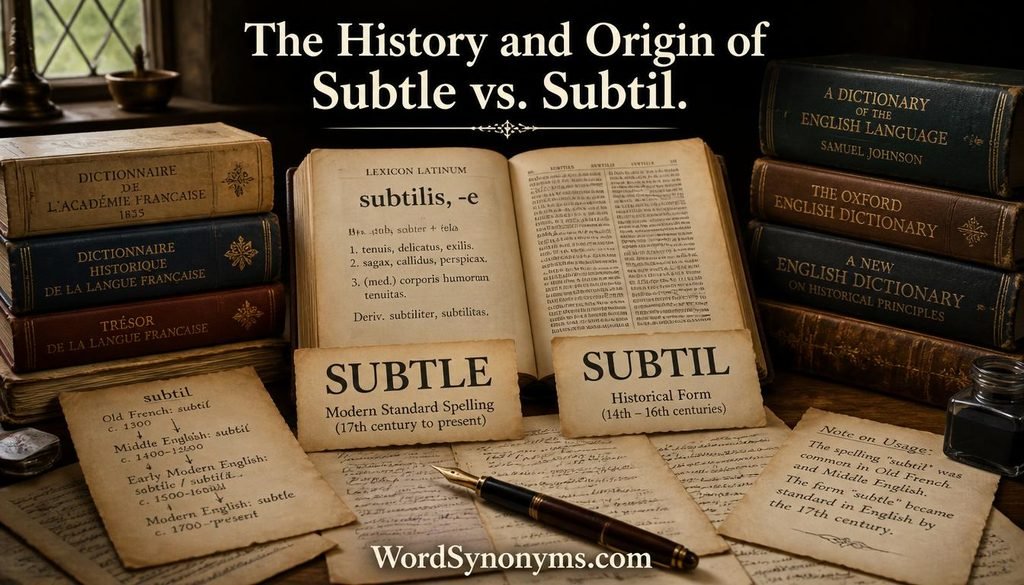
The word developed through earlier forms of English and French, ultimately connecting to the Latin adjective subtilis. That Latin word could describe something fine, delicate, or skillfully constructed. Its range of meaning helps explain the modern English uses of subtle.
Over time, English spelling shifted toward the form now used in standard dictionaries.
The older spelling subtil reflects an earlier stage of that history. As spelling conventions became more standardized, subtle became the normal form in contemporary English.
How the Word’s Meaning Developed
The modern meanings of subtle share a central idea: something requires care or attention to recognize fully.
1. A subtle color difference requires close observation.
2. A subtle hint requires interpretation.
3. A subtle argument requires careful thought.
These uses may seem different, but they share the idea of something that isn’t immediately obvious.
The historical sense of delicacy or refinement also helps explain why the word appears in descriptions of art, food, writing, and design.
For example, a chef might balance several ingredients so that no single flavor dominates. A reviewer could describe the result as having a subtle flavor.
Similarly, a writer may develop a character’s feelings through small gestures rather than direct statements. Those choices can create a subtle emotional effect.
The word remains useful because it captures these fine distinctions in a single adjective.
Read more: That Which: Grammar and Examples
Subtle vs. Subtil: Common Spelling Mistakes
Although the difference between subtle and subtil is straightforward, several related mistakes can cause confusion.
Treating Both Spellings as Equally Standard
The historical relationship between the words doesn’t mean both forms are equally appropriate today.
Incorrect for ordinary modern writing: The speaker made a subtil suggestion.
Correct: The speaker made a subtle suggestion.
Use subtle unless the historical spelling itself is relevant to your discussion.
Pronouncing the B in Subtle
Another common mistake is pronouncing the written b.
The standard American pronunciation sounds like “SUT-ul,” not “sub-tul.”
Try saying the word naturally in a sentence:
“She noticed a subtle difference.”
With practice, the correct pronunciation becomes familiar.
Confusing Subtle With Subtile
The word subtile is a rare spelling variant associated with subtle. However, it isn’t the usual spelling in contemporary American English.
For general writing, use subtle. Readers will recognize it immediately, and you won’t distract them with an unusual variant.
Assuming an Old Spelling Is a Typographical Error
When you encounter subtil in an older document, don’t automatically assume the author made a mistake.
Historical English spelling varied considerably. A form that looks unusual today may have been accepted or used during an earlier period.
If you’re transcribing an original document, preserving its spelling may be important. If you’re writing a new article, use modern conventions.
Using Subtle When You Mean Obvious
The word also causes confusion when writers use it to describe something unmistakable.
For example:
- Less accurate: The bright flashing sign was subtle.
- Better: The bright flashing sign was conspicuous.
Subtle usually describes something understated or difficult to detect. Choose another word when the feature stands out clearly.
Subtle vs. Subtil: Related Words and Word Forms
Learning the related forms of subtle helps you use the word naturally in different sentence structures.
| Word | Part of speech | Meaning | Example |
| Subtle | Adjective | Delicate or difficult to notice | She noticed a subtle change. |
| Subtly | Adverb | In a delicate or indirect way | He subtly changed the subject. |
| Subtler | Comparative adjective | More subtle | The second design has a subtler pattern. |
| Subtlest | Superlative adjective | Most subtle | That was the subtlest hint. |
| Subtlety | Noun | The quality of being subtle | The subtlety of the argument impressed us. |
How to Use Subtly
Use subtly when describing how an action happens.
Examples:
- She subtly changed the subject.
- The artist subtly blended the colors.
- He subtly suggested a different approach.
The adverb modifies a verb by explaining the manner of the action.
How to Use Subtler and Subtlest
Use subtler when comparing two things. Use subtlest when identifying the most subtle item in a group.
Examples:
- This painting has a subtler color palette than the earlier version.
- Of all the clues, that was the subtlest.
You can also write more subtle and most subtle. Both constructions are acceptable.
How to Use Subtlety
The noun subtlety describes a fine distinction, delicate quality, or indirect feature.
Examples:
- The subtlety of her argument impressed the committee.
- Good comedy often depends on subtlety rather than exaggeration.
- The artist captured the subtlety of the changing light.
Remember that these related forms retain their own spellings. For example, subtly doesn’t become subtily in standard modern American English.
Subtle vs. Subtil: Synonyms and Antonyms
Synonyms can help you express a more precise meaning. However, words with similar definitions don’t always work interchangeably.
Common Synonyms of Subtle
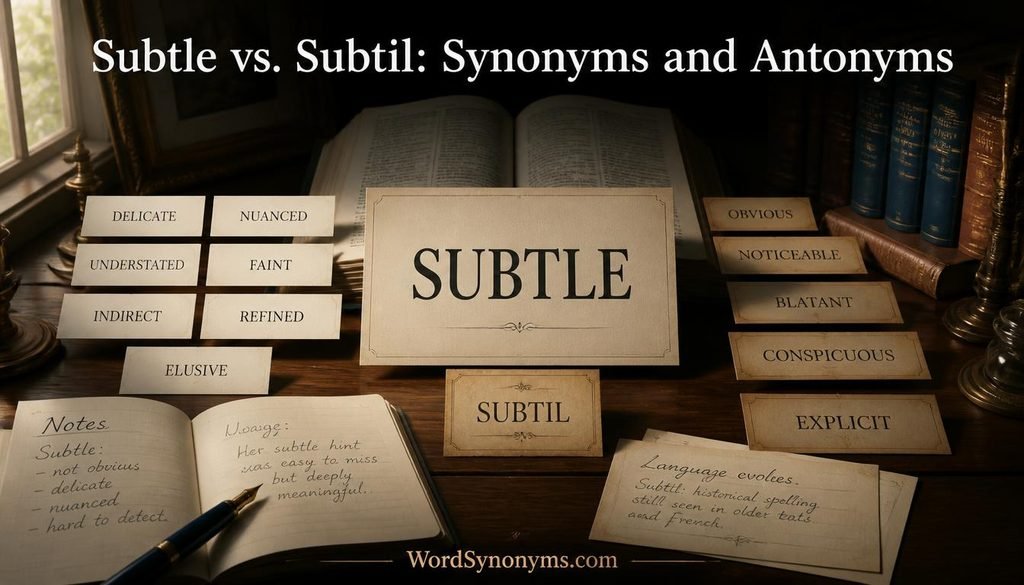
| Synonym | Meaning | Example |
| Delicate | Fine or easily affected | The fabric has a delicate pattern. |
| Nuanced | Showing fine distinctions | Her review offers a nuanced analysis. |
| Understated | Intentionally restrained | The room has an understated elegance. |
| Faint | Weak or barely noticeable | We heard a faint sound outside. |
| Indirect | Not stated openly | He made an indirect request. |
| Refined | Polished or sophisticated | The dish has a refined flavor. |
| Elusive | Difficult to find or understand | The solution remained elusive. |
These words overlap with subtle, but each adds a slightly different meaning.
For example, nuanced often emphasizes complexity and fine distinctions. Understated suggests restraint, while faint usually refers to something weak or barely perceptible.
Choosing the right synonym makes your writing more precise.
Common Antonyms of Subtle
Antonyms express the opposite idea.
- Obvious: Easy to recognize or understand.
- Noticeable: Easy to see, hear, or detect.
- Blatant: Extremely obvious, often in an offensive way.
- Conspicuous: Attracting attention.
- Explicit: Stated clearly and directly.
For example, a subtle suggestion communicates an idea indirectly. An explicit instruction states exactly what someone should do.
Similarly, a subtle design may blend into its surroundings, while a conspicuous design immediately attracts attention.
How to Remember the Correct Spelling
The easiest way to remember subtle vs. subtil is to connect the modern spelling with the situations in which you use the word.
Use subtle for contemporary English. Reserve subtil for historical references that require the original form.
These simple techniques can help:
- Remember the silent B: Write subtle, but pronounce it “SUT-ul.”
- Think about modern usage: Subtle hints, subtle colors, and subtle differences all use the same spelling.
- Check the context: If you’re writing a new article, choose subtle. If you’re quoting an old source, verify its original spelling.
- Learn the word family: Subtle, subtly, subtler, subtlest, and subtlety all belong to the same family.
A useful memory sentence is: “The subtle clue revealed a subtle difference.”
Both uses reinforce the correct spelling and show how naturally the word fits into everyday English.
Read more: T-Shirt, T-Shirt, Tee-Shirt, or Tee Shirt: Which Is Correct?
A Practical Case Study: Choosing Between Subtle and Subtil
Imagine you’re editing a business report about customer behavior.
Your first draft reads:
“The survey revealed a subtil change in customer preferences.”
The sentence communicates the intended meaning, but subtil looks outdated in contemporary business writing.
You revise it:
“The survey revealed a subtle change in customer preferences.”
Now the spelling follows modern English conventions, and the sentence reads naturally.
Consider a second situation. You’re studying an old printed book and find the spelling subtil in a passage describing a clever plan.
In that case, the spelling may be part of the original historical text. If you quote the passage exactly, you may preserve it. If you summarize the passage in your own words, you would normally use subtle.
These examples show that spelling choices depend partly on purpose. Modern writing calls for modern spelling, while historical analysis may require preserving older forms.
Frequently Asked Questions
1. Is subtle or subtil the correct spelling?
Subtle is the correct spelling in modern English. Subtil is an obsolete English spelling that you may encounter in older texts.
2. What does subtle mean?
Subtle describes something slight, delicate, or difficult to notice or understand. For example, “There was a subtle difference between the two paintings.”
3. Why is the B silent in subtle?
The B in subtle is silent because of the word’s historical development. Although you write the letter, you pronounce the word approximately as “SUH-tuhl.”
4. What is the noun form of subtle?
The most common noun form is subtlety, which describes a fine distinction or a quality of being subtle. Subtleness is also a noun, but it is less common.
5. How do you use subtly in a sentence?
Subtly is the adverb form of subtle. It describes an action performed in a slight or understated way. For example, “She subtly changed the subject during the conversation.”
6. Is subtil still used in other languages?
Yes, subtil remains a word in languages such as French and German. However, English speakers generally use subtle in modern writing, so the correct choice depends on the language you’re using.
Conclusion
In the Subtle vs. Subtil spelling debate, the correct choice for modern English is simple: use subtle. It describes something delicate, slight, or difficult to notice, making it useful in everyday conversations and formal writing. Although subtil appears in older English texts, it is no longer the standard spelling.
Remember the related forms, too: subtlety and subtleness are nouns, while subtly is the adverb. Learning these variations helps you avoid common spelling errors and express your ideas more clearly. The next time you describe a small change, a hidden meaning, or a fine distinction, choose subtle with confidence.

Syeda Naalain Zahra is a content writer with an interest in English vocabulary and language. She creates simple and informative articles about synonyms, antonyms, word meanings, and everyday English usage. Her aim is to help readers build better vocabulary and communicate more confidently.