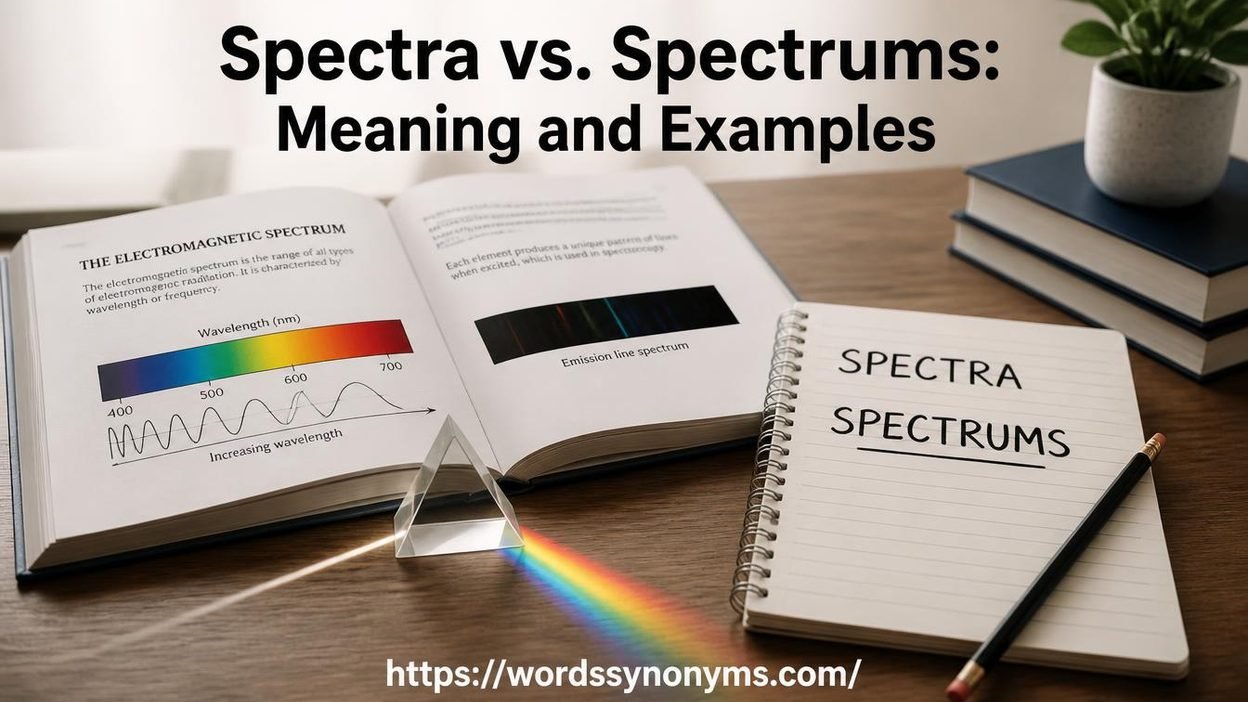
Spectra vs. Spectrums: Meaning and Examples explains the difference between these two plural forms of the word spectrum.
Although both are accepted in English grammar, spectra is the traditional Latin-derived plural, commonly used in scientific writing, academic contexts, and formal communication. In contrast, spectrums follows regular English pluralization and appears more often in everyday language and informal writing.
The choice between spectra and spectrums depends on your audience and writing style. Spectra is generally preferred in scientific contexts because it follows traditional grammar and established language conventions.
For example, scientists often study light spectra to understand different wavelengths. Meanwhile, spectrums is also an accepted plural form in modern English. You can use it in non-technical contexts when it sounds more natural. Understanding these usage differences helps you choose the right word for your sentence without assuming that either form is incorrect.
Quick Answer
Both spectra and spectrums are correct plural forms of spectrum. Spectra is more common in scientific writing, such as discussions of light, chemistry, and astronomy. Spectrums works well in general English when describing different ranges, opinions, or experiences. Choose the form that fits your context, and remember that spectras is not the standard plural.
Spectra vs. Spectrums: Quick Comparison
Both spectra and spectrums are plural forms of the singular noun spectrum. The main difference lies in convention and context rather than basic meaning.
| Feature | Spectra | Spectrums |
| Singular form | Spectrum | Spectrum |
| Part of speech | Plural noun | Plural noun |
| Grammatical status | Correct | Correct |
| Word formation | Traditional Latin-derived plural | Regular English plural |
| Common contexts | Science, physics, chemistry, astronomy | General English, discussions of ranges and viewpoints |
| Example | Scientists analyzed several spectra. | The report examined different spectrums of opinion. |
These distinctions describe common tendencies rather than strict grammatical rules. You may encounter spectra in general writing and spectrums in technical discussions.
Quick answer: Use spectra when it matches established terminology in your field. Use spectrums when the regular English plural fits your sentence and audience.
What Does Spectra Mean?
Spectra is the plural of spectrum. It refers to two or more spectra, which can represent distributions, ranges, or collections of related values.
The word appears frequently in scientific contexts. For example, scientists study light spectra to understand the wavelengths emitted, absorbed, or reflected by different substances.
However, spectra isn’t limited to science. Writers also use it to describe ranges of political opinions, social experiences, or other characteristics.
How Spectra Is Used in Science
In science, a spectrum represents a distribution of measurable properties. The exact meaning depends on the subject being studied.
In optics, a light spectrum can show how light separates into different wavelengths. In chemistry, a spectrum can help researchers identify substances by examining how they interact with electromagnetic radiation.
Astronomers also study spectra to learn about distant stars and galaxies. By analyzing the light they receive, researchers can investigate a celestial object’s composition, temperature, and movement.
Consider these examples:
- Astronomers compared the spectra of several distant stars.
- The laboratory recorded the absorption spectra of different chemical compounds.
- Researchers examined the emission spectra produced by heated gases.
- The telescope captured detailed spectra from a distant galaxy.
In these sentences, spectra refers to multiple scientific distributions or measurements.
How Spectra Is Used in General English
Outside scientific writing, spectra can describe multiple ranges of ideas, opinions, or experiences.
For example, a political discussion might cover several spectra of opinion. A social study might examine different spectra of human behavior.
This usage follows the same basic principle: one spectrum represents a range, while multiple spectra represent more than one.
Examples include:
- The conference explored the spectra of cultural experiences.
- The report compared the spectra of public opinion across several communities.
- Researchers examined different spectra of human behavior.
Although these sentences are grammatically possible, spectrums may sound more natural to some readers in general prose. The best choice depends on context and editorial preference.
What Does Spectrums Mean?
Spectrums is another accepted plural of spectrum. It follows a familiar English pattern by adding -s to the singular noun.
English contains many nouns with regular plurals, such as book/books, range/ranges, and system/systems. The form spectrums follows this same pattern.
Although spectra has a long history in scientific terminology, spectrums isn’t an incorrect alternative. It can work well when writers discuss multiple ranges or continua in ordinary English.
How Spectrums Is Used in General Writing
The word spectrum often describes a range between different positions, conditions, or possibilities. When a sentence refers to several distinct ranges, spectrums can express that meaning.
For example, a report might examine different spectrums of public opinion. A researcher might compare several spectrums of risk across different industries.
Here are some examples:
- The survey explored different spectrums of public opinion.
- The report compared several spectrums of risk.
- These models represent different spectrums of human behavior.
- The discussion covered multiple spectrums of social experience.
These examples use spectrums as a plural noun. Each sentence refers to more than one range or continuum.
Is Spectrums Suitable for Formal Writing?
Yes. Spectrums is grammatically acceptable in formal writing. However, the subject matter may influence which form sounds most natural.
In a physics paper, spectra will often be the conventional choice. In an article about several ranges of public opinion, spectrums may fit comfortably.
When writing for a university, journal, or professional organization, check its style guide and established terminology. Consistency matters more than forcing one plural form into every situation.
What Is the Difference Between Spectra and Spectrums?
The main difference between spectra and spectrums is their word formation and common usage. Both refer to multiple spectra or ranges, but certain contexts favor one form over the other.
Differences in Usage
The word spectra is especially common in scientific and technical writing. Scientists use expressions such as mass spectra, atomic spectra, and emission spectra when describing measurements and observations.
The form spectrums also appears in standard English, particularly when writers discuss multiple ranges of opinions, experiences, or characteristics. Neither form is restricted exclusively to one subject.
For example:
- The astronomers analyzed the spectra of several stars.
- The discussion examined different spectrums of public opinion.
Both sentences use a correct plural. The first follows familiar scientific terminology, while the second uses the regular English plural.
Differences in Meaning
Do spectra and spectrums have different meanings? Generally, no. Both are plural forms of the same noun, so the choice doesn’t automatically change the intended meaning.
Consider these examples:
- The researchers studied several spectra of electromagnetic radiation.
- The researchers studied several spectrums of electromagnetic radiation.
Both sentences communicate the same basic idea. However, spectra sounds more conventional in this scientific context.
The same principle applies to broader subjects. Writers can use either form to discuss multiple ranges, provided the wording suits the intended meaning.
Differences in Formality and Style
Some writers assume spectra is more formal and spectrums is informal. That distinction oversimplifies the issue.
Spectra is the traditional plural form and has a strong presence in scientific terminology. Meanwhile, spectrums follows standard English plural formation and remains suitable for formal writing.
Your choice should depend on three practical factors:
- Subject matter: Scientific disciplines often favor established technical expressions.
- Audience: General readers may find the regular plural more familiar in some contexts.
- Consistency: A document should follow its chosen terminology unless the context calls for a change.
In other words, choose the form that communicates your meaning clearly without fighting the conventions of your subject.
Which Form Should You Choose?
When deciding between spectra and spectrums, use this simple guide:
| Situation | Recommended approach |
| Writing about light or electromagnetic radiation | Prefer spectra when following standard scientific terminology. |
| Discussing chemical measurements | Use spectra in conventional technical expressions. |
| Writing about multiple ranges of opinions | Either form may work, depending on the sentence. |
| Preparing a scientific paper | Follow the terminology used in your discipline. |
| Writing a general audience article | Choose the form that sounds natural and remains clear. |
| Editing an existing document | Keep the usage consistent unless a change improves accuracy. |
The key is flexibility. You don’t need to treat spectrums as a mistake simply because spectra is more familiar in scientific contexts.
Spectra vs. Spectrums in Different Contexts
Context makes the choice easier. Let’s examine how both plural forms work across several fields.
Science and Physics
In physics, a spectrum can represent the distribution of electromagnetic radiation according to wavelength or frequency. Scientists study spectra to understand how radiation behaves and interacts with matter.
For example, visible light can be separated into colors. The resulting band forms part of the electromagnetic spectrum, which also includes radio waves, microwaves, infrared radiation, ultraviolet radiation, X-rays, and gamma rays.
When scientists compare multiple such distributions, spectra is the conventional choice.
Examples:
- The physicist compared the emission spectra of two light sources.
- The instrument recorded several absorption spectra.
- Researchers examined the energy spectra of different particles.
Although spectrums is also accepted, spectra fits these established technical expressions naturally.
Chemistry and Astronomy
Chemistry and astronomy provide especially clear examples of the word’s scientific use.
Chemists can examine how substances absorb or emit radiation. These measurements produce spectra that may help identify compounds or reveal details about their structure.
Astronomers use spectroscopy to study light from stars, galaxies, and other celestial objects. The features in a spectrum can provide evidence about an object’s chemical composition, temperature, and motion.
For instance:
- The chemist compared the spectra of several samples.
- Astronomers studied the spectra of distant galaxies.
- The research team identified characteristic features in the recorded spectra.
These examples demonstrate why spectra remains deeply established in scientific vocabulary.
Politics and Society
The word spectrum also describes a range of positions or opinions. A political spectrum, for example, represents different political viewpoints rather than a physical distribution of light.
When writers discuss several distinct ranges, both plural forms can work.
Examples:
- The researchers compared political spectrums across different regions.
- The discussion explored the spectra of social attitudes.
- The report examined different spectrums of public opinion.
The first and third examples use the regular English plural. The second uses the traditional plural.
In general prose, the best option depends on the sentence’s rhythm, the intended audience, and the publication’s preferred style.
Psychology and Human Behavior
People also use spectrum to describe a range of characteristics, experiences, or behaviors. The word suggests variation rather than a simple division into two opposing categories.
For example, a study might explore different spectrums of human behavior or examine several spectra of responses to a particular situation.
However, writers should be careful not to imply that every behavioral range represents a formally defined scientific spectrum. The term should match the research and its findings.
Examples:
- The study considered a broad spectrum of responses.
- Researchers compared the spectra of measured behavioral patterns.
- The report discussed several spectrums of social experience.
Notice that the singular form remains useful even when a range contains many individual possibilities. You need a plural only when referring to multiple distinct ranges.
General and Academic Writing
In essays, reports, and everyday communication, either plural may be appropriate. The subject and sentence structure usually provide enough context to make the choice.
Consider these examples:
- The report covered a broad spectrum of issues.
- The reports covered several spectrums of issues.
- The laboratory produced multiple spectra for comparison.
The first sentence uses the singular because it refers to one broad range. The second uses spectrums because it refers to several ranges. The third follows conventional scientific usage.
The lesson is straightforward: identify what you mean before choosing the plural.
Read more: Summary vs. Summery: Difference and Examples
Grammar Rules for Spectra and Spectrums
Both forms follow clear grammatical rules. Once you understand the singular noun and its plural forms, using them correctly becomes much easier.
Is Spectrum Singular or Plural?
Spectrum is singular. Spectra and spectrums are plural.
Use spectrum when referring to one range or distribution. Use either accepted plural when referring to more than one.
| Number | Correct form | Example |
| Singular | Spectrum | The spectrum contains several wavelengths. |
| Plural | Spectra | The spectra contain different wavelengths. |
| Plural | Spectrums | The report examines several spectrums of opinion. |
A common mistake is using spectra when the sentence requires a singular noun.
Incorrect: The spectra shows a broad range of colors.
Correct: The spectrum shows a broad range of colors.
Correct: The spectra show different ranges of colors.
The verb must agree with the noun, not with the writer’s preferred plural form.
Should You Use a Singular or Plural Verb?
Both spectra and spectrums take plural verbs in standard English.
Use is, was, or shows with the singular spectrum. Use are, were, or show with the plural forms.
Examples:
- The spectrum is wider than expected.
- The spectra are difficult to distinguish.
- The spectrums were examined separately.
- Each spectrum shows a different distribution.
- Several spectra show similar patterns.
Remember that a long sentence can make agreement harder to spot. Identify the main subject first, then select the correct verb.
Is Spectras Correct?
Spectras is not the standard plural of spectrum.
The word already has two accepted plural forms: spectra and spectrums. Adding another -s to spectra creates a nonstandard form.
For example:
Incorrect: The scientist compared three spectras.
Correct: The scientist compared three spectra.
Also correct: The scientist compared three spectrums.
If you need to refer to several groups of spectra, use a phrase that clearly describes those groups.
- Three groups of spectra were analyzed.
- The researchers compared several sets of spectra.
- Multiple collections of spectra were stored separately.
These constructions avoid the unnecessary form spectras.
Can You Use Both Forms in the Same Article?
Yes. English permits both plural forms, so an article may contain spectra and spectrums when the context supports each choice.
However, switching between them without a reason can distract readers. A consistent approach usually produces smoother writing.
For example, a science article might use spectra throughout its technical discussion. If the article later discusses several broad ranges of public opinion, spectrums might fit that section naturally.
Consistency doesn’t mean forcing one form into every sentence. It means making deliberate choices that suit the meaning.
Common Mistakes to Avoid
Even though both plurals are correct, a few mistakes can make your writing confusing or grammatically incorrect.
| Mistake | Better version | Why |
| The spectra is clear. | The spectra are clear. | Spectra is plural. |
| The spectrums shows a pattern. | The spectrums show a pattern. | A plural subject takes a plural verb. |
| We recorded three spectras. | We recorded three spectra. | Spectras is nonstandard. |
| Spectrum are difficult to compare. | Spectra are difficult to compare. | The sentence needs a plural noun. |
| The spectra was analyzed. | The spectra were analyzed. | The plural noun requires a plural verb. |
| Spectrums is always incorrect. | Spectrums is an accepted plural form. | Both forms are correct. |
Here are some additional points worth remembering:
- Don’t assume that every scientific term requires a Latin-derived plural.
- Don’t assume that regular English plurals are unsuitable for formal writing.
- Don’t confuse one broad spectrum with several separate spectrums.
- Don’t change terminology simply to make a sentence sound more sophisticated.
- Don’t overlook subject-verb agreement when revising a sentence.
Clear writing depends on accuracy, not on choosing the word that looks more complicated.
Spectra vs. Spectrums: Example Sentences
Examples make grammatical rules easier to remember. The following sentences demonstrate how each plural form works in different situations.
Examples Using Spectra
Use spectra when it fits your sentence and the terminology of your subject.
- The astronomers studied the spectra of several distant stars.
- The laboratory compared the absorption spectra of different compounds.
- Scientists analyzed the emission spectra produced by heated gases.
- The instrument recorded multiple spectra during the experiment.
- The researchers examined the energy spectra of the particles.
- Several spectra displayed similar patterns across the measured wavelengths.
- The report included the spectra collected during the final stage of testing.
Each example refers to more than one spectrum. The plural form fits the sentence without changing the noun’s basic meaning.
Examples Using Spectrums
Use spectrums when the regular English plural suits your context.
- The report compared different spectrums of public opinion.
- The discussion covered several spectrums of social experience.
- Researchers explored various spectrums of human behavior.
- The organization considered different spectrums of risk.
- These models represent separate spectrums of possible outcomes.
- The meeting brought together people with different spectrums of experience.
- The study examined several spectrums of responses to the same issue.
These sentences demonstrate the regular plural in general English. Depending on the intended meaning, a writer might also choose spectra in some of these examples.
Examples Comparing Both Forms
The following pairs show how both forms can appear in similar sentences.
Example one: Scientific research
- The researchers compared the spectra of several samples.
- The researchers compared the spectrums of several samples.
Both are grammatically possible, but spectra is the more conventional choice for scientific measurements.
Example two: Public opinion
- The report explored different spectra of public opinion.
- The report explored different spectrums of public opinion.
Both communicate the idea of multiple ranges of opinion. The best choice depends on the writer’s style and audience.
Example three: General discussion
- The conference covered several spectra of experience.
- The conference covered several spectrums of experience.
Both forms can work. However, a writer may prefer a more familiar expression, such as a wide range of experiences, if it communicates the point more naturally.
Read more: Subtle vs. Subtil: What is the difference?
A Practical Case Study: Choosing the Right Plural
Imagine an editor reviewing two short passages for a publication. The first discusses laboratory measurements, while the second covers public attitudes.
Case Study: A Scientific Report
Original sentence:
“The team compared three spectrums produced by the instrument.”
The sentence is understandable and grammatically possible. However, the report uses conventional scientific terminology elsewhere.
Revised sentence:
“The team compared three spectra produced by the instrument.”
The revision aligns with established scientific usage. It also keeps the terminology consistent with the rest of the report.
Case Study: A Social Research Article
Original sentence:
“The researchers examined several spectra of public opinion.”
This sentence is grammatically correct. However, the article uses regular English plurals throughout its discussion of broad categories and ranges.
Possible revision:
“The researchers examined several spectrums of public opinion.”
The revision matches the article’s chosen style without changing the basic meaning.
These examples illustrate an important principle: the right choice depends on context, not on a rule that declares one form universally correct.
FAQs
1. Is spectra or spectrums correct?
Both spectra and spectrums are correct plural forms of spectrum. Spectra is traditionally preferred in scientific and formal writing, while spectrums is common in general English.
2. What is the singular form of spectra?
The singular form of spectra is spectrum. For example, you might study one spectrum of light or compare several spectra.
3. Why do scientists prefer spectra over spectrums?
Scientists generally prefer spectra because it follows the traditional Latin plural form. Scientific writing often preserves established terminology to maintain consistency and precision.
4. Can I use spectrums in academic writing?
Yes, but spectra is usually the safer choice in scientific or technical papers. In other academic contexts, spectrums may be appropriate depending on the subject, style guide, and intended meaning.
5. What is the plural of spectrum in everyday English?
Both spectra and spectrums work in everyday English. For example, you can discuss a broad spectrum of opinions or several spectrums of experience, although the first phrasing is more common.
6. Do spectra and spectrums have different meanings?
Generally, no. Spectra and spectrums have the same basic meaning and refer to multiple spectra or ranges. The main difference is their usage: spectra follows Latin tradition, while spectrums follows regular English pluralization.
Conclusion
Choosing between spectra and spectrums becomes simple once you understand their usage. Both are correct plural forms of spectrum, but spectra is the traditional choice for scientific, technical, and formal writing. Spectrums fits naturally into everyday English and less technical discussions.
When writing, consider your audience, subject, and preferred style. If you’re discussing light, physics, or scientific research, spectra is usually the better option. For general conversations, spectrums can work just as well. Ultimately, understanding this small difference helps you write more clearly and choose the word that best fits your context.

Syeda Naalain Zahra is a content writer with an interest in English vocabulary and language. She creates simple and informative articles about synonyms, antonyms, word meanings, and everyday English usage. Her aim is to help readers build better vocabulary and communicate more confidently.