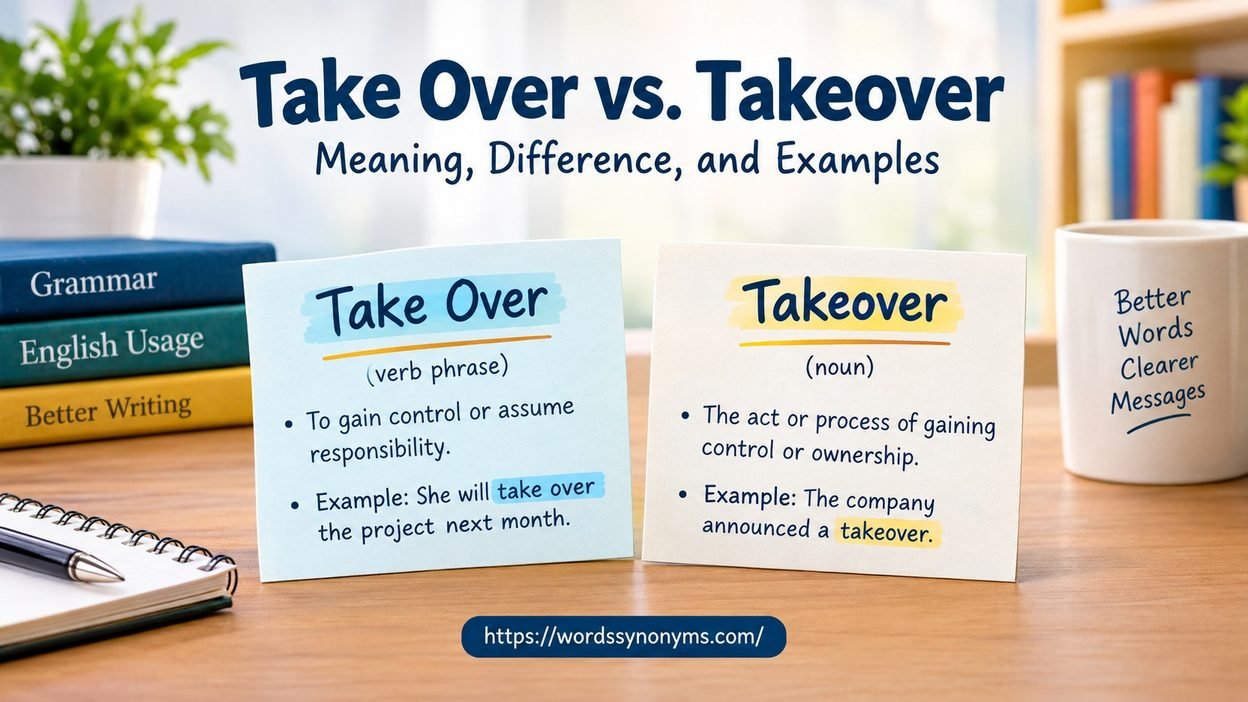
Take Over vs. Takeover: Meaning and Difference explains why one phrase uses two words while the other uses one, despite their related meanings and different grammatical functions.
Take over is a phrasal verb that means gaining control of something. For example, “The conqueror wants to take over the country to the east.” In contrast, takeover is a noun describing the act of gaining control, as in “The takeover of the country was peaceful.” The one-word form can also function as an adjective, but it isn’t a standard verb.
This difference matters when writing about control, ownership, or authority. English has countless phrasal verbs with corresponding one-word forms that function as nouns or function as adjectives. These word forms have different grammatical functions, even when their meaning is closely related.
In edited writing and published writing, one-word forms such as takeover never catch on as standard verbs. However, people sometimes use them as verbs in informal contexts and commonly treat them as verbs in everyday conversation.
From a practical editing perspective, checking usage and identifying the correct forms helps prevent grammatical mistakes. Remember that take over vs. takeover depends on how you use the expression in a sentence: choose the two-word phrasal verb for an action and the one-word noun for the act or event.
Quick Answer
Take over is a phrasal verb that means to gain control or assume responsibility, while takeover is a noun that describes the act of gaining control. For example, “The company will take over its competitor” describes an action, while “The company announced a takeover” refers to the event. Use two words for the verb and one word for the noun.

Take Over vs. Takeover: The Key Difference
The main difference between take over and takeover is their grammatical function. Although both relate to gaining control, you cannot usually substitute one for the other without changing the sentence structure.
Take over consists of the verb take and the particle over. Together, they form a phrasal verb that means to assume control, responsibility, authority, or ownership.
Takeover, on the other hand, is a compound noun. It refers to the act or process of gaining control of something, especially a company or organization.
Consider these examples:
- Take over: The new director will take over the department next month.
- Takeover: The director’s takeover of the department surprised the employees.
In the first sentence, take over describes an action the director will perform. In the second, takeover identifies the event itself.
The distinction becomes clearer when you compare their grammatical features.
| Feature | Take Over | Takeover |
| Part of speech | Phrasal verb | Noun |
| Spelling | Two words | One word |
| Main meaning | To assume control or responsibility | The act or process of gaining control |
| Typical use | Describing an action | Naming an event or process |
| Example | They will take over the business. | The takeover is complete. |
| Common modifiers | Can be followed by an object | Can be modified by adjectives |
| Example with a modifier | She will take over the project. | The hostile takeover attracted attention. |
The easiest rule to remember: Use take over when describing what someone does. Use takeover when naming the event or process.
What Does Take Over Mean?
Take over is a phrasal verb that means to gain control of something or assume a role, duty, or responsibility. The exact meaning depends on the situation.
For example, a manager might take over a department, a colleague might take over someone’s shift, or a business might take over another company.
The phrase can describe a planned transfer of responsibility, a change in leadership, or a situation in which something gains control unexpectedly.
Examples of Take Over in Sentences
Here are several examples showing how to use take over correctly.
- Business: The technology company plans to take over its smaller competitor.
- Workplace: Maria will take over the project while Daniel is on vacation.
- Leadership: The deputy director had to take over after the director resigned.
- Daily life: My older brother usually takes over the cooking when our parents are busy.
- Unexpected control: Panic began to take over as the storm approached.
- Transportation: A second driver will take over after the first driver rests.
Notice that the phrase remains two words in every example. The verb may change tense or form, but the two-word structure remains intact.
For instance, you can write take over, takes over, took over, taking over, or taken over. Each form describes an action rather than naming an event.
Common Uses of Take Over
The phrase take over appears in several contexts. Understanding these uses will help you recognize its meaning more quickly.
Assuming responsibility: Someone takes over when they accept duties previously handled by another person.
Example: “A senior accountant will take over the monthly reporting process.”
Gaining business control: A company takes over another business when it gains control of its operations or ownership.
Example: “The retail chain plans to take over three regional stores.”
Replacing someone: A person takes over when they assume another person’s position, shift, or role.
Example: “A substitute teacher will take over the class this afternoon.”
Gaining influence: An emotion, activity, or situation can take over when it begins to dominate.
Example: “Excitement took over when the team scored the winning goal.”
Assuming control of operations: An organization may take over a service, facility, or process previously managed by someone else.
Example: “The city will take over the maintenance of the public park.”
These meanings share one central idea: something or someone assumes control, influence, or responsibility.
How to Use Take Over in Different Tenses
Because take over is a verb phrase, you can change its tense to show when an action happens.
| Verb form | Example |
| Present | She takes over the evening shift. |
| Present continuous | She is taking over the evening shift. |
| Simple past | She took over the evening shift. |
| Present perfect | She has taken over the evening shift. |
| Past perfect | She had taken over the evening shift before the manager arrived. |
| Future | She will take over the evening shift tomorrow. |
Pay particular attention to the past-tense forms. The simple past is took over, while the past participle is taken over.
Incorrect: “She has took over the department.”
Correct: “She has taken over the department.”
This distinction matters because take is an irregular verb. Its principal forms are take, took, and taken.
Can You Separate Take Over?
Yes. In many sentences, you can place an object between take and over. This feature is common with phrasal verbs.
For example:
- The company will take over the factory.
- The company will take the factory over.
Both sentences are grammatically correct. However, the second arrangement may sound less natural in some contexts.
Pronouns generally go between the verb and the particle.
- Correct: The company will take it over.
- Incorrect: The company will take over it.
This flexibility is another useful clue that take over functions as a phrasal verb.
Read more: Somebody vs. Someone: Rules and Examples
What Does Takeover Mean?
Takeover is a noun that describes an act, event, or process in which someone gains control of something. It appears most often in business and finance, although it can also describe political, organizational, or other changes in control.
In business, a takeover usually involves one company acquiring control of another. Depending on the transaction, the acquiring company may purchase shares, assets, or another ownership interest that gives it control.
For example, consider this sentence:
“The proposed takeover could change the company’s leadership and business strategy.”
Here, takeover names a proposed transaction. It does not describe the action through a verb phrase.
You can identify the noun by looking at how it functions in a sentence. It can follow an article, appear as the subject or object, and take an adjective that describes the type of takeover.
Examples include:
- A takeover is expected next year.
- The hostile takeover attracted media attention.
- Investors opposed the proposed takeover.
- The takeover of the company required regulatory approval.
In each example, takeover names an event or process.
Examples of Takeover in Sentences
The following examples show how the noun works in different situations.
- Business: The company announced a takeover of its smaller rival.
- Finance: Investors closely monitored the proposed takeover.
- Corporate leadership: The takeover resulted in several changes to the management team.
- Politics: The military takeover disrupted the country’s political institutions.
- Technology: The acquisition raised concerns about a potential takeover of the market.
- Sports: The team’s second-half takeover of the match surprised its opponents.
The context determines the precise meaning. A business takeover generally concerns control of an organization, while a political takeover may involve control of a government or institution.
One important distinction: takeover does not automatically mean an illegal or hostile action. A takeover can occur with the target company’s agreement or against the wishes of its management.
Common Types of Takeovers
The word takeover can describe several different situations. In business writing, the following distinctions are especially useful.
Friendly takeover
A friendly takeover occurs when the target company’s leadership supports the proposed transaction. The companies typically negotiate the terms and follow the required approval process.
Example: “The board recommended the friendly takeover after reviewing the offer.”
Hostile takeover
A hostile takeover is an attempt to gain control of a company without the support of its existing management or board. Depending on the legal framework and ownership structure, the bidder may approach shareholders directly or pursue other available routes.
Example: “The bidder launched a hostile takeover attempt after negotiations failed.”
Management buyout
A management buyout occurs when a company’s existing managers purchase all or part of the business they manage. It is related to changes in control, although it is more specific than the general term takeover.
Example: “The management buyout allowed the leadership team to acquire the company.”
Government or military takeover
A political takeover occurs when a person, group, or institution assumes control of governmental power or public institutions. A military coup is one particular form of this kind of seizure of power.
Example: “The military takeover led to major changes in the country’s administration.”
These categories describe different circumstances rather than one universal process. In particular, a management buyout is a specific ownership transaction, while a hostile takeover describes the relationship between the bidder and the target’s leadership.
Takeover in Business and Finance
Business reporting uses takeover to describe transactions that can reshape entire industries. A takeover may affect ownership, executive leadership, competition, employees, customers, and investors.
For example, imagine that Northstar Foods wants to acquire a controlling interest in Valley Farms. After negotiations and the necessary approvals, Northstar gains control of Valley Farms.
A business reporter might write:
“Northstar Foods completed its takeover of Valley Farms on Monday.”
The noun identifies the completed transaction. To describe the action from Northstar’s perspective, the reporter could write:
“Northstar Foods took over Valley Farms on Monday.”
Both sentences communicate a similar event, but their grammatical structures differ.
A takeover can also be proposed, pending, completed, blocked, or abandoned. These modifiers help readers understand the transaction’s status.
| Phrase | Meaning |
| Proposed takeover | A transaction under consideration |
| Pending takeover | A transaction awaiting completion or required steps |
| Friendly takeover | A transaction supported by the target’s leadership |
| Hostile takeover | An attempt to gain control without management’s support |
| Completed takeover | A transaction that has been completed |
| Failed takeover | An attempt that did not succeed |
The terminology matters because a proposed transaction is not the same as a completed one. Writers should describe the status accurately rather than implying that control has already changed hands.
Takeover vs. Acquisition vs. Merger
Although these terms sometimes overlap in everyday business reporting, they do not always mean the same thing.
An acquisition occurs when one entity purchases or otherwise obtains another entity or its assets. A takeover emphasizes gaining control, often of a company. A merger generally describes two businesses combining into one business structure.
| Term | General meaning | Example |
| Takeover | Gaining control of a company or organization | The firm completed the takeover. |
| Acquisition | Obtaining ownership of a business, assets, or another entity | The acquisition expanded its operations. |
| Merger | Combining businesses into a single organization | The merger created a larger company. |
The terms can overlap. A transaction described as an acquisition may also constitute a takeover if it gives the buyer control of the target.
However, not every acquisition involves taking control of an entire company, and not every merger follows the same legal or commercial structure. The precise terminology depends on the transaction.

Take Over vs. Takeover: Grammar Rules
Understanding the grammar behind these expressions makes the spelling much easier to remember. Instead of memorizing isolated examples, focus on the role each term plays in the sentence.
Take Over Is a Phrasal Verb
A phrasal verb combines a verb with a particle or another short word to create a meaning that may differ from the verb alone.
In take over, the word take combines with over to express assuming control or responsibility.
Examples:
- The new supervisor will take over the team.
- Our department took over the project last month.
- She is taking over the business operations.
- The organization has taken over the service.
In each sentence, take over expresses an action. You can also change the subject, tense, or object without changing the basic spelling rule.
Takeover Is a Compound Noun
A compound noun consists of two or more words that function as a single noun. The word takeover combines take and over into one written word.
Examples:
- The takeover attracted public attention.
- A takeover may change the company’s strategy.
- The board approved the takeover.
- The proposed takeover remains under review.
You can place adjectives before the noun to describe the event more precisely.
For example, a successful takeover, a controversial takeover, and a hostile takeover all use the noun correctly.
The spelling remains one word even when you add a modifier.
How to Identify the Correct Form
When you’re unsure which form to use, ask yourself one question: Am I describing an action or naming an event?
Use take over if you are describing someone assuming control.
- The new owner will take over the store.
- Our team must take over the assignment.
- The company wants to take over its competitor.
Use takeover if you are naming the event or process.
- The takeover will occur next month.
- The company’s takeover attracted investors.
- The proposed takeover remains uncertain.
You can also examine the words around the expression. An auxiliary verb such as will, has, or is may help reveal a verb construction, while an article such as a or the often introduces the noun.
These clues aren’t absolute rules for every sentence, but they work well for the most common uses.
Can Take Over Be Written as Takeover?
Not when you need the verb phrase in standard usage. Although the expressions share a meaning, they have different grammatical functions.
Compare the following pairs:
| Correct sentence | Why it works |
| The company will take over the factory. | The phrase describes a future action. |
| The company’s takeover of the factory is complete. | The noun identifies the transaction. |
| They plan to take over operations. | The phrase describes what they plan to do. |
| Their takeover of operations changed the business. | The noun names the event. |
Now consider these incorrect constructions:
- Incorrect: “The company will takeover the factory.”
- Correct: “The company will take over the factory.”
- Incorrect: “The company’s take over of the factory was completed.”
- Correct: “The company’s takeover of the factory was completed.”
The errors occur because the writer uses the noun where a verb is needed or the verb phrase where a noun is required.
Is Take Over One Word or Two?
The answer depends on its grammatical role.
Write take over as two words when it functions as a verb phrase. Write takeover as one word when it functions as a noun.
Here are four quick examples:
- Correct: “They take over the office every weekend.”
- Correct: “Their takeover of the office caused confusion.”
- Correct: “She took over the project yesterday.”
- Correct: “The takeover happened yesterday.”
Remember that the spelling doesn’t depend on whether the situation involves business, work, politics, or everyday life. The grammatical function determines the form.
Is Takeover Hyphenated?
In standard American English, takeover is normally written as one word without a hyphen when used as a noun.
Correct examples include:
- The takeover was successful.
- The hostile takeover attracted attention.
- The company announced a takeover plan.
The verb phrase remains separate:
- The company will take over the operation.
- A new director will take over next week.
Don’t add a hyphen simply because the expression describes a complex event. The standard noun spelling is takeover, not take-over.
What Is the Past Tense of Take Over?
The simple past tense of take over is took over. The past participle is taken over.
| Form | Example |
| Base form | They take over the department. |
| Third-person singular | She takes over the department. |
| Simple past | She took over the department. |
| Present participle | She is taking over the department. |
| Past participle | She has taken over the department. |
The difference between took and taken is particularly important in perfect tenses.
Say, “The new manager took over yesterday,” because the sentence uses the simple past.
Say, “The new manager has taken over,” because the sentence uses the present perfect.
Avoid writing “has took over” or “had took over.” Those forms don’t follow the standard conjugation of take.

Take Over vs. Takeover in Business Writing
Business writing frequently uses both expressions to describe changes in ownership, leadership, and operations. Choosing the correct form helps readers distinguish the action from the transaction.
Consider these examples:
- “The firm plans to take over the regional supplier.”
- “The proposed takeover could expand the firm’s market share.”
- “Investors reacted positively to the takeover announcement.”
- “The parent company will take over operations in January.”
The first and fourth examples describe actions. The second and third name an event or proposal.
This distinction becomes especially useful in financial reports, press releases, internal announcements, and news articles. Readers need to know whether a company intends to gain control, has begun the process, or has already completed the transaction.
A Practical Business Writing Case Study
Imagine that Horizon Retail wants to gain control of Market Lane, a regional grocery business.
At first, Horizon announces its intention to purchase a controlling interest. The transaction remains subject to negotiations and regulatory review.
A clear report might say:
“Horizon Retail plans to take over Market Lane, subject to the required approvals.”
Here, take over describes the intended action. Because the transaction has not been completed, the sentence also makes its status clear.
Later, the companies announce that the deal has received the necessary approvals. A reporter might write:
“The companies confirmed the planned takeover after completing the approval process.”
Finally, after the transaction closes, the reporter could write:
“Horizon Retail took over Market Lane on Monday.”
Or:
“Horizon Retail completed its takeover of Market Lane on Monday.”
Both final sentences are correct. The first focuses on the action, while the second emphasizes the completed transaction.
This example illustrates two important writing principles:
- Choose the spelling that matches the grammatical role.
- Describe the transaction’s status accurately.
The second principle is just as important as the first. A grammatically correct sentence can still mislead readers if it presents a proposed takeover as a completed one.
Choosing the Right Form in Emails and Reports
The distinction also matters in everyday workplace communication.
Suppose a manager needs to tell a colleague that another employee will handle a project.
A natural email sentence would be:
“Alex will take over the project starting Monday.”
If the manager is discussing the transition as an event, the wording changes:
“The takeover of the project will begin on Monday.”
However, the noun can sound unnecessarily formal when the verb communicates the message more directly. In ordinary workplace emails, prefer the simplest wording that conveys the intended meaning.
Use take over to explain responsibilities, assignments, and planned actions. Use takeover when the event itself is the subject of discussion.
Read more: To Wit: How to Use It Correctly
Take Over vs. Takeover: Common Mistakes to Avoid
Even experienced writers sometimes confuse these forms, especially when writing quickly. The following mistakes are easy to fix once you recognize the pattern.
Using Takeover as a Verb
The noun takeover cannot normally replace the verb phrase in a sentence describing an action.
Incorrect: “The company will takeover the business.”
Correct: “The company will take over the business.”
The word will requires the base form of the verb, which is take over in this construction.
Using Take Over as a Noun
When the sentence needs a noun to identify the transaction, use takeover.
Incorrect: “The company’s take over was successful.”
Correct: “The company’s takeover was successful.”
The noun identifies the event and functions as the subject or object of the sentence.
Confusing Took Over With Taken Over
These expressions differ in tense and grammatical construction.
Incorrect: “The company has took over the factory.”
Correct: “The company has taken over the factory.”
Incorrect: “The company taken over the factory yesterday.”
Correct: “The company took over the factory yesterday.”
Use took over for the simple past. Use taken over with the appropriate auxiliary verb in perfect constructions.
Assuming Takeover Always Means a Hostile Transaction
A takeover isn’t necessarily hostile. The word describes gaining control, while hostile specifies that the target’s management opposes the attempt.
For example, “The company completed a friendly takeover” is perfectly valid. The adjective explains the circumstances of the transaction.
Confusing Takeover With Merger
A takeover and a merger may both involve major corporate changes, but they aren’t identical terms.
A takeover emphasizes gaining control of a target. A merger emphasizes the combination of businesses into one organizational structure.
The appropriate term depends on what actually happened. Accurate wording helps prevent confusion in business reports and financial discussions.
Take Over vs. Takeover: Quick Comparison Table
When you need a quick reminder, use this table to review the main differences.
| Question | Take Over | Takeover |
| Is it one word? | No, two words | Yes, one word |
| What part of speech is it? | Phrasal verb | Noun |
| What does it describe? | An action or process of assuming control | An event or process involving a change of control |
| Can it follow will? | Yes: will take over | Not as a verb: will takeover is incorrect |
| Can it follow a or the as a noun? | Not in the same construction | Yes: a takeover, the takeover |
| Can it change tense? | Yes: took over, taking over, taken over | The noun doesn’t conjugate for tense |
| Example | The buyer will take over the company. | The buyer announced a takeover. |
The most reliable test is to examine the sentence’s meaning and structure. If you need an action verb, choose take over. If you need a noun, choose takeover.
FAQs
1. What is the difference between take over and takeover?
Take over is a phrasal verb that describes gaining control of something. Takeover is a noun that refers to the act or process of gaining control.
2. Is takeover one word or two words?
Takeover is one word when used as a noun or adjective. Take over is two words when used as a phrasal verb.
3. Can takeover be used as a verb?
In standard edited English, takeover isn’t normally used as a verb. Use take over instead, especially in formal writing.
4. How do you use take over in a sentence?
Use take over when describing an action involving control or responsibility. For example, “Maya will take over the project next week.”
5. What does takeover mean as a noun?
As a noun, takeover means gaining control of a company, organization, country, or another entity. For example, “The company announced a takeover of its competitor.”
6. Can takeover be used as an adjective?
Yes, takeover can describe something related to a takeover. For example, “The board discussed the takeover bid.” Here, takeover modifies the noun bid.
Conclusion
Choosing between take over and takeover becomes easier when you understand how each form works. Use take over when describing an action, such as taking control of a company or accepting responsibility for a project. Use takeover when referring to the event itself or describing something related to it, as in a company takeover or a takeover bid.
Although the two forms share a similar meaning, they aren’t interchangeable in every sentence. Pay attention to their grammatical roles, and you’ll use both expressions naturally in everyday conversations, professional emails, and formal writing..

Muhammad Taqi is a content writer interested in English vocabulary and language. He writes clear and useful articles on synonyms, antonyms, word meanings, and English usage, helping readers expand their vocabulary and improve their communication skills.