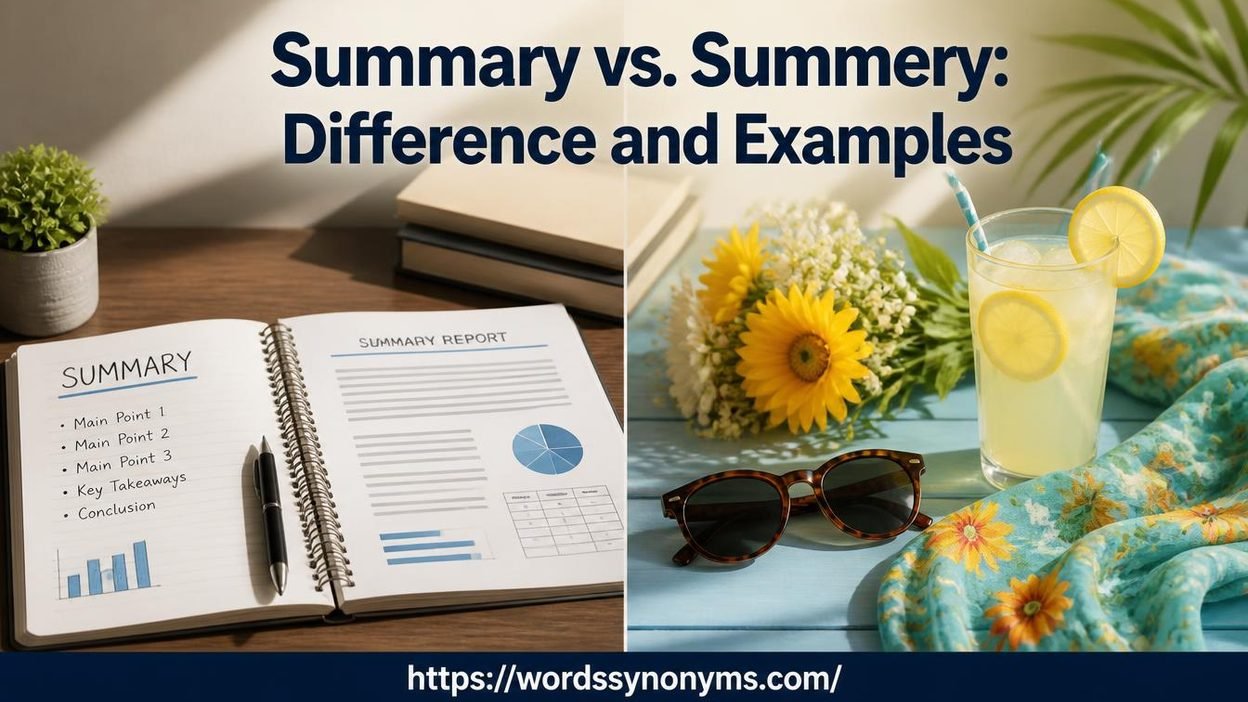
Summary and summery have similar spelling and pronunciation, but their meaning and grammatical context differ. Understanding Summary vs. Summery: Difference and Examples helps you choose the right word for clear, accurate English writing.
A summary is a noun that provides a short description, short version, or brief overview of the main points and essential information in an article, report, book, meeting, or event. For example, a meeting summary, report summary, article summary, book summary, or event summary presents the main idea without every detail.
In English grammar, understanding noun usage, sentence construction, and word meaning helps you choose summary when you need a short overview or concise version. A dictionary and sentence examples can clarify the summary definition and its correct usage in everyday writing and written communication.
In contrast, summery is a descriptive adjective for something that feels, looks, or seems suitable for summer. It describes a summer atmosphere, summer appearance, or summer feeling, often suggesting a light, bright, and warm appearance. Think of seasonal clothing, a summery dress, or decoration with bright colors, pale colors, and fresh flowers.
These details create a summery look and a cheerful summer description. The summery definition relates to the summer season, seasonal qualities, and things evocative of summer.
The word distinction matters because both are real words, so a spell checker may miss an incorrect word choice. Writing “a summery of the report” creates a grammar mistake and a spelling-related usage error, even though summery is spelled correctly. Similarly, “a summary outfit” is an incorrect word usage when you mean summer clothing.
During editing, check the contextual meaning, semantic difference, and grammatical accuracy rather than relying only on proofreading tools or automated spell checking. This habit strengthens English writing, vocabulary knowledge, language learning, and language accuracy while reducing vocabulary confusion, spelling errors, and contextual errors.
Quick Answer
Summary means a short account of the main points of a book, report, meeting, or article. Summery describes something that feels or looks like summer, such as warm weather, bright colors, or lightweight clothing.
Examples:
- Summary: She wrote a summary of the story.
- Summery: She wore a summery dress to the picnic.
Easy trick to remember: A summary summarizes information, while summery reminds you of summer.

Summary vs. Summery: What’s the Difference?
The main difference between summary and summery is their meaning and usage. Although they share several letters, you use them in different situations.
Summary usually functions as a noun that describes a shortened account of a longer text, report, meeting, or event. It can also function as an adjective in expressions such as summary judgment and summary dismissal.
Summery is an adjective that describes something characteristic of summer. You might use it for warm weather, lightweight clothing, bright colors, seasonal food, or a cheerful outdoor atmosphere.
Consider these examples:
- Summary: The manager requested a summary of the quarterly report.
- Summery: She wore a summery dress to the garden party.
In the first sentence, summary refers to a brief account of information. In the second, summery describes clothing associated with summer.
| Feature | Summary | Summery |
| Meaning | A shortened account or something related to a quick, simplified procedure | Characteristic of or suitable for summer |
| Part of speech | Noun and adjective | Adjective |
| Common uses | Reports, books, meetings, legal terminology | Clothing, weather, colors, food, scenery |
| Example | I wrote a summary of the article. | The garden has a summery atmosphere. |
| Memory trick | Think of summarize | Think of summer |
Quick rule: Use summary when discussing information or certain formal procedures. Use summery when describing something that feels or looks like summer.
What Does Summary Mean?
The word summary refers to a brief account that presents the main points of a larger piece of information. Instead of repeating every detail, a summary highlights the essential ideas and leaves out less important material.
For example, imagine reading a 20-page business report. You might create a one-page summary that explains the report’s main findings, recommendations, and conclusions. Your summary helps someone understand the important information without reading the entire document.
The word also has a more specialized meaning when it functions as an adjective. In legal and formal contexts, summary can describe an action or procedure carried out quickly, sometimes without the usual full process.
The exact meaning depends on the sentence.
Summary as a Noun
As a noun, summary means a concise statement or account of the main points of something. It can describe a written document, an oral explanation, or a short overview of an event.
People use summaries in education, journalism, business, research, and everyday communication. Students summarize chapters, journalists summarize breaking news, and professionals prepare summaries of meetings or project results.
A good summary preserves the original meaning while removing unnecessary details. It shouldn’t introduce unsupported claims or change the author’s main argument.
Examples of summary as a noun:
- The teacher asked everyone to write a summary of the assigned chapter.
- Please send me a summary of the meeting before the end of the day.
- The executive summary highlights the company’s main goals and financial results.
- Her summary of the novel helped me understand its central conflict.
- The report begins with a short summary of the research findings.
- He gave the audience a summary of the proposed changes.
Notice that summary names a thing in each example. It refers to a condensed account that communicates essential information.
What Makes a Good Summary?
A useful summary does more than shorten a text. It identifies the central message and presents it in a clear, logical order.
A strong summary usually includes:
- Main idea: The central message or purpose of the original material.
- Key supporting points: Important facts, arguments, or findings.
- Accuracy: A faithful representation of the source’s meaning.
- Conciseness: Only the details needed to understand the main message.
- Clarity: Simple language that readers can understand quickly.
For instance, a five-page meeting transcript might contain greetings, repeated comments, side discussions, and several decisions. A useful summary would focus on the decisions, responsibilities, deadlines, and unresolved questions.
A summary shouldn’t become a collection of random details. It should give readers a coherent picture of the original material.
Summary as an Adjective
Although people most often use summary as a noun, it can also function as an adjective. In this role, it describes something done quickly or through a simplified procedure, often with a specific formal or legal meaning.
You’ll frequently encounter this usage in legal documents, workplace policies, and formal writing. The meaning differs from the everyday sense of a brief account.
Here are some common expressions:
- Summary judgment: A court decision made without a full trial when the applicable legal standard is met and no genuine dispute of material fact requires a trial.
- Summary dismissal: The immediate termination of someone’s employment or removal from a position, usually under circumstances permitted by the relevant rules or law.
- Summary execution: The killing of a person without the usual judicial process.
For example:
- The judge granted summary judgment after reviewing the evidence and applicable law.
- The employee challenged the summary dismissal through the company’s formal procedure.
- The report documented allegations of summary execution during the conflict.
In these sentences, summary doesn’t mean a shortened explanation. Instead, it describes the nature of a decision, procedure, or action.
Important distinction: Don’t assume that every action described as summary is automatically lawful or appropriate. In legal contexts, the consequences and requirements depend on the jurisdiction and circumstances.
Synonyms and Related Words for Summary
Several words share some of summary’s meaning, but each has a slightly different use.
| Word | Meaning | Example |
| Overview | A general explanation of a subject | The presentation provides an overview of the project. |
| Synopsis | A condensed account of a book, film, or other work | The publisher requested a synopsis of the novel. |
| Abstract | A brief account of a research paper or scholarly work | The researcher wrote an abstract for the study. |
| Outline | A structured list of main ideas or sections | She prepared an outline before writing the report. |
| Recap | A brief review of events or information | The host gave a recap of yesterday’s episode. |
| Digest | A condensed presentation of important information | The newsletter contains a digest of industry news. |
These words aren’t always interchangeable. An outline usually shows a structure, while an abstract often summarizes a research paper. A recap frequently reviews something that has already happened.
Choose the word that best describes the type of information you’re presenting.
What Does Summery Mean?
Summery is an adjective that means characteristic of, suggestive of, or suitable for summer. Writers use it to describe things that evoke the season through their appearance, temperature, colors, atmosphere, or activities.
For example, a lightweight cotton dress with bright floral patterns might look summery. A refreshing drink served with fresh berries could also feel summery, especially on a warm afternoon.
The word doesn’t require summer to be officially underway. You can describe something as summery in spring, autumn, or even winter if it reminds you of summer.
Consider these examples:
- The restaurant introduced a summery menu featuring fresh fruit and chilled drinks.
- Her yellow curtains gave the bedroom a bright, summery appearance.
- We enjoyed a summery afternoon in the garden.
- He selected a summery color palette for the wedding invitations.
- The lightweight fabric makes this shirt perfect for summery weather.
In every example, summery describes a quality associated with summer. It doesn’t refer to a shortened explanation or report.
Common Uses of Summery
The word summery appears in everyday conversation, fashion writing, travel descriptions, food reviews, and lifestyle content. Its exact meaning changes slightly with the noun it modifies.
Here are the most common contexts.
Summery Weather
When you describe weather as summery, you usually mean that it feels warm, bright, or otherwise typical of summer.
For example:
- The forecast promises summery weather throughout the weekend.
- We enjoyed a warm, summery day at the lake.
- The afternoon felt surprisingly summery for early April.
However, summery doesn’t always mean hot. Depending on the setting, it can suggest sunshine, gentle breezes, or pleasant conditions suitable for outdoor activities.
Summery Clothes
Fashion writers often use summery for clothing that suits the summer season. Such clothing may feature lightweight materials, breathable fabrics, bright colors, floral patterns, or relaxed designs.
Examples include:
- She wore a summery linen dress to the picnic.
- These pastel shorts create a relaxed, summery look.
- He paired a lightweight shirt with summery canvas sneakers.
The word describes the overall seasonal style rather than a specific garment. A dress, shirt, hat, or pair of sandals can all look summery.
Summery Colors and Decorations
Colors can create a summer-inspired atmosphere even when the temperature outside doesn’t match the season. Bright yellow, coral, turquoise, and fresh green often appear in summer-themed designs.
For example:
- The designer chose summery colors for the invitation.
- Bright cushions gave the patio a cheerful, summery feel.
- Their kitchen features summery decorations inspired by the beach.
These descriptions communicate a visual impression. They don’t suggest that the colors themselves belong exclusively to summer.
Summery Food and Drinks
Food writers use summery to describe meals, ingredients, and beverages that suit warm-weather dining. Fresh fruit, crisp salads, chilled soups, lemonade, and iced tea can all create this impression.
Examples include:
- The café added three summery drinks to its menu.
- We prepared a summery salad with tomatoes, cucumbers, and fresh herbs.
- Fresh peaches gave the dessert a summery flavor.
The term is flexible. A dish doesn’t have to follow a traditional seasonal recipe to feel summery.
Summery Scenery and Atmosphere
You can also use summery to describe places, experiences, and moods associated with summer.
For instance:
- The coastal town had a relaxed, summery atmosphere.
- Colorful umbrellas created a summery scene along the beach.
- The garden looked bright and summery after the rain.
In descriptive writing, this adjective helps readers imagine a scene without requiring a long explanation. It adds seasonal character in a single word.
Synonyms and Related Words for Summery
Several adjectives can communicate qualities associated with summer. However, each emphasizes something different.
| Word | Meaning | Example |
| Summerlike | Resembling summer | The warm breeze felt summerlike. |
| Sunny | Full of sunshine or cheerful in mood | We spent a sunny afternoon outdoors. |
| Warm | Having a comfortably high temperature | The warm evening was perfect for dinner outside. |
| Breezy | Characterized by a light wind or relaxed style | She wore a breezy linen outfit. |
| Seasonal | Appropriate or associated with a particular season | The café introduced seasonal fruit drinks. |
| Tropical | Suggestive of tropical climates or landscapes | The hotel used tropical prints in its décor. |
| Airy | Light, open, and well ventilated | The airy cotton shirt felt comfortable. |
These alternatives aren’t exact substitutes for summery. A sunny day might occur in winter, and a tropical design might evoke a region rather than summer itself.
Use summery when you want to express the broader feeling of the season.
Summary vs. Summery: Key Differences at a Glance
The quickest way to distinguish these words is to look at what they describe. Summary concerns information or certain formal procedures, while summery describes summer-related qualities.
| Comparison point | Summary | Summery |
| Basic definition | A brief account of main points | Characteristic of summer |
| Part of speech | Noun or adjective | Adjective |
| Main purpose | To condense information or describe a type of procedure | To describe a seasonal quality |
| Common nouns or contexts | Report, chapter, meeting, judgment, dismissal | Dress, weather, colors, drink, atmosphere |
| Related word | Summarize | Summer |
| Example | I prepared a summary of the book. | I bought a summery dress. |
| Common mistake | Using it to describe summer clothing | Using it to mean a shortened report |
A Simple Grammar Test
When you’re unsure which word to choose, ask yourself what you’re trying to communicate.
Are you talking about a shortened account? Use summary.
- The editor requested a summary of the article.
- My notes include a summary of the lecture.
- We reviewed the summary before the presentation.
Are you describing something that feels like summer? Use summery.
- The shop sells summery dresses.
- The garden has a summery appearance.
- We enjoyed summery weather during our vacation.
This simple test works in most everyday situations. For the less common adjective summary, remember that formal expressions such as summary judgment have their own established meanings.
Read more: Magic Bullet vs. Silver Bullet: Meaning and Correct Usage
Summary vs. Summery: Example Sentences
Seeing the words in different contexts makes their distinction easier to remember. The following examples cover schoolwork, professional communication, fashion, travel, and everyday descriptions.
Examples of Summary in Sentences
Here are examples of summary used as a noun:
- The student submitted a summary of the assigned reading.
- Our meeting summary lists every decision made by the team.
- The journalist wrote a summary of the election debate.
- Please include a short summary at the beginning of the report.
- The book’s summary explains its central conflict without revealing every detail.
- I prepared a summary of the customer feedback.
- Her summary captured the speaker’s main argument.
- The project manager circulated a summary of the week’s progress.
- The article includes a summary of recent research findings.
- We read the executive summary before examining the full proposal.
Now consider summary as an adjective:
- The court considered whether summary judgment was appropriate.
- The policy explains the circumstances that may justify summary dismissal.
- The historical account discusses the use of summary proceedings.
The first group focuses on condensed information. The second uses summary in a more specialized sense.
Examples of Summery in Sentences
Here are examples of summery used to describe clothing and personal style:
- She chose a summery dress for the outdoor celebration.
- His summery shirt featured a bright floral pattern.
- The boutique displayed summery outfits in its front window.
- Lightweight sandals completed her summery look.
These examples describe seasonal fashion rather than the length of a document.
More examples show how the adjective works in other contexts:
- The warm breeze created a summery atmosphere.
- We ordered summery drinks with fresh citrus.
- Bright curtains gave the room a summery appearance.
- The garden looked summery beneath the afternoon sunshine.
- The travel brochure featured summery photographs of coastal villages.
- They decorated the patio with summery flowers and colorful cushions.
- A fresh fruit salad makes a summery addition to lunch.
- The illustrator used summery shades of yellow, green, and blue.
Each sentence connects summery with the feeling, appearance, or activities of summer.
Summary vs. Summery in Paired Sentences
Comparing the words side by side makes the difference even clearer.
| Summary | Summery |
| I wrote a summary of the travel guide. | I chose a summery outfit for the trip. |
| The report includes a summary of the findings. | The report features summery photographs of the beach. |
| She prepared a summary of the meeting. | She planned a summery picnic in the park. |
| The editor requested a summary of the story. | The editor selected a summery design for the magazine cover. |
| We reviewed the summary before class. | We enjoyed the summery weather after class. |
Notice that the words can appear in the same general situation without sharing a meaning. A travel guide can have a summary and contain descriptions of summery destinations.
A Practical Case Study: Choosing the Correct Word
Imagine you’re preparing a travel blog post about a beach vacation. You want to write a short introduction, describe your clothing, and explain the atmosphere.
Here’s how the two words fit into that assignment:
Incorrect: I wrote a summery of our beach vacation.
Correct: I wrote a summary of our beach vacation.
The first sentence uses summery incorrectly because the writer means a condensed account. The second sentence communicates that meaning clearly.
Now consider a different sentence:
Incorrect: I wore a summary dress during our beach vacation.
Correct: I wore a summery dress during our beach vacation.
This time, summery is correct because it describes clothing suitable for the season.
The lesson is straightforward: choose the word according to its meaning, not its appearance. Their similar spelling doesn’t make them interchangeable.

How to Remember the Difference Between Summary and Summery
You don’t need to memorize complicated grammar rules to distinguish these words. A simple connection between each word and its meaning will usually do the trick.
Connect Summary With Summarize
The word summary shares its meaning with the verb summarize. When you summarize something, you shorten it while preserving its main points.
For example:
- You summarize a chapter.
- You write a summary of a report.
- You prepare a summary of a meeting.
Think of summary whenever you’re dealing with information that needs condensing.
Connect Summery With Summer
The word summery contains the complete word summer. This spelling connection makes the meaning easy to remember.
For example:
- Summery weather feels like summer.
- Summery clothing suits summer.
- Summery colors evoke summer.
- Summery drinks often suit warm-weather occasions.
Whenever you’re describing a seasonal feeling or appearance, summery is likely the word you need.
Use This Quick Memory Trick
Remember this simple distinction:
A summary shortens information. Summery brings summer to mind.
You can apply this rule to most everyday writing situations. If you still feel unsure, replace the word with a simple explanation.
- If you mean “a brief account,” choose summary.
- If you mean “characteristic of summer,” choose summery.
For example, “a brief account of the meeting” clearly points to summary. Meanwhile, “a dress that feels appropriate for summer” points to summery.
Read more: Waist vs. Waste: Meaning and Usage
Common Mistakes When Using Summary and Summery
Because the two words look and sound similar, writers sometimes confuse them. The mistake often happens during quick typing, proofreading, or spelling checks.
Understanding the most common errors can help you avoid them.
Using Summery When You Mean Summary
This mistake occurs when someone uses summery to refer to a shortened explanation or account.
Incorrect: Please send me a summery of the meeting.
Correct: Please send me a summary of the meeting.
The meeting needs a concise account of its main points. It doesn’t need anything related to summer.
Another example:
Incorrect: The student submitted a summery of the chapter.
Correct: The student submitted a summary of the chapter.
Remember that summary is the standard noun for a condensed account.
Using Summary When You Mean Summery
The opposite mistake happens when someone uses summary to describe summer clothing, weather, or decorations.
Incorrect: She wore a summary dress to the picnic.
Correct: She wore a summery dress to the picnic.
The sentence describes the dress’s seasonal style, so summery fits.
Another example:
Incorrect: We enjoyed the summary weather during our vacation.
Correct: We enjoyed the summery weather during our vacation.
Here, summery describes conditions that feel characteristic of summer.
Assuming Both Words Have the Same Grammatical Role
Although the words look similar, their grammatical uses differ.
Summary functions as both a noun and an adjective:
- Noun: The summary explains the main findings.
- Adjective: The court considered summary judgment.
Summery functions as an adjective:
- The summery landscape looked beautiful.
- She selected a summery color scheme.
You wouldn’t normally use summery as a noun to mean a short account. Likewise, summary doesn’t function as the standard adjective for summer-inspired clothing.
Confusing Summary With Other Related Words
Another common problem involves treating summary, synopsis, overview, and outline as identical terms.
These words overlap, but their uses differ:
- A summary condenses the main ideas.
- A synopsis provides a condensed account of a work, often a story or publication.
- An overview presents a general picture of a subject.
- An outline organizes main points in a structured sequence.
For example, a student might create an outline before writing an essay and then add a summary of the completed essay.
Each word serves a different purpose, so choose the one that best matches your intended meaning.
Forgetting to Proofread Similar-Looking Words
Spell-checking tools may not flag summary and summery because both are legitimate English words. A sentence can therefore contain a correctly spelled word that doesn’t fit its meaning.
Consider this sentence:
“The report includes a summery of the company’s annual performance.”
Both the spelling and grammar might appear plausible at a glance. However, summary is the correct choice because the report presents condensed information.
When proofreading, check the meaning of each word rather than relying entirely on spelling tools.
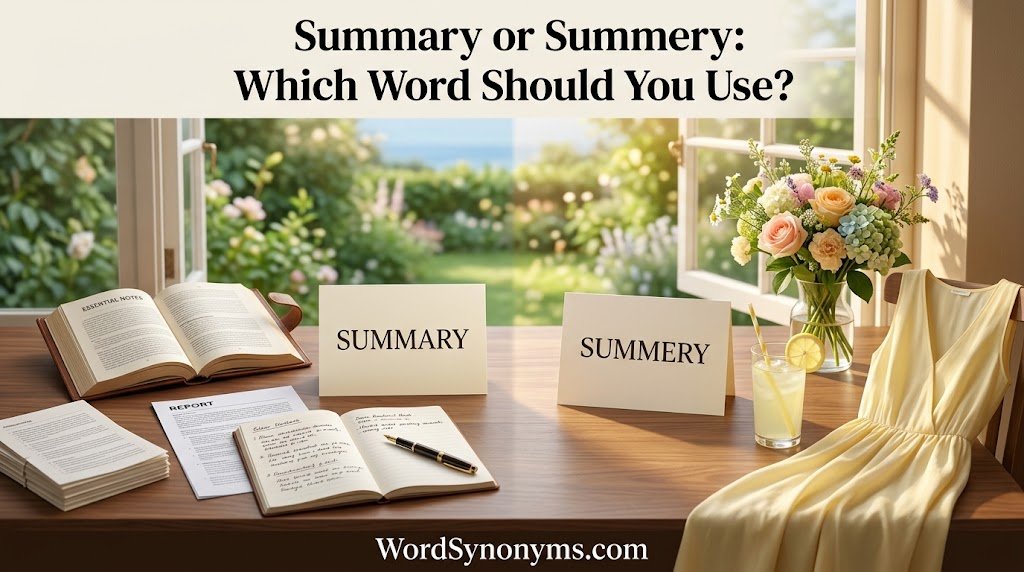
Summary or Summery: Which Word Should You Use?
Choosing between summary and summery becomes easy once you identify what the sentence describes.
Use summary when you mean a brief account of information or when the word appears in an established expression describing a formal procedure.
Use summery when you describe something that resembles, evokes, or suits summer.
Here’s a practical guide:
| Your intended meaning | Correct choice | Example |
| A brief account of a book | Summary | I wrote a summary of the book. |
| A shortened meeting report | Summary | Please read the meeting summary. |
| A legal procedure | Summary | The judge considered summary judgment. |
| Summer-inspired clothing | Summery | She bought a summery dress. |
| Warm, summerlike conditions | Summery | We enjoyed summery weather. |
| A summer-inspired design | Summery | The designer created a summery color palette. |
A Short Decision-Making Checklist
Before choosing a word, ask yourself these questions:
- Am I referring to the main points of something longer? Use summary.
- Am I describing something associated with summer? Use summery.
- Am I using a formal expression such as summary judgment? Use summary.
- Am I describing a seasonal appearance, style, or atmosphere? Use summery.
If the sentence still feels unclear, replace the word temporarily with its meaning. “A summary of the report” makes sense as “a brief account of the report.” “A summery dress” makes sense as “a dress with a summerlike style.”
That substitution test is a useful way to catch errors before publishing.
FAQs
1. What is the main difference between summary and summery?
Summary is a noun that means a short version of something longer. Summery is an adjective that describes something associated with summer, such as warm weather, bright colors, or light clothing.
2. Is summery a real word?
Yes, summery is a correctly spelled English word. It describes something that feels or looks like summer. However, it cannot replace summary when you mean a brief explanation or overview.
3. How do you use summary in a sentence?
You can use summary when you want to present the main points without including every detail. For example: “Please write a summary of the book before tomorrow’s class.”
4. How do you use summery in a sentence?
Use summery to describe a summer-like appearance, feeling, or style. For example: “She chose a summery dress with bright colors and floral patterns for the picnic.”
5. Why does spell check sometimes miss the mistake between summary and summery?
Spell check may miss this error because both words are spelled correctly. The problem lies in their meaning and context, not their spelling. You need to check whether the sentence requires a noun or an adjective.
6. What is an easy way to remember summary vs. summery?
Remember that summary gives you the main points of something, while summery describes something that reminds you of summer. A meeting can have a summary, but a sunny afternoon can feel summery.
Conclusion
Understanding the difference between summary and summery becomes easy once you focus on what you want to say. Use summary when you need to share the main points of a book, report, or meeting. Choose summery when describing something that reminds you of summer, such as a floral dress, bright colors, or a warm atmosphere. Both words are correct, but they serve different purposes.
Before you finish writing, read your sentence once more and check whether the word fits its meaning. This small habit can help you avoid common word-choice mistakes and make your English clearer and more accurate.

Muhammad Taqi is a content writer interested in English vocabulary and language. He writes clear and useful articles on synonyms, antonyms, word meanings, and English usage, helping readers expand their vocabulary and improve their communication skills.