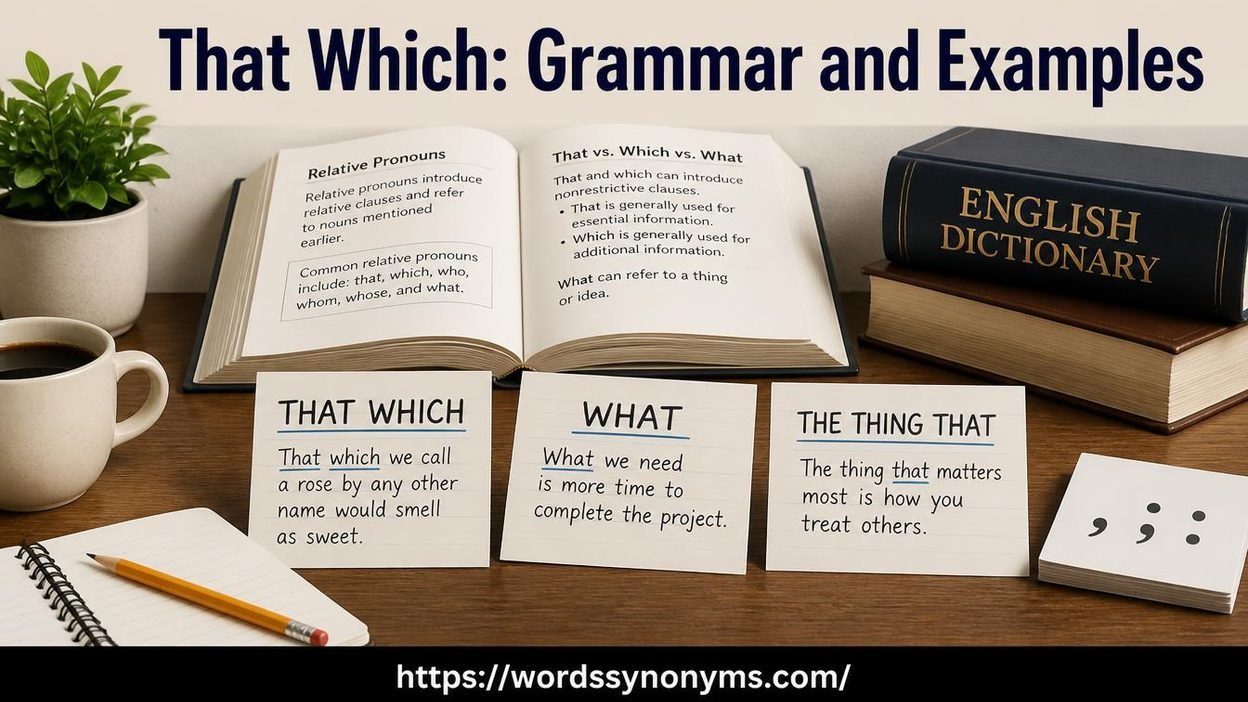
In That Which: Grammar and Examples, the phrase that which may sound formal or longer than necessary, so it can often be shortened to a one-word equivalent.
For example, pronouns such as what and whatever can make sentences clearer and more natural. If you write, “Take that which you need,” you can usually say, “Take what you need.” This shorter pronoun works well in everyday writing while keeping the basic meaning clear. The same approach applies when deciding whether a one-word replacement is suitable.
The main exception appears when that which refers to a specific antecedent. In that situation, replacing it with a simple equivalent can change the meaning or make the sentence less precise. That is why that which remains useful in formal writing and carefully worded sentences.
From an editing perspective, I’d keep the longer form when the reference matters, rather than forcing what or whatever into a sentence where it does not fit. The key exception is knowing when a shorter form can safely replace the original.
Quick Answer
“That which” is grammatically correct and usually means “what” or “the thing that.” It often sounds formal or literary. For everyday American English, “what” is usually the smoother choice. For example, “Take that which you need” means “Take what you need.” Use “that which” when its formal tone fits the context; otherwise, choose the simpler wording.
What Does “That Which” Mean?
“That which” generally means “the thing that,” “the thing which,” or simply “what.”
It refers to something without naming that thing directly. The thing could be physical, abstract, known, unknown, singular, or general depending on context.
Consider this sentence:
Choose that which best suits your needs.
The phrase “that which” refers to the thing that best suits your needs.
You could rewrite it as:
Choose what best suits your needs.
Or:
Choose the thing that best suits your needs.
All three sentences communicate essentially the same idea. Their tones differ.
| Expression | Meaning | Typical tone |
| That which | The thing that/which | Formal or literary |
| What | The thing that | Neutral and natural |
| The thing that | The specific thing that | Explicit and conversational |
| Which | A particular thing or choice | Depends on context |
| That | Often introduces a defining relative clause | Neutral |
The construction appears especially often when writers discuss ideas, principles, choices, qualities, or abstract concepts.
For example:
- We fear that which we don’t understand.
- Protect that which matters most.
- He pursued that which others considered impossible.
- She rejected that which conflicted with her values.
In each example, “that which” points to something that remains unnamed.
Is “That Which” Grammatically Correct?
Yes. “That which” is grammatically correct when the sentence uses the construction appropriately.
It isn’t an error simply because that and which appear next to each other.
The apparent duplication causes confusion because English uses both words in several grammatical roles. In “that which,” however, the words can perform separate functions.
Consider:
That which matters most deserves attention.
Here, that points to an unspecified thing. Which matters most then describes that thing.
Compare that with:
The book that matters most deserves attention.
In the second sentence, that introduces a relative clause modifying the noun book.
That’s an important distinction.
English relative clauses commonly use words such as who, whom, whose, that, and which. Defining relative clauses provide information needed to identify the person or thing being discussed. Non-defining clauses add information that isn’t essential to identifying it.
The phrase “that which” can therefore look unusual without actually being ungrammatical.
A Simple Test
When you’re unsure about “that which,” substitute “what.”
She accepted that which was offered.
Becomes:
She accepted what was offered.
If the meaning remains intact, you’re probably looking at the familiar “that which” = “what” relationship.
You can also try “the thing that.”
She accepted the thing that was offered.
That version makes the underlying meaning especially clear.
How Does “That Which” Work Grammatically?
The key to understanding “that which” lies in separating the two words.
“That” as a Demonstrative
In many examples, the first that functions as a demonstrative pronoun.
A demonstrative points to a person, thing, idea, or situation.
For example:
That is expensive.
Here, that points toward something understood from the context.
Now consider:
That which is expensive may not be valuable.
The that still points toward an unspecified thing. The following which adds information about it.
So the construction can be understood roughly as:
that + which describes that thing
This explains why calling the phrase automatically redundant misses the grammatical structure.
“Which” as a Relative Pronoun
The which introduces the relative clause.
Look at:
That which she purchased was defective.
The relative clause is:
which she purchased
The clause tells you more about that.
You can expand the sentence conceptually:
The thing that she purchased was defective.
The grammar becomes easier to see once the sentence gets expanded.
The Full Construction
Here are several examples broken down:
| Sentence | Meaning |
| That which is useful should be preserved. | The thing that is useful should be preserved. |
| Take that which you need. | Take what you need. |
| He explained that which happened. | He explained what happened. |
| She rejected that which offended her. | She rejected what offended her. |
The construction essentially packages an unnamed noun together with information describing it.
That is why “that which” often feels more elaborate than “what.”
“That Which” vs. “What”
The most useful comparison is “that which” vs. “what.”
In many sentences, what provides a shorter and more natural alternative.
Compare:
Take that which you need.
with:
Take what you need.
The second sentence is shorter without losing the essential meaning.
This isn’t because “that which” is wrong. It simply has a different stylistic register.
Why “What” Often Sounds Better
Modern American English generally favors direct wording in everyday communication.
Compare these pairs:
- Do that which seems appropriate.
- Do what seems appropriate.
- Keep that which belongs to you.
- Keep what belongs to you.
- Remember that which I told you.
- Remember what I told you.
The second sentence in each pair sounds more conversational.
However, style depends on purpose. A formal speech, philosophical essay, legal document, or deliberately elevated piece of writing may benefit from the more ceremonious construction.
“What” Is Not Always a Mechanical Replacement
You shouldn’t assume that what can replace every occurrence of that which without examining the sentence.
For example:
The policy protects that which matters most.
You can write:
The policy protects what matters most.
That’s straightforward.
But when that has a different grammatical function elsewhere in the sentence, blindly replacing words can change the structure.
The important lesson is simple:
Compare the complete construction rather than individual words.
“That Which” vs. “Which”
“That which” and “which” aren’t interchangeable in every sentence.
Consider:
I chose the book which you recommended.
Here, which refers directly to the book.
Now compare:
I chose that which you recommended.
Here, that stands for the unspecified thing being selected. Which you recommended describes it.
The difference becomes clearer when you add the noun:
I chose the book which you recommended.
The noun book already identifies the thing.
In:
I chose that which you recommended.
the noun remains unstated.
That’s one reason “that which” can sound more abstract.
Compare These Structures
| Sentence | What is being referred to? |
| I bought the laptop which you recommended. | A named laptop |
| I bought that which you recommended. | An unnamed thing |
| I bought what you recommended. | An unnamed thing |
| I bought the thing that you recommended. | An explicitly identified thing |
The last three essentially express the same basic idea.
“That Which” vs. “That”
The word that can perform several grammatical jobs. That’s where many learners get tripped up.
Compare:
The book that I bought was expensive.
Here, that introduces a defining relative clause.
The clause that I bought identifies the book.
Now look at:
That which I bought was expensive.
The first that refers to an unspecified thing. The which I bought portion describes that thing.
The surface similarity can be deceptive.
A Useful Comparison
The car that I bought
means:
the specific car + a clause describing it
Whereas:
that which I bought
means approximately:
the thing + a clause describing it
The second construction therefore behaves much more like “the thing that.”
“That Which” vs. “The Thing That”
If you want to understand the phrase quickly, replace it with “the thing that.”
For example:
That which you seek may already be nearby.
Becomes:
The thing that you seek may already be nearby.
The meaning becomes more transparent immediately.
However, the two versions aren’t stylistic twins.
“That which” sounds elevated.
“The thing that” sounds explicit and conversational.
“What” often sounds the most compact.
Three Versions Compared
That which you seek may already be nearby.
Formal or literary.
The thing that you seek may already be nearby.
Explicit and conversational.
What you seek may already be nearby.
Concise and natural.
The best choice depends on the audience and the tone you want.
When Should You Use “That Which”?
Use “that which” when its formal or rhetorical tone serves a genuine purpose.
It can work particularly well when the sentence discusses an abstract concept or principle.
Formal Writing
You may encounter it in formal prose where an elevated register fits the subject.
For example:
The committee must preserve that which serves the public interest.
The construction gives the sentence a deliberately formal tone.
A simpler version would be:
The committee must preserve what serves the public interest.
Both are grammatical.
The second is more direct.
Philosophical or Abstract Writing
The phrase can also suit philosophical writing.
People often desire that which remains beyond their reach.
The construction gives the statement a somewhat aphoristic quality.
Compare:
People often desire what remains beyond their reach.
This version sounds more modern and conversational.
Neither version is inherently superior. The surrounding prose determines which one feels appropriate.
Literary Writing
Authors sometimes use more formal constructions to create a particular voice.
He devoted his life to that which others had abandoned.
The wording sounds deliberate and somewhat solemn.
Replacing it with “what others had abandoned” makes the sentence lighter:
He devoted his life to what others had abandoned.
That’s perfectly natural. It simply carries less ceremonial weight.
When Should You Avoid “That Which”?
Avoid it when it makes simple writing sound unnecessarily grand.
That’s particularly important in web content, instructions, business communication, and everyday American English.
Consider:
Please submit that which is required before Friday.
It sounds unnecessarily formal.
A cleaner version is:
Please submit what is required before Friday.
Even better, when you can name the items:
Please submit the required documents before Friday.
The final version wins because it removes ambiguity.
A Good Editing Rule
Ask yourself:
Does “that which” add meaning, or does it merely add formality?
If it only adds formality, “what” will often work better.
If the formal tone serves the passage, keeping it can make sense.
Is “That Which” Redundant?
Not necessarily.
The claim that “that which” is always redundant oversimplifies English grammar.
The two words can serve distinct grammatical functions.
Consider:
That which matters most deserves protection.
The first that serves as the thing being referred to. The which begins the clause describing it.
Calling the phrase simply “redundant” ignores that structure.
However, something can be grammatically valid yet stylistically unnecessary.
That’s the more useful distinction.
Grammatically Correct Doesn’t Always Mean Best Style
Compare:
Use that which works best.
with:
Use what works best.
The first sentence isn’t wrong.
The second is simply leaner.
Good writing isn’t just about avoiding grammatical errors. It also involves choosing wording that suits the reader and purpose.
“That Which” and Punctuation
The phrase “that which” doesn’t automatically require a comma.
Punctuation depends on the sentence’s larger grammatical structure.
For example:
Choose that which works best.
No comma belongs between that and which.
Likewise:
She kept that which belonged to her.
No comma separates the two words.
The reason is straightforward: the relative clause is integrated into the construction.
Restrictive and Nonrestrictive Clauses
Relative clauses can be restrictive or nonrestrictive.
A restrictive clause supplies information needed to identify what you’re discussing. In standard usage, it doesn’t take commas.
For example:
The documents that contain errors need revision.
The clause that contain errors identifies which documents need revision.
A nonrestrictive clause supplies extra information and is normally set off with commas.
For example:
The documents, which contain several errors, need revision.
The punctuation changes the relationship between the main noun and the relative clause.
However, don’t transfer this rule mechanically to every sentence containing which.
The structure “that which” is different from a simple noun followed by which.
A Common Mistake
Incorrect:
Take that, which you need.
That comma disrupts the intended construction.
Better:
Take that which you need.
Or, in ordinary American English:
Take what you need.
The second option is usually the clearest.
“That Which” in American English
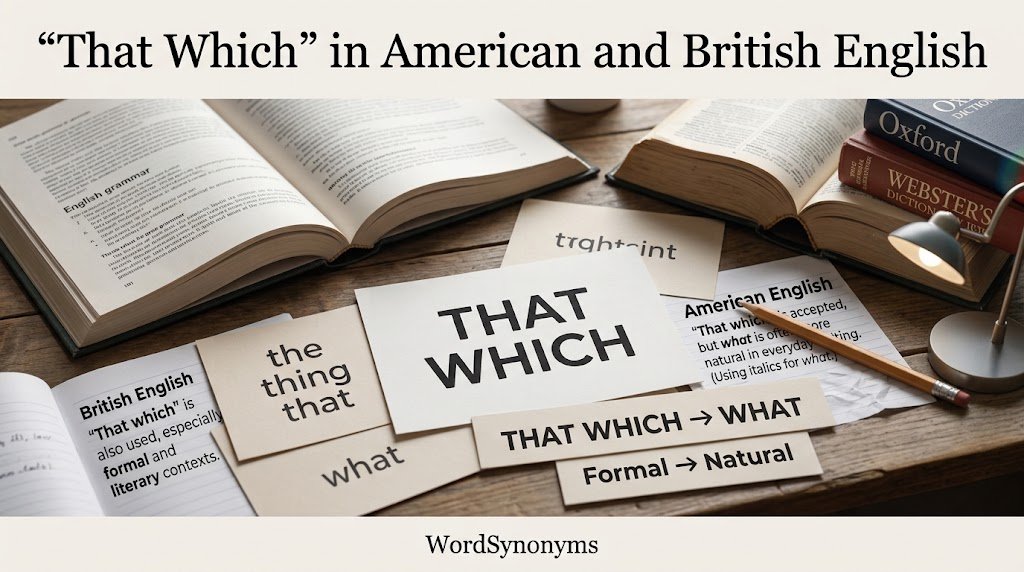
American English accepts “that which,” but modern usage often favors shorter alternatives.
The phrase isn’t obsolete. You may still encounter it in formal writing, literature, speeches, legal language, and philosophical discussion.
However, everyday American English tends to prefer:
- what
- the thing that
- a specific noun
For example:
Choose that which you prefer.
sounds more formal than:
Choose what you prefer.
The meaning remains essentially unchanged.
This difference matters when writing for a broad audience. A sentence can be grammatically impeccable yet feel stiff because its vocabulary belongs to a more formal register.
“That Which” in British English
British English also uses “that which.”
The construction isn’t exclusive to American or British English. Its main distinction is stylistic rather than geographic.
You can find it in formal and literary contexts in both varieties.
The important point is not to invent a rigid dialect rule such as:
“British English uses that which, while American English uses what.”
Real English doesn’t divide that neatly.
Both varieties use all of these constructions:
- that which
- what
- the thing that
- which
- that
Context determines the choice.
Read more: Totaled vs. Totalled vs. Totaling vs. Totalling
Common Examples of “That Which”
Seeing the construction in different environments makes its function much easier to recognize.
Example: General Meaning
Take that which you need.
Meaning:
Take what you need.
The phrase refers to an unspecified thing.
Example: Abstract Concept
We often fear that which we don’t understand.
Meaning:
We often fear what we don’t understand.
Here, that which refers to an abstract or unspecified subject.
Example: Formal Writing
The organization must protect that which benefits its members.
Meaning:
The organization must protect what benefits its members.
The first version deliberately sounds more formal.
Example: Literary Style
He pursued that which others considered impossible.
Meaning:
He pursued what others considered impossible.
The formal construction gives the sentence a more elevated tone.
Example: Personal Choice
Choose that which brings you the greatest satisfaction.
Natural alternative:
Choose what brings you the greatest satisfaction.
Example: Abstract Principle
Society tends to preserve that which it values.
Natural alternative:
Society tends to preserve what it values.
Both are grammatically sound.
Common Mistakes With “That Which”
Understanding the phrase becomes much easier when you know what not to do.
Mistake: Assuming “That Which” Is Always Wrong
This is the biggest misconception.
That which matters most should come first.
is grammatical.
The phrase may sound formal, but formality isn’t the same thing as incorrectness.
Mistake: Using “That Which” Everywhere
The opposite mistake is equally common.
Writing:
Please review that which appears below.
sounds unnecessarily stiff.
Better:
Please review what appears below.
Even better when possible:
Please review the information below.
The third version identifies the subject instead of forcing the reader to decode it.
Mistake: Treating “What” and “That Which” as Completely Different Ideas
In many contexts, they’re close equivalents.
I understand that which you mean.
I understand what you mean.
The second sentence is much more natural.
The important distinction isn’t usually meaning. It’s structure and register.
Mistake: Adding an Unnecessary Comma
Don’t write:
She chose that, which seemed appropriate.
when you mean:
She chose that which seemed appropriate.
The comma breaks the construction.
Mistake: Choosing Formality Over Precision
Consider:
The manager reviewed that which was submitted by employees.
This is grammatically possible, but it isn’t especially clear.
A more precise version is:
The manager reviewed the documents employees submitted.
Specific nouns often improve readability more than ornate constructions do.
How to Make “That Which” Sound More Natural
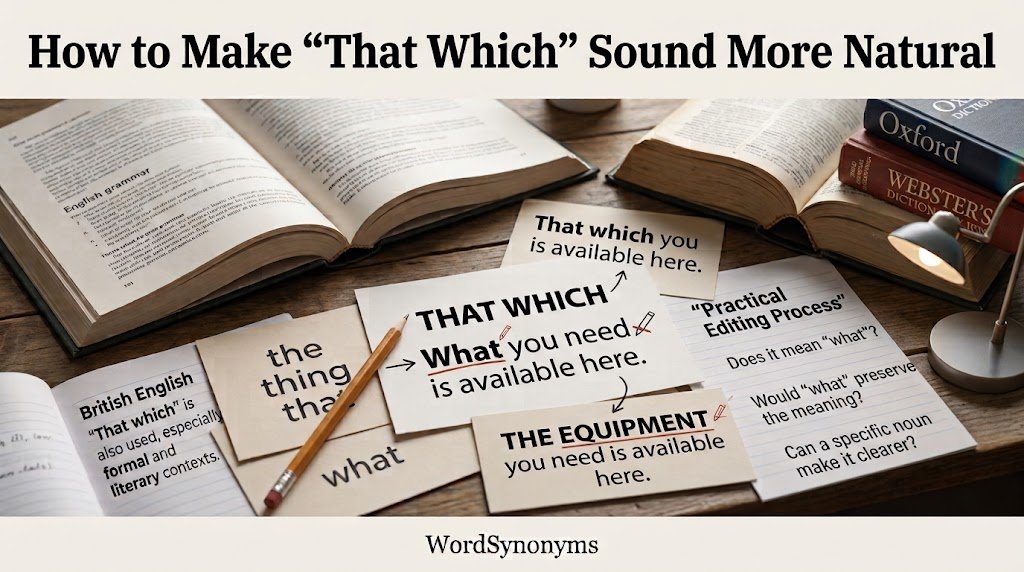
The easiest improvement is often replacing it with a shorter construction.
Start with the original:
That which you need is available here.
Then try:
What you need is available here.
If you can identify the noun, go further:
The equipment you need is available here.
The third sentence gives the reader the most concrete information.
A Practical Editing Process
When you encounter “that which,” ask:
- Does it mean “what”?
- Would “what” preserve the meaning?
- Can a specific noun make the sentence clearer?
- Does the formal tone serve the purpose?
- Would a normal reader naturally say it this way?
If “what” works and you aren’t deliberately using a formal register, it will often be the stronger choice.
“That Which” Sentence Examples With Explanations
“That which is useful should be preserved.”
Meaning: Anything useful should be preserved.
The phrase refers to an unspecified thing with the quality of being useful.
More natural:
What is useful should be preserved.
“She accepted that which was offered.”
Meaning: She accepted whatever thing was offered.
The phrase “which was offered” identifies the unnamed thing.
More natural:
She accepted what was offered.
“He rejected that which conflicted with his principles.”
Meaning: He rejected anything that conflicted with his principles.
The phrase has a formal, somewhat philosophical tone.
More natural:
He rejected what conflicted with his principles.
“Protect that which matters most.”
Meaning: Protect what matters most.
This sentence works especially well as a rhetorical statement because the elevated wording reinforces its serious tone.
“They preserved that which remained after the disaster.”
Meaning: They preserved whatever remained after the disaster.
The construction emphasizes the remaining material without naming it.
A Useful Case Study: Formal vs. Natural Style
Consider this sentence:
Employees should retain that which they receive from the company.
It’s grammatical, but the wording feels unnecessarily elaborate.
A clearer version would be:
Employees should retain what they receive from the company.
An even more precise version might be:
Employees should keep the documents they receive from the company.
Notice what happened.
The first revision replaced “that which” with “what.” The second revision replaced the abstract construction with a specific noun.
This illustrates an important writing principle:
Clarity often improves when you name the thing you’re discussing.
The best revision isn’t always the shortest one. It’s the one that gives readers the clearest path through the sentence.
Quick Comparison: That Which vs. What vs. Which vs. That
| Word or phrase | Basic function | Example | Tone |
| That which | Refers to an unnamed thing and introduces its description | “Choose that which fits.” | Formal |
| What | Means roughly “the thing that” | “Choose what fits.” | Neutral |
| Which | Refers to a noun or specified antecedent | “Choose the option which fits.” | Neutral/formal |
| That | Often introduces a defining relative clause | “Choose the option that fits.” | Neutral |
| The thing that | Explicitly names the implied thing | “Choose the thing that fits.” | Conversational |
One subtle point matters here: “what” can function as a fused or free relative construction. Its meaning incorporates the thing being referred to rather than requiring a separate noun before the relative clause. That helps explain why “what you need” can stand where “that which you need” might otherwise appear.
Why “What” Is Often the Modern Choice
What has a major advantage: efficiency.
Consider:
That which you said surprised me.
Now compare:
What you said surprised me.
The second version removes two words while preserving the central meaning.
It also sounds more like ordinary conversation.
That’s why modern editors often favor what when no special formal tone is intended.
This doesn’t make “that which” obsolete. It simply means writers should use it intentionally rather than automatically.
Does “That Which” Refer to People?
Usually, “that which” refers to things, ideas, qualities, or situations rather than directly identifying people.
For a person, English normally uses constructions involving who, whom, whoever, or the person who, depending on the sentence.
For example:
The person who called earlier left a message.
Not:
That which called earlier left a message.
The second sentence would normally treat the caller as a thing rather than a person.
However, English can use abstract constructions in unusual contexts, especially when discussing qualities or behavior rather than the person as an individual.
For ordinary writing, use a human-oriented construction when the antecedent is a person.
Is “That Which” Formal?
Yes, “that which” usually carries a formal, literary, philosophical, or somewhat old-fashioned flavor.
That doesn’t mean every use sounds archaic.
Its tone depends heavily on surrounding vocabulary.
Compare:
Take that which you need.
with:
Take what you need.
The first sounds ceremonious.
The second sounds ordinary.
Now consider:
The court shall consider that which is relevant to the matter.
The formal construction fits the surrounding legal register more naturally.
This is a useful reminder that register is contextual. A word or phrase can be perfectly normal in one environment and conspicuously formal in another.
Can “That Which” Replace “What”?
Often, yes. But don’t treat the two expressions as mechanically interchangeable.
For example:
I understand what you mean.
can become:
I understand that which you mean.
But the second version sounds awkward because the phrase doesn’t fit the normal idiomatic pattern.
A better example is:
Choose what you prefer.
and:
Choose that which you prefer.
Both work. The second simply sounds more formal.
This distinction is crucial.
Grammatical possibility doesn’t guarantee natural usage.
English contains many structures that technically work but rarely sound good in ordinary speech.
Does “That Which” Need a Comma?
No.
Don’t place a comma simply because which follows that.
Correct:
Take that which you need.
Correct:
She preserved that which remained.
Incorrect for the intended construction:
Take that, which you need.
The comma would change the structure and potentially the meaning.
Remember that commas belong to the grammatical structure of the sentence. They aren’t required merely because a sentence contains which.
Is “That Which” Common in Everyday English?
Not particularly.
You may encounter it in formal writing, literature, philosophy, legal language, religious writing, or deliberately elevated prose.
In casual American English, speakers usually prefer:
what
For example:
Do what you think is right.
sounds much more natural than:
Do that which you think is right.
The latter isn’t necessarily wrong. It simply sounds more formal.
Read more: United States: Is It Plural or Singular?
How “That Which” Compares With “Whatever”
Sometimes “whatever” can provide another alternative.
Compare:
1. Take that which you need.
2. Take what you need.
3. Take whatever you need.
These aren’t perfectly identical.
What you need generally identifies the thing or things that satisfy the stated condition.
Whatever you need can add a sense of unrestricted choice or “anything that.”
That small difference matters.
For example:
Choose what you need.
means choose the things you need.
Choose whatever you need.
can suggest that you may choose anything you need without restriction.
So don’t replace “that which” with “whatever” automatically.
A Simple Decision Guide
When you see “that which,” use this quick guide:
| If you want to… | Consider using… |
| Sound conversational | what |
| Keep the meaning explicit | the thing that |
| Name the exact object | A specific noun |
| Sound formal | that which |
| Sound literary | that which |
| Describe a known noun | which or that, depending on the clause |
| Refer to a person | who or another suitable human reference |
This approach keeps grammar and style working together.
FAQs
What does “that which” mean?
“That which” refers to a particular thing, idea, or situation already understood from the context. It often means “the thing that” or “what.”
Can “that which” be replaced with “what”?
Yes, in many sentences. For example, “Choose that which you prefer” can become “Choose what you prefer.” The shorter version usually sounds more natural.
Is “that which” grammatically correct?
Yes. “That which” is grammatically correct, although it can sound formal or old-fashioned in everyday English.
When should I use “that which” instead of “what”?
Use “that which” when you need to clearly refer to a specific antecedent or when a formal writing style suits the context.
What is the difference between “that which” and “whatever”?
“That which” usually points to a particular thing or idea. “Whatever” has a broader meaning and can refer to any thing or choice that fits the situation.
Is “that which” too formal for everyday writing?
Not necessarily, but it may sound more formal than “what.” In casual writing, “what” is often the smoother and more natural choice.
Conclusion
“That which” is grammatically correct, but it often sounds more formal than necessary. In everyday English, what usually gives you a shorter and smoother option. Still, don’t replace it automatically. When that which points clearly to a specific antecedent, keeping the phrase can make your meaning more precise.
The best choice depends on context, tone, and clarity. Formal documents may benefit from the traditional structure, while casual writing usually feels more natural with simpler wording. Once you understand this small distinction, choosing between that which, what, and whatever becomes much easier.

Muhammad Taqi is a content writer interested in English vocabulary and language. He writes clear and useful articles on synonyms, antonyms, word meanings, and English usage, helping readers expand their vocabulary and improve their communication skills.