T-Shirt, T-Shirt, Tee-Shirt, or Tee Shirt: Which Is Correct? can seem confusing when you choose a plain, comfy shirt for everyday writing today.
Finding the right T-shirt can feel like a challenge, even with a simple affair such as a plain, comfy shirt with short sleeves. There are many styles, and every fit isn’t created equal. Major brands in the industry offer hundreds of options, so choosing the right fabric can matter.
Cotton, polyester, and a blend all feel different. The right fit also depends on the shirt’s construction, including side-seamed or tubular designs, plus fashion fit and standard fit. These principles make a great fit easier to judge, while useful recommendations can save time when you’re shopping.
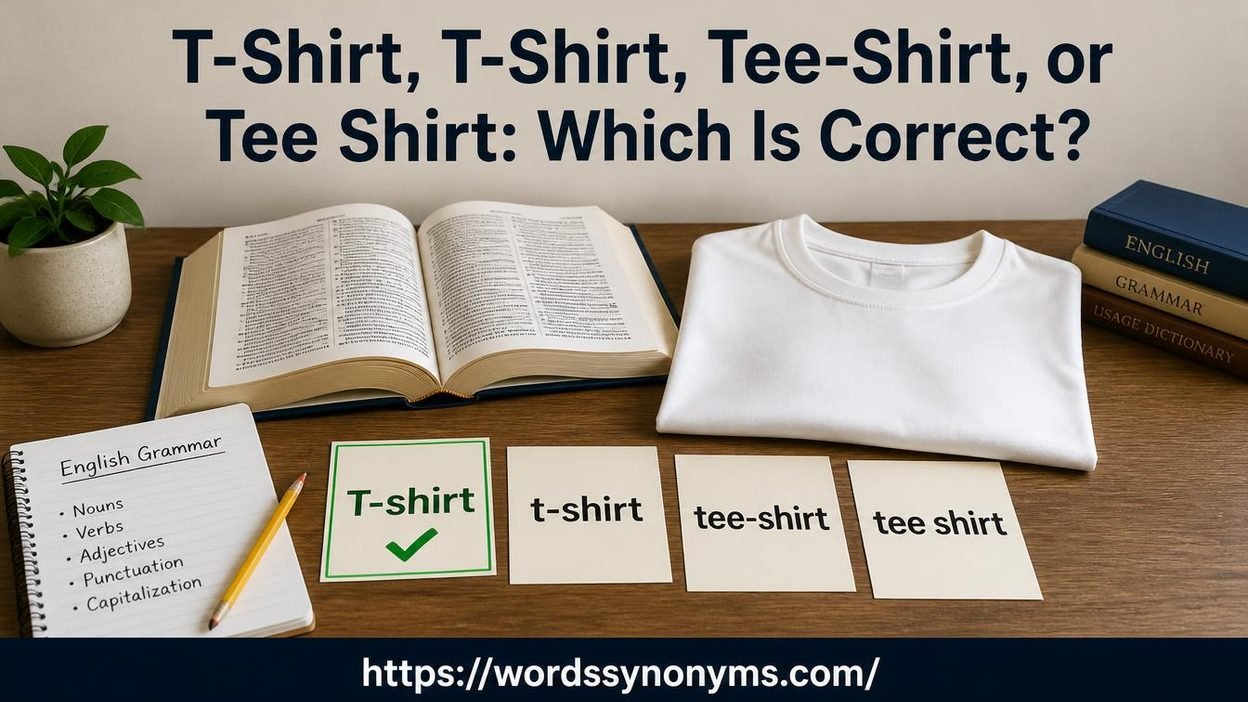
The confusion also extends to the word itself. T-shirt, t-shirt, tee shirt, tee-shirt, and teeshirt appear spelled in different ways, but the standard, common form in edited writing remains T-shirt. Dictionaries generally recommend it, although t-shirt is gaining ground, and some adherents prefer other variants.
The simple truth is that these forms are used and understood online, across shopping sites, ads, stores, daily talk, and everyday writing. This mix-up can make the correct choice unclear, but the alternatives aren’t considered incorrect. For clean, normal English, particularly in formal writing, T-shirt is the safer choice.
Understanding its usage, terminology, and different terminology gives you more confidence. This guide offers a fast answer for the ongoing mission: type the form that looks natural, and you can feel sure your choice isn’t wrong.
Quick Answer
Here’s the practical answer at a glance:
| Form | Is it used? | Recommended? | Main point |
| T-shirt | Yes | Yes | Standard modern form |
| t-shirt | Yes | Usually | Often appears in lowercase or informal contexts |
| tee shirt | Yes | Acceptable | Recognized alternative spelling |
| tee-shirt | Yes | Less preferred | Hyphenated variant |
| tshirt | Yes, especially online | No for polished writing | Closed informal spelling |
| T shirt | Sometimes | Usually no | Missing the conventional hyphen |
The key takeaway is simple:
Use “T-shirt” when you want the conventional spelling in American English.
That doesn’t mean the other forms are meaningless or automatically wrong. English has room for variants. In fact, Cambridge explicitly defines tee shirt as another spelling of T-shirt.
The important distinction is between acceptable and preferred.
What Does T-Shirt Mean?
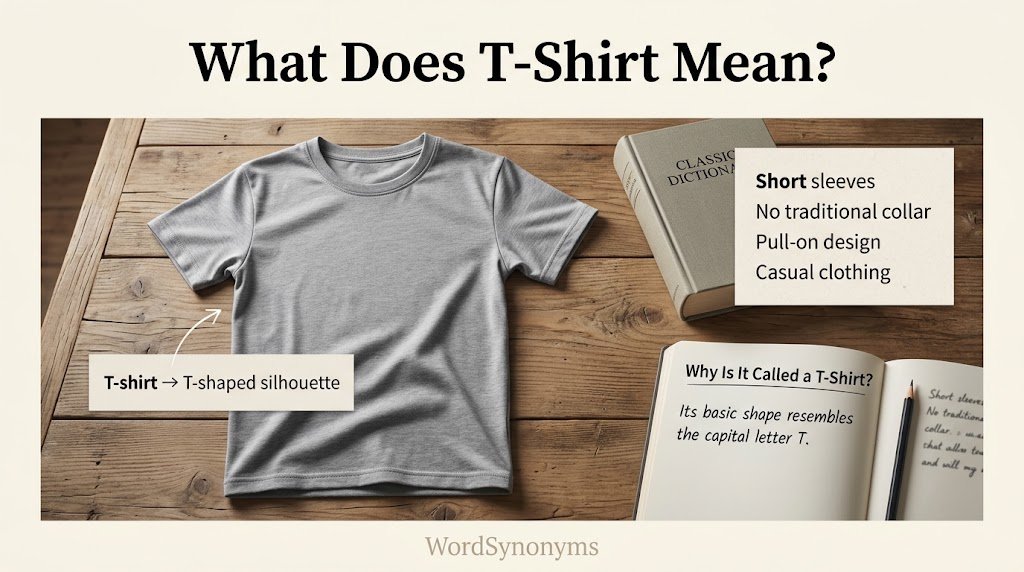
A T-shirt is a simple shirt that usually has short sleeves and no collar. It generally covers the upper body and pulls over the head.
Cambridge gives essentially this definition and identifies the garment as a common type of casual clothing.
The typical T-shirt has several recognizable features:
- Short sleeves
- No traditional shirt collar
- A body that covers the upper torso
- A pull-on design
- A relatively simple construction
- Common use in casual clothing
- Frequent production in cotton or cotton-blend fabrics
Of course, modern T-shirts come in many variations. You can find crew-neck, V-neck, oversized, fitted, long-sleeve, graphic, athletic, and heavyweight versions.
The name itself is much simpler than the fashion industry surrounding it.
Why Is It Called a T-Shirt?
The word T-shirt refers to the garment’s rough T-shaped silhouette.
When you look at a basic short-sleeved shirt from the front, the body forms the vertical part of the shape while the sleeves extend outward. The result resembles the capital letter T.
That visual resemblance gave English speakers a compact way to describe the garment.
The spelling also explains why the capital T has traditionally remained visible. It isn’t simply the first letter of an ordinary word. It represents the letter that gives the garment its name.
Why Is “T-Shirt” Usually the Preferred Spelling?
The form T-shirt combines the letter T with the noun shirt.
The hyphen makes that relationship visually clear. It tells the reader that the two elements function together as one established term.
For example:
- She bought a T-shirt.
- His favorite T-shirt is black.
- The store sells graphic T-shirts.
- I washed my new T-shirt yesterday.
The spelling is compact and immediately recognizable.
Modern dictionaries support this form. Cambridge lists T-shirt as its main headword while also recognizing tee shirt as an alternative.
That distinction matters.
A dictionary’s recognition of a variant doesn’t necessarily mean that every variant has the same frequency or editorial preference. Language contains plenty of words with multiple accepted spellings. Writers still need to choose the form that fits their audience and context.
For general American English, T-shirt is the sensible default.
Why Does the T Have a Capital Letter?
The capital T comes from the letter name itself.
The garment’s name developed from its resemblance to the letter T, so the capital form remained part of the conventional spelling.
Consider these examples:
- Correct: He wore a blue T-shirt.
- Less conventional: He wore a blue t-shirt.
- Preferred: The company printed its logo on every T-shirt.
The lowercase form is widely visible, especially online. However, edited writing commonly preserves the capital T.
Is “T-Shirt” or “T-shirt” Correct?
This question sounds more complicated than it really is.
The standard spelling is generally written T-shirt, with a capital T and lowercase shirt.
The form t-shirt also appears frequently, especially in casual digital writing, product feeds, search queries, and text where writers use lowercase styling.
However, the lowercase form doesn’t create a new meaning.
Compare:
She bought a T-shirt for the concert.
with:
She bought a t-shirt for the concert.
The reader understands both.
The difference is mainly one of orthographic convention and style.
For polished American English, T-shirt is the stronger choice. If you’re following a specific publication’s house style, however, follow that style consistently.
T-Shirt Examples in Sentences
Here are some natural examples:
- I need a clean T-shirt for tomorrow.
- He wore a white T-shirt with jeans.
- That T-shirt has a funny slogan.
- She bought three new T-shirts.
- The black T-shirt fits perfectly.
- His favorite T-shirt is almost ten years old.
- The store sells cotton T-shirts in several sizes.
Notice how the spelling stays consistent. That’s the real goal.
Read more: That vs. Which: Difference, Rules and Examples
Is “Tee Shirt” Correct?
Yes.
Tee shirt is a recognized alternative spelling of T-shirt. Cambridge explicitly lists it as another spelling and defines it as the same type of garment.
The word tee represents the spoken name of the letter T.
So these two forms essentially approach the same idea from different directions:
- T-shirt → uses the written letter T
- tee shirt → spells out the pronunciation tee
Neither changes the garment’s meaning.
Still, frequency and convention matter. T-shirt is generally the more familiar form in modern general writing.
T-Shirt vs. Tee Shirt
| Feature | T-shirt | tee shirt |
| Meaning | Same garment | Same garment |
| Structure | Hyphenated | Open compound |
| Letter representation | T | tee |
| Dictionary recognition | Yes | Yes |
| General recommendation | Preferred | Acceptable alternative |
Think of tee shirt as a legitimate alternative rather than a spelling mistake.
If you write it, readers won’t wonder what you mean. They may simply notice that you’ve chosen a less common form.
Is “Tee-Shirt” Correct?
Tee-shirt is also found in English usage.
The spelling combines tee and shirt with a hyphen. Historical and corpus examples show that this form has been used in real English writing. Cambridge’s dictionary material also includes examples containing tee-shirt.
However, its existence doesn’t make it the best default.
Modern writers generally have a simpler choice: T-shirt.
That’s especially true when you’re writing for a broad American audience.
A useful rule is:
Recognized doesn’t always mean preferred.
English contains many variants that dictionaries record because speakers and writers actually use them. A professional writer still benefits from choosing the most conventional form.
T-Shirt vs. Tee-Shirt vs. Tee Shirt
These three forms mean the same thing:
T-shirt
The conventional modern spelling and the best general choice.
tee shirt
An accepted alternative that spells out the letter name.
tee-shirt
A less common hyphenated variant.
Here’s the practical comparison:
| Spelling | Meaning | Modern usefulness |
| T-shirt | Casual short-sleeved shirt | Highest |
| tee shirt | Same garment | Common enough and accepted |
| tee-shirt | Same garment | Less common |
| tshirt | Same intended meaning | Mostly informal/digital |
When consistency matters, T-shirt removes unnecessary uncertainty.
T-Shirt or Tshirt?
You may encounter tshirt, especially on websites.
Search boxes, hashtags, usernames, product URLs, filenames, database fields, and social media often remove punctuation. Digital systems don’t always follow traditional English typography.
That explains why forms such as these appear:
- tshirt
- Tshirt
- tshirts
- tshirt design
- tshirt printing
Their appearance online doesn’t automatically make them standard editorial spellings.
For ordinary prose, T-shirt remains the better choice.
Compare:
The company launched a new T-shirt collection.
with:
The company launched a new tshirt collection.
The first looks polished and conventional. The second looks more like search-oriented or platform-specific text.
T-Shirt or T Shirt?
The open form T shirt occasionally appears in writing.
However, T-shirt is the conventional form.
The hyphen has an important visual function. It connects T and shirt into a single lexical unit.
This is particularly useful because the first element is only one letter.
Compare:
- T-shirt
- T shirt
The first immediately looks like a single established word. The second can look like an improvised combination.
For edited content, T-shirt is the safer option.
Tee vs. T: Why Are Both Used?
The difference between T and tee is mostly a matter of representation.
T is the written letter.
Tee is the name of that letter when spoken.
English frequently moves between letters and their spoken names. That makes both T-shirt and tee shirt understandable.
The word tee, however, has other meanings.
For example, in golf, a tee can mean the small object that holds a golf ball or the area from which a player begins a hole. Cambridge also records tee as a clothing term meaning a T-shirt.
Context normally solves the problem.
If someone says, “Nice tee,” they’re probably complimenting a shirt.
If someone says, “Put the ball on the tee,” they’re talking about golf.
Same word. Completely different neighborhood.
T-Shirt Plural: T-Shirts or T-Shirts?
The standard plural is:
T-shirts
You add the plural -s to shirt.
Examples:
- one T-shirt
- two T-shirts
- several T-shirts
- five black T-shirts
Don’t use an apostrophe simply because the word contains a capital letter.
T-Shirt’s vs. T-Shirts
This is a common punctuation trap.
T-shirts means more than one T-shirt.
T-shirt’s usually shows possession.
For example:
I bought three T-shirts.
Here, you’re talking about multiple shirts.
But:
The T-shirt’s color faded.
Here, the apostrophe indicates possession. The color belongs to or is associated with the shirt.
The distinction becomes even clearer in a table:
| Form | Meaning | Example |
| T-shirt | Singular | I bought one T-shirt. |
| T-shirts | Plural | I bought three T-shirts. |
| T-shirt’s | Singular possessive | The T-shirt’s sleeve tore. |
| T-shirts’ | Plural possessive | The T-shirts’ designs differed. |
Apostrophes don’t make ordinary nouns plural.
That’s a useful rule far beyond T-shirt spelling.
T-Shirt Possessive Form
The singular possessive form is:
T-shirt’s
Example:
The T-shirt’s fabric feels soft.
The plural possessive is:
T-shirts’
Example:
The T-shirts’ prices were listed online.
This follows the normal English possessive system.
The punctuation can look awkward because T-shirt already contains a hyphen. Still, the grammar remains straightforward.
More Possessive Examples
- The T-shirt’s collar stretched.
- The T-shirt’s graphic faded.
- The T-shirts’ colors were different.
- The T-shirts’ designs attracted attention.
- The T-shirt’s fabric became softer after washing.
How to Use T-Shirt in a Sentence
The word works naturally in countless everyday contexts.
Everyday Examples
- My favorite T-shirt is gray.
- He wore a red T-shirt to dinner.
- She folded the clean T-shirts.
- That old T-shirt still looks great.
- I spilled coffee on my T-shirt.
Professional Writing
There’s nothing inherently informal about the word T-shirt.
You can use it in reports, product descriptions, marketing copy, academic writing, and news writing whenever the garment itself matters.
For example:
The company introduced a new line of organic cotton T-shirts.
There’s no reason to replace T-shirt with an unnecessarily formal phrase.
Simple language often communicates better.
T-Shirt as a Modifier
T-shirt can also modify another noun.
This creates many familiar expressions:
- T-shirt design
- T-shirt printing
- T-shirt business
- T-shirt brand
- T-shirt fabric
- T-shirt material
- T-shirt collection
- T-shirt manufacturer
- T-shirt sales
- T-shirt graphic
These expressions are especially common in retail, fashion, manufacturing, and marketing.
Why the Hyphen Still Matters
When T-shirt functions as a compound term before another noun, retaining its established spelling helps readers identify the phrase quickly.
For example:
The company specializes in T-shirt printing.
The reader immediately recognizes T-shirt as one established term.
In longer compound constructions, however, punctuation can depend on the exact grammar and a publication’s style guide. Don’t mechanically add hyphens to every word surrounding T-shirt.
American English vs. British English
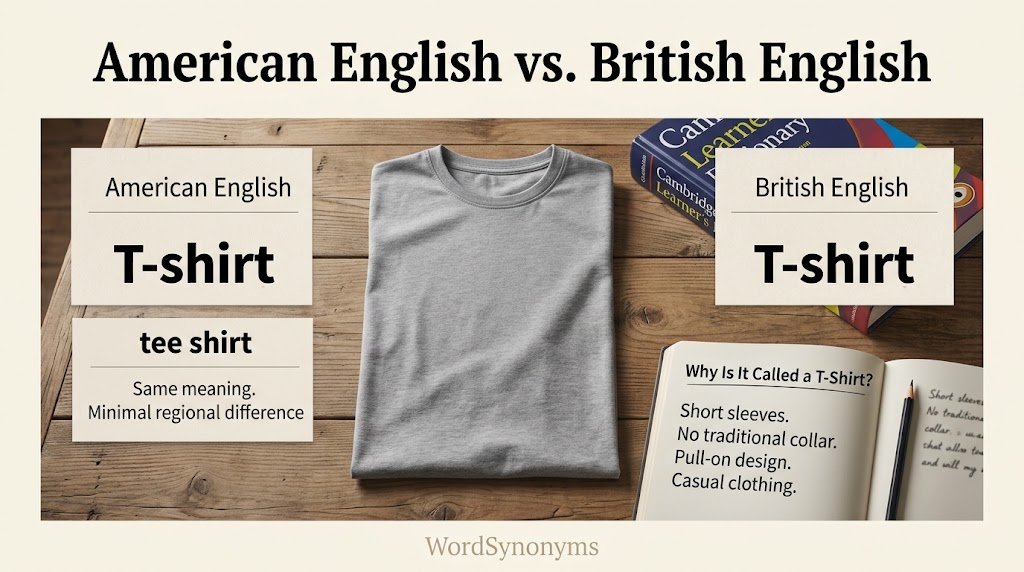
The word T-shirt is widely understood in both American and British English.
The major difference isn’t meaning. It’s more about spelling preferences and editorial conventions.
Cambridge lists T-shirt in both its British and American dictionary material and also recognizes tee shirt.
That makes the term unusually stable across major English varieties.
You don’t need to change T-shirt simply because your reader uses British English.
Other clothing terms may differ significantly between American and British English. T-shirt generally doesn’t create that kind of vocabulary barrier.
T-Shirt Capitalization Rules
Capitalization can cause unnecessary confusion.
The standard form keeps the T capitalized:
T-shirt
Here are the most useful forms:
| Context | Form | Example |
| Singular | T-shirt | She bought a T-shirt. |
| Plural | T-shirts | He owns several T-shirts. |
| Singular possessive | T-shirt’s | The T-shirt’s sleeve tore. |
| Plural possessive | T-shirts’ | The T-shirts’ designs varied. |
| Beginning of sentence | T-shirt | T-shirt sales increased. |
| Compound term | T-shirt | T-shirt design is popular. |
One subtle point deserves attention.
At the beginning of a sentence, the capital T doesn’t tell you much because the first letter of a sentence must be capitalized anyway. The more revealing example is the middle of a sentence:
She wore a T-shirt.
The capital T remains because it belongs to the conventional spelling.
Common T-Shirt Spelling Mistakes
Even familiar words can cause surprisingly persistent errors.
Writing “Tshirt”
Tshirt is common in informal online environments, but it’s not the preferred form for polished prose.
Use:
T-shirt
instead.
Writing “T Shirt”
The open form drops the conventional hyphen.
Use:
T-shirt
for standard general writing.
Writing “T-shirt’s” for the Plural
This is a punctuation error.
Wrong:
I bought five T-shirt’s.
Correct:
I bought five T-shirts.
The apostrophe belongs in possessive constructions, not ordinary plurals.
Using “T-shirts” for Possession
If you’re showing possession, use the appropriate apostrophe:
The T-shirts’ designs were colorful.
The apostrophe follows the s because the owner is plural.
Mixing Spellings
Consistency matters.
Suppose an article uses T-shirt in one paragraph, tee shirt in another, and t-shirt in the next. None of those choices necessarily destroys comprehension. The inconsistent presentation does make the writing look less polished.
Pick one primary form.
For most American English content, that form should be T-shirt.
T-Shirt or Tee Shirt: Which Should You Choose?
The answer depends partly on context.
For General American English
Choose T-shirt.
It’s concise, recognizable, and conventional.
For an Alternative Dictionary-Recognized Form
Choose tee shirt.
It is a legitimate spelling and means the same thing. Cambridge directly identifies it as another spelling of T-shirt.
For Formal or Edited Content
Use T-shirt unless a particular style guide requires something else.
For Informal Digital Writing
You’ll often encounter t-shirt or tshirt.
Those forms may work in contexts where typography or search behavior drives the wording. They aren’t the best default for polished prose.
For Consistent Branding
Follow the brand’s established spelling.
A clothing company might intentionally use tee in its branding. That’s a stylistic decision rather than evidence that tee shirt has replaced T-shirt.
T-Shirt vs. Tee: Are They Exactly the Same?
In clothing contexts, tee can mean T-shirt.
Cambridge specifically records tee as a noun meaning a T-shirt.
That’s why you’ll see phrases such as:
- graphic tee
- vintage tee
- cotton tee
- oversized tee
- plain tee
These expressions are especially common in fashion and casual conversation.
However, tee is broader in meaning because it can refer to other things. Golf provides the most familiar example.
So context matters.
If a friend says, “That’s a cool tee,” the clothing meaning is obvious. If a golfer says, “The ball is on the tee,” the meaning changes completely.
The History Behind the T-Shirt Name
The T-shirt didn’t receive its name randomly.
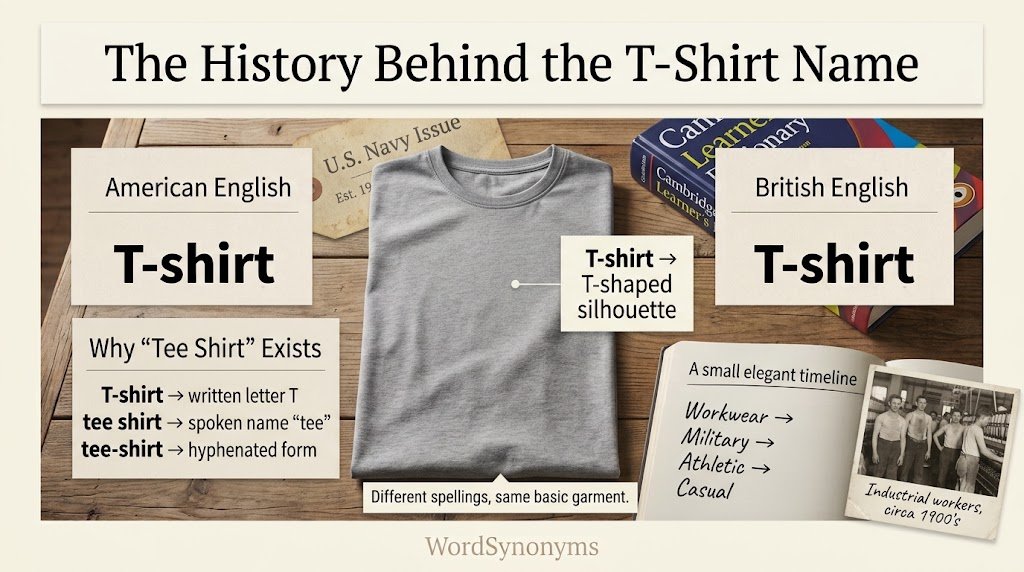
The term reflects the garment’s basic silhouette. A short-sleeved shirt viewed from the front resembles a capital T.
The clothing itself has a deeper history than the name suggests.
Simple pull-on shirts developed from practical undergarments and work clothing. Over time, they moved into military, athletic, industrial, and casual settings. Eventually, the T-shirt became a mainstream piece of everyday clothing.
Its transformation is worth noting because the garment now carries meanings far beyond basic utility.
A plain T-shirt can represent:
- A sports team
- A company
- A political campaign
- A band
- A tourist destination
- A social movement
- A personal joke
- A fashion label
- A cultural identity
The blank fabric became a miniature billboard.
That evolution also helped make T-shirt an extremely familiar compound noun.
Why “Tee Shirt” Exists
The alternative tee shirt makes sense phonetically.
When you pronounce the letter T, it sounds exactly like tee.
So English speakers could describe the garment in two straightforward ways:
T-shirt → based on the written letter
tee shirt → based on the spoken name of the letter
Neither construction requires a completely different definition.
Cambridge’s treatment confirms this relationship by listing tee shirt as another spelling of T-shirt.
The spelling difference is therefore orthographic rather than semantic.
What About “Tee-Shirt”?
The hyphenated tee-shirt form sits between the other two conventions.
It uses:
- tee rather than T
- a hyphen rather than a space
Historical and corpus material shows that writers have used this form. Cambridge’s examples include tee-shirt in actual English-language usage.
Still, modern general writing usually doesn’t need it.
If you’re deciding between T-shirt and tee-shirt, the first form is simpler and more conventional.
There’s little practical benefit in choosing the longer variant unless you’re following a source, quotation, brand style, or established publication convention.
Read more: Uncomparable Adjectives: Rules and Common Mistakes
A Practical Style Guide for T-Shirt Spelling
When editing an article, product page, or business document, use this quick checklist.
Use “T-shirt” when:
- You need the standard general form.
- You’re writing in American English.
- You’re preparing edited web content.
- You’re writing an article or report.
- You’re describing clothing in ordinary prose.
Use “tee shirt” when:
- The alternative spelling fits your established style.
- You’re reproducing a source’s wording.
- You want to use a recognized variant.
Avoid “tshirt” when:
- You’re writing polished editorial content.
- You’re preparing formal documents.
- You want conventional English spelling.
Avoid “T shirt” when:
- You mean the established clothing term.
- You don’t have a style-specific reason to omit the hyphen.
A Simple Case Study: Choosing the Right Form
Imagine you’re writing a product description for a clothing store.
The draft says:
This premium tshirt is made from soft cotton. Our tee-shirt has a relaxed fit and comes in six colors. These T shirt designs work well for everyday wear.
Nothing is impossible to understand. Yet the paragraph looks inconsistent.
A polished version would read:
This premium T-shirt is made from soft cotton. The relaxed-fit T-shirt comes in six colors. These T-shirt designs work well for everyday wear.
The meaning hasn’t changed.
The writing simply follows one consistent convention.
That’s an important lesson with spelling variants: consistency often matters almost as much as the individual choice.
T-Shirt Facts Worth Knowing
A few linguistic and practical facts help explain why the spelling causes confusion.
- T-shirt is the conventional modern spelling.
- Tee shirt is a recognized alternative.
- Tee-shirt is a documented variant.
- T-shirt and tee shirt refer to the same basic garment.
- The T relates to the garment’s T-like shape.
- Tee is also an independent English word with meanings in golf and sports.
- The standard plural is T-shirts.
- T-shirt’s normally marks singular possession.
- T-shirts’ marks plural possession.
- Tshirt appears frequently in digital contexts but is not the preferred polished spelling.
Cambridge’s dictionary entries support the equivalence of T-shirt and tee shirt and also document tee as a clothing term.
FAQs About T-Shirt, T-Shirt, Tee-Shirt, or Tee Shirt
Is T-shirt the correct spelling?
Yes. T-shirt is the most widely accepted and commonly used spelling in modern English, especially in edited and professional writing.
Is t-shirt also correct?
Yes. t-shirt is widely used, particularly in informal writing, online stores, product listings, and everyday communication. The lowercase form isn’t generally considered wrong.
Is tee shirt or tee-shirt correct?
Yes, both tee shirt and tee-shirt are used. However, they are less common than T-shirt in contemporary English.
Is teeshirt written as one word?
Teeshirt appears occasionally, but it’s much less common. If you want the safest and most familiar form, choose T-shirt.
Why is it called a T-shirt?
The name comes from the shirt’s basic shape, which resembles the capital letter T when laid flat. The term eventually became the standard name for this short-sleeved garment.
Which T-shirt spelling should I use in formal writing?
Use T-shirt. It is the safest choice for articles, school assignments, business writing, product descriptions, and other edited English.
Conclusion
The easiest choice is T-shirt. It looks familiar, reads naturally, and works well in everyday and formal English. You may still see t-shirt, tee shirt, or tee-shirt, especially online or in casual writing. These forms are understandable, but T-shirt remains the safest option when you want your writing to look polished.
Whether you’re writing a product description, shopping guide, advertisement, or everyday message, consistency matters. Pick T-shirt and stick with it throughout your writing. That small choice keeps your wording clean and avoids an unnecessary spelling debate.

Samreen Saif is a passionate writer and language enthusiast who contributes informative and engaging content to WordsSynonyms.com. She enjoys exploring English vocabulary, synonyms, antonyms, word meanings, and language usage to help readers understand and use words with confidence.
Samreen focuses on creating clear, accurate, and easy-to-read content for students, writers, professionals, and English learners. Through her articles, she aims to make vocabulary learning simple, practical, and useful for everyday communication.
When she is not writing, Samreen enjoys learning about language, discovering new words, and creating helpful content that makes English learning more accessible to everyone.