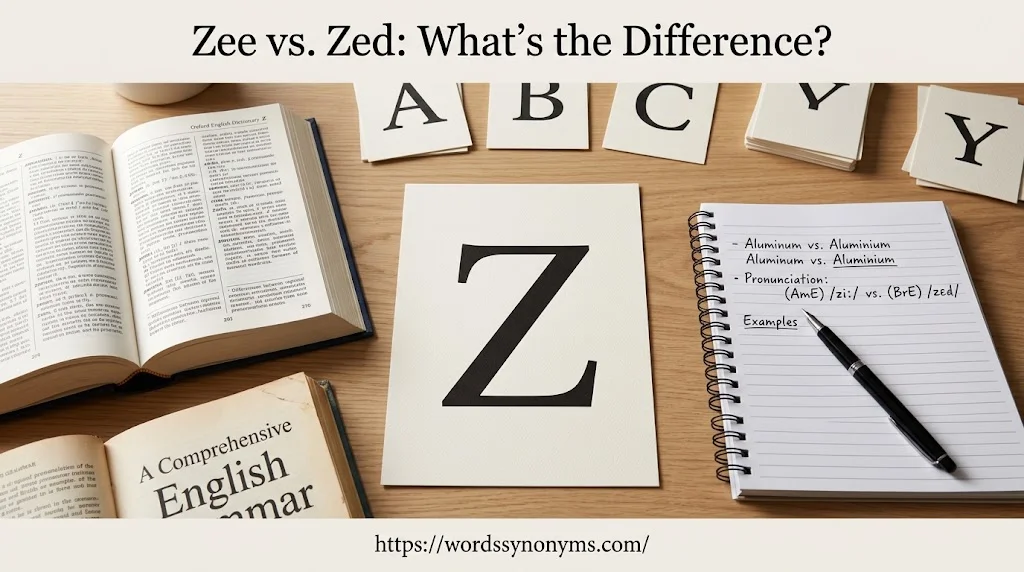
Understanding Zee vs. Zed: What’s the Difference? starts with recognizing how American English and British English pronounce the letter z today.
In American English, Zee is the standard pronunciation, while British English generally uses Zed. Neither choice is right or wrong, and using one form doesn’t make you ignorant when pronouncing the English letter. The zed pronunciation is older and connects more closely to the Greek letter zeta, from which the English form was derived.
Other languages show similar patterns: French uses zède, German speakers commonly say zet, and Spanish speakers use zeta. These historical points give Zed a clear place in the story of English spelling and pronunciation.
The U.S. pronunciation likely developed through analogy with familiar letters such as bee, cee, dee, and gee. It became established in American English during the 19th century and is now deeply ingrained among Americans, many of whom are unaware that the British pronunciation differs.
Regional habits make the contrast even clearer. Australian and New Zealand English speakers generally use Zed, while Canadians use both Zee and Zed in Canadian English.
From my experience with English usage, this is easiest to remember as a matter of regional speech shaped by history, geography, and everyday communication rather than a difference in correctness.
Quick Answer
Zee and zed are two names for the same letter, Z. American English uses zee (/ziː/), while British English and many Commonwealth varieties use zed (/zɛd/). The spelling and meaning don’t change. If you’re speaking American English, use zee. If you’re following British English, use zed. Knowing both helps you understand speakers from different English-speaking regions without confusion.
Zee vs. Zed at a Glance
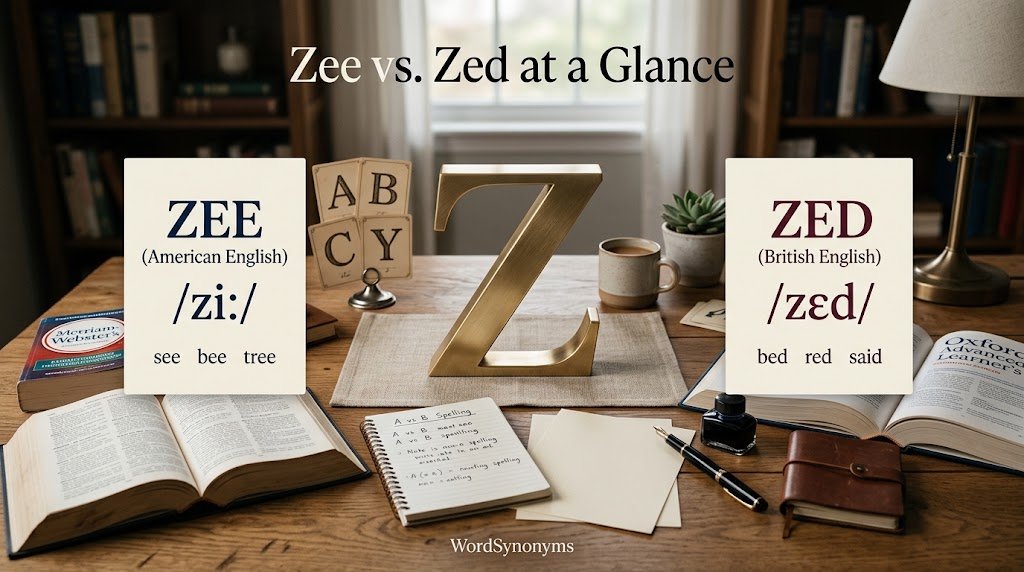
The quickest way to understand zee vs. zed is to compare the two forms directly.
| Feature | Zee | Zed |
| Letter | Z | Z |
| Pronunciation | /ziː/ | /zɛd/ |
| Main association | American English | British English |
| Common in Canada | Minority variant | Traditional majority form |
| Plural | zees | zeds |
| Rhymes with | see, bee, tree | bed, red, said |
| Meaning | The letter Z | The letter Z |
| Written form | Z or z | Z or z |
The most important point is simple: zee and zed don’t represent different letters.
They are two names for the same letter.
For example, an American might say:
“The word ends with zee.”
A British speaker might say:
“The word ends with zed.”
Both speakers mean Z.
The difference becomes noticeable only when the letter gets spoken aloud.
What Does “Zee” Mean?
Zee is the standard American English name for the letter Z.
It is pronounced /ziː/, with a long “ee” sound. That makes it rhyme closely with words such as see, bee, and tree.
For example:
- “Zee is the final letter of the alphabet.”
- “Her last initial is Z, pronounced zee.”
- “Please spell the word and finish with zee.”
- “The company name starts with a Z, or zee.”
Cambridge Dictionary identifies zee as the US name for the last letter of the English alphabet.
The word also has a plural form: zees.
You might therefore hear:
“The word has two zees.”
That sentence means the word contains two instances of the letter Z.
Why Does “Zee” Sound Like Other Letter Names?
One useful clue comes from the pattern of English letter names.
Consider:
- B → bee
- C → cee
- D → dee
- E → ee
- G → gee
- P → pee
- T → tee
- V → vee
- Z → zee
The -ee ending creates a noticeable pattern.
Historical sources describe zee as a form that developed by analogy with other English letter names. The spelling and pronunciation became established in American English over time.
That pattern helps explain why zee feels perfectly natural to an American English speaker.
What Does “Zed” Mean?
Zed is the traditional British English name for the letter Z.
It is pronounced /zɛd/ and rhymes closely with words such as bed, red, and said.
Examples include:
- “Zed is the last letter of the alphabet.”
- “The password ends with zed.”
- “Spell your surname, including the final zed.”
- “The word contains two zeds.”
The plural is zeds.
British dictionaries identify zed as the British spoken form of the letter Z. The word also appears in other varieties of English around the world.
Unlike zee, the ending of zed does not follow the long -ee pattern found in several English letter names.
Instead, it has a short vowel followed by a final d sound.
That final consonant is the feature American listeners notice immediately.
Zee vs. Zed Pronunciation
The pronunciation difference is small on paper but obvious when spoken.
How to Pronounce Zee
Say:
/ziː/
Think of:
see → zee
The vowel is long and the word ends with the same sound found in bee or tree.
Try saying:
“A, B, C … X, Y, zee.”
The ending should sound smooth and open.
How to Pronounce Zed
Say:
/zɛd/
Think of:
bed → zed
The vowel is shorter and the word ends with a clear d.
Try saying:
“X, Y, zed.”
The final consonant gives the word its distinctive sound.
An Easy Memory Trick
If you speak American English, remember:
Zee rhymes with “see.”
If you speak British English, remember:
Zed rhymes with “bed.”
That tiny rhyme can make the distinction much easier for English learners.

Why Do Americans Say “Zee” and British Speakers Say “Zed”?
The answer goes back several centuries.
The traditional English name zed ultimately traces back through French and Latin to the Greek letter zeta. The word entered English in the Middle English period. Etymological sources place the English form in the late medieval period.
The American form zee has a different history.
Historical records show that zee was already being used in English by the late 1600s. One early documented appearance dates to 1677. The form developed alongside the names of other English consonant letters and later became firmly associated with American English.
The change wasn’t an overnight decision.
English pronunciation develops gradually through everyday speech, education, regional influence, and language patterns. Over generations, zee became the established American pronunciation while zed remained standard in Britain and many other English-speaking regions.
Did Noah Webster Invent “Zee”?
Not exactly.
This is a common oversimplification.
Zee existed before Noah Webster. Historical evidence places the form in English during the 17th century. However, Noah Webster’s influential American spelling books and dictionaries helped standardize many features of American English. Sources on Canadian English note that Webster’s work also helped reinforce the American form.
So it is more accurate to say that Webster helped establish American language conventions rather than claiming he personally invented zee.
Where Is “Zee” Used?
The clearest association is with American English.
In the United States, zee is the normal pronunciation used in:
- Schools
- Everyday conversation
- Spelling exercises
- Dictionaries
- Alphabet recitation
- Names and initials
- Serial numbers and codes
- Business communication
If an American teacher asks a student to pronounce the alphabet, the final letter will normally sound like zee.
For an American English learner, therefore, zee is the expected pronunciation.
That doesn’t mean zed is incomprehensible. Americans generally recognize zed as another English pronunciation of Z, especially through international media, British English, or Canadian speakers.
Where Is “Zed” Used?
Zed is standard in British English.
It is also common across many English-speaking regions with historical British influence.
These include:
- United Kingdom
- Australia
- New Zealand
- Ireland
- South Africa
- India
- Several other Commonwealth English communities
Regional speech isn’t perfectly uniform, however. English changes from one community to another, and individual speakers can have different preferences.
The broad pattern remains useful:
American English → zee
British and many Commonwealth varieties → zed
This distinction appears consistently in dictionary descriptions and linguistic references.
What About Canadian English?
Canada deserves special attention because it sits between American and British English in many linguistic features.
Canadian English traditionally uses zed for Z.
Research summarized by the Dictionary of Canadianisms describes zed as the predominant Canadian pronunciation while also documenting zee as a stable minority variant. One cited description places zee at roughly 20% across Canadian age groups and regions.
That makes the simple statement “Canadians always say zed” too broad.
Why Do Some Canadians Say Zee?
One important influence is the alphabet song.
The familiar American version ends with:
“X, Y, Z.”
When sung with the melody commonly used in North America, zee rhymes with the preceding letter-name pattern.
The ending works musically because:
- T → tee
- U → you
- V → vee
- W → double-you
- X → ex
- Y → why
- Z → zee
A child can hear zee repeatedly in songs even if the family normally uses zed.
Canadian linguistic research has specifically discussed this influence. Some Canadian children use zee while singing the alphabet and later return to zed in ordinary speech.
That is a fascinating example of how songs can influence pronunciation without completely changing everyday speech.
Zee vs. Zed in the Alphabet Song
The alphabet song creates one of the most recognizable differences between American and British English.
In the familiar English-language melody, the final sequence usually ends with:
X, Y, Z
When Z is pronounced zee, it fits neatly into the musical pattern.
When someone normally says zed, the original rhyme disappears.
That’s why children who grow up hearing the traditional American alphabet song can become familiar with *zee even when their local variety normally uses zed.
This doesn’t necessarily mean they have changed their regional accent.
It simply shows how music can preserve a pronunciation in a child’s memory.
For English learners, the alphabet song can therefore be slightly misleading if the goal is to learn a particular regional variety.
Zee vs. Zed in Different English-Speaking Countries
Regional usage can be summarized like this:
| Region or variety | Common pronunciation |
| United States | zee |
| United Kingdom | zed |
| Canada | zed is traditional; zee is also used |
| Australia | zed |
| New Zealand | zed |
| Ireland | zed is common |
| South Africa | zed is common |
| India | zed is widely used |
| Other Commonwealth varieties | Generally zed |
These are broad language patterns rather than rules for every individual speaker.
A person’s education, media exposure, family background, location, and contact with other English varieties can all influence pronunciation.
Is “Zee” Correct?
Yes.
Zee is completely correct in American English.
1. It isn’t slang.
2. It isn’t a mispronunciation.
3.It isn’t an informal replacement for the “proper” name.
American dictionaries recognize zee as the name of the letter Z. Cambridge, for example, marks it as a US pronunciation.
So if someone says:
“Zee is the last letter.”
There is nothing grammatically or linguistically wrong with that sentence.
It simply reflects American English.
Is “Zed” Correct?
Yes.
Zed is also completely correct.
It is the standard British name for the letter and remains widely used in other English varieties.
If someone from Britain says:
“The word ends with zed.”
They aren’t using an outdated or incorrect version.
They’re using the normal pronunciation of their variety of English.
The important lesson is that regional pronunciation doesn’t automatically equal correctness or incorrectness.
English has many regional differences.
The same language can accommodate them quite comfortably.
Zee vs. Zed for English Learners
English learners often wonder which pronunciation they should memorize.
The answer depends on the English variety you’re learning.
If You’re Learning American English
Use:
Z = zee
For example:
“My name ends with a zee.”
If You’re Learning British English
Use:
Z = zed
For example:
“The word has a zed at the end.”
If You Communicate Internationally
Learn both.
You don’t need to switch between them constantly. You simply need to recognize what the other speaker means.
This is especially useful during phone calls.
Imagine someone gives you a product code containing Z. If you only know zee, hearing zed might briefly make you wonder whether the person said another letter.
Once you know the difference, the problem disappears.
Zee vs. Zed in Spelling Aloud
The difference becomes especially practical when people spell information verbally.
Consider the name:
ZANE
An American speaker might say:
“Zee-A-N-E.”
A British speaker might say:
“Zed-A-N-E.”
The written spelling remains identical.
This distinction matters when people exchange:
- Names
- Email addresses
- Account numbers
- Product codes
- Street names
- Serial numbers
- Passwords
- Initials
- License information
When accuracy matters, context usually resolves the difference.
For even greater clarity, speakers can use a phonetic alphabet.
For example, the NATO phonetic alphabet represents Z as Zulu.
That avoids any confusion between zee and zed entirely.
Read more: Aerie vs. Airy: Difference and Examples
Zee vs. Zed in Names and Brands
Sometimes the pronunciation of Z becomes part of a proper name.
A famous example is the stage name Jay-Z.
The pronunciation of the name is generally Jay-Z, with Z pronounced zee.
This demonstrates an important point: a person’s established name pronunciation doesn’t necessarily follow the regional preference of every listener.
The same principle applies to:
- Company names
- Product names
- Band names
- Organizations
- Place names
- Personal initials
When a specific name has an established pronunciation, that pronunciation should be treated separately from the general regional rule for the letter.
Zee vs. Zed in Technical Communication
Technical communication makes small pronunciation differences more noticeable.
Suppose someone reads this code aloud:
AB7Z9
One speaker might say:
“A-B-seven-zee-nine.”
Another might say:
“A-B-seven-zed-nine.”
The code hasn’t changed.
Only the spoken name of Z has changed.
When accuracy matters, spelling systems such as the NATO phonetic alphabet provide an even clearer solution:
Z = Zulu
That’s particularly useful in situations involving:
- Aviation
- Radio communication
- Military communication
- Customer support
- Technical support
- Banking
- Telecommunications
The broader lesson is useful beyond zee vs. zed: spoken letters can become ambiguous when people have different accents or regional vocabulary.
Common Mistakes About Zee and Zed
Several myths appear repeatedly when people discuss these two words.
Mistake 1: Thinking Zed Is Wrong in America
Americans generally say zee, but zed is still an established English word.
It doesn’t become incorrect simply because it isn’t the dominant American pronunciation.
Mistake 2: Thinking Zee Is Wrong in Britain
Zee isn’t meaningless to British speakers.
It is recognized as the American name for Z. British dictionaries commonly identify it as such.
However, zed remains the standard British pronunciation.
Mistake 3: Assuming Every Canadian Says Zed
Canadian English traditionally favors zed, but documented research shows meaningful use of zee as well.
So “Canada always says zed” is too absolute.
Mistake 4: Thinking the Written Letter Changes
It doesn’t.
The letter remains:
Z
The pronunciation changes:
zee /ziː/
or
zed /zɛd/
Mistake 5: Thinking the Two Words Have Different Meanings
They don’t.
Both refer to the letter Z.
The difference is regional pronunciation.
The History of “Zed”
The history of zed reaches much further back than modern British English.
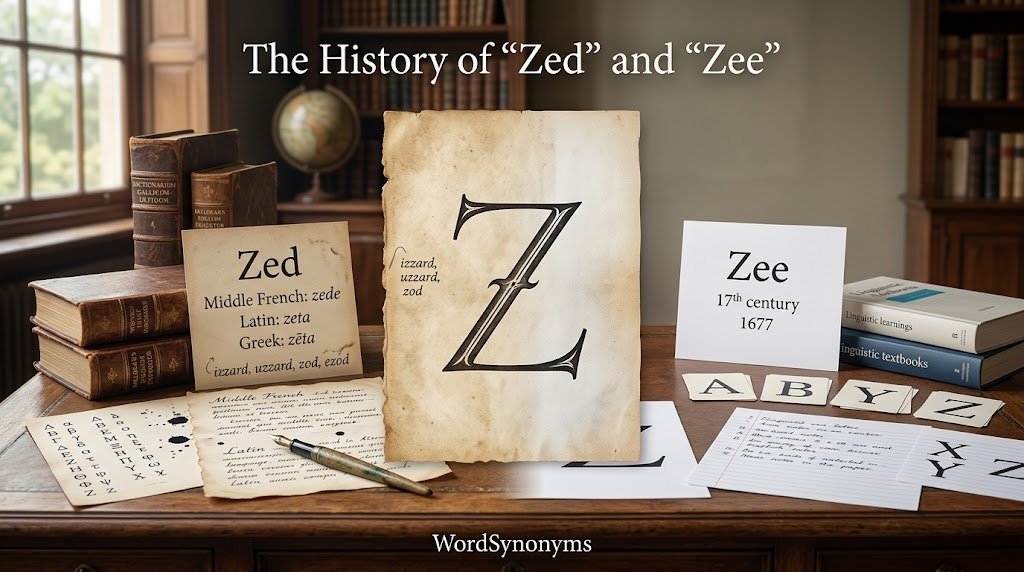
The word is traced through Middle French zede, Late Latin zeta, and Greek zēta. The Greek name ultimately connects with the ancient history of the letter itself.
English didn’t always have only one name for Z, either.
Historical sources record older forms such as:
- izzard
- uzzard
- zod
- ezod
These forms are largely historical today.
The survival of zed therefore represents a much older naming tradition than many modern speakers realize.
The History of “Zee”
Zee has its own long history.
Dictionary evidence dates the American form to the 17th century, with one early documented record appearing in 1677. Its development is associated with the naming pattern of other English consonants.
The pronunciation later became strongly associated with American English.
That history matters because it corrects a popular misconception:
Zee isn’t a modern American invention.
It has been part of English usage for centuries.
No single moment created the modern American pronunciation. Language change usually works more like a river than a light switch. It shifts gradually as speakers repeat forms, schools teach them, dictionaries record them, and communities adopt them.
A Simple Case Study: Spelling a Name
Imagine an international customer service call.
A customer says:
“My surname ends in Z.”
The representative asks:
“Zee or zed?”
The customer understands immediately that the question concerns pronunciation rather than spelling.
This tiny exchange illustrates why the distinction matters.
Neither speaker is wrong.
They simply come from different pronunciation traditions.
Now imagine the same situation with a long account number. A speaker could avoid uncertainty altogether by using the NATO phonetic alphabet and saying Zulu for Z.
That’s why awareness of regional differences can improve communication without requiring anyone to abandon their normal accent.
Zee vs. Zed: Key Facts
Here are the most useful facts to remember:
- Zee is the standard American English name for Z.
- Zed is the standard British English name for Z.
- Both words mean the same thing.
- Zee is pronounced /ziː/.
- Zed is pronounced /zɛd/.
- Zed has roots connected to Greek zēta through French and Latin.
- Zee was documented in English by the 17th century.
- Noah Webster helped reinforce American language conventions, but he didn’t invent zee.
- Canadian English traditionally uses zed.
- Canadian English also has a documented minority use of zee.
- The American alphabet song helps explain why zee appears in some Canadian children’s speech.
- The written letter remains Z regardless of pronunciation.
- Both pronunciations are legitimate forms of English.
Zee vs. Zed Examples
The following examples make the difference easy to see.
| Situation | American English | British English |
| Name of Z | zee | zed |
| “Z is the final letter.” | “zee” | “zed” |
| “The word ends in Z.” | “ends in zee” | “ends in zed” |
| Plural | zees | zeds |
| Rhyming word | see | bed |
| IPA | /ziː/ | /zɛd/ |
Example 1
American:
“Spell it with a zee at the end.”
British:
“Spell it with a zed at the end.”
Example 2
American:
“My initials are A and zee.”
British:
“My initials are A and zed.”
Example 3
American:
“The code contains two zees.”
British:
“The code contains two zeds.”
The written information stays exactly the same.
Read more: Away vs. A Way: What’s the Difference?
How to Remember Zee vs. Zed
If the two pronunciations keep getting mixed up, use a simple two-word association.
Remember Zee With “See”
Zee → see
Both contain the long ee sound.
You can also connect zee with:
- bee
- C
- D
- gee
- pee
- tee
- vee
Remember Zed With “Bed”
Zed → bed
Both have the short e sound followed by a final d.
You can also connect it with:
- red
- fed
- led
- said
This mnemonic works particularly well for English learners because it focuses on sound rather than spelling.
Is Zee or Zed More Common?
There isn’t one worldwide answer because English pronunciation varies by region.
Within American English, zee is the normal form.
Within British English, zed is the normal form.
Across many Commonwealth varieties, zed is also widespread. Canadian English provides a useful example of variation because zed remains predominant while zee has a substantial minority presence.
So asking which one is “more common” without naming a population can produce a misleading answer.
The better question is:
More common where?
Language statistics always need a population and region attached to them.
Why Zee vs. Zed Matters for English Learners
For a native speaker, this distinction may seem tiny.
For an English learner, however, it can cause genuine confusion.
Imagine learning:
“X, Y, Z.”
Then hearing a British speaker say:
“X, Y, zed.”
If you’ve only learned American English, you may briefly wonder whether zed is another letter.
It’s not.
Understanding the difference helps you:
- Follow international conversations.
- Understand British and American media.
- Communicate spelling clearly.
- Recognize regional accents.
- Avoid correcting someone unnecessarily.
- Learn vocabulary according to the English variety you need.
The smartest approach isn’t to memorize one pronunciation and forget the other.
Learn your target variety, then recognize the alternative.
FAQs
Is Zee or Zed the correct pronunciation?
Both Zee and Zed are correct English pronunciations. Zee is mainly associated with American English, while Zed is common in British English and several other varieties.
Why do Americans say Zee instead of Zed?
The American form likely developed by analogy with letter names such as bee, cee, dee, and gee. Over time, Zee became firmly established in American English.
Why do British speakers say Zed?
Zed is the older English pronunciation. It also has a historical connection with zeta, the name of the Greek letter from which the English letter name developed.
Do Canadians say Zee or Zed?
Canadians use both pronunciations. The choice can vary depending on the speaker, region, and exposure to American or British English.
Which countries commonly use Zed?
Zed is widely used in British English and is also common in Australian and New Zealand English. It appears in other English-speaking regions as well.
Does Zee or Zed change the spelling of the letter?
No. The letter is still written as z in both varieties. The difference is only in pronunciation, not the spelling or identity of the letter.
Conclusion
Zee vs. Zed: What’s the Difference? comes down to pronunciation, not correctness. Americans generally say zee, while British, Australian, and New Zealand speakers commonly use zed. Canadians may use either form.
The interesting part is the history behind these two little words. Zed is the older English form, with roots connected to Greek zeta, while zee became established in American English through its own pronunciation pattern. So, whether you say “zee” or “zed,” you’re using a recognized form of the English letter z. The spelling stays the same, even when the sound changes.

Syeda Naalain Zahra is a content writer with an interest in English vocabulary and language. She creates simple and informative articles about synonyms, antonyms, word meanings, and everyday English usage. Her aim is to help readers build better vocabulary and communicate more confidently.