Veracity vs. Voracity: Difference and Examples helps you see how these similar-looking words differ in meaning, usage, and everyday English context.
Veracity is a noun that means truthfulness, honesty, truth, accuracy, sincerity, or credibility. Its corresponding adjective is veracious, which means true or truthful. These words are closely synonymous.
Voracity, however, is a noun connected to the adjective voracious. Someone voracious is eager to consume a great amount of food, showing a marked, insatiable appetite for eating and consumption.
The confusion usually comes from the similar spelling of these words, rather than their meanings. Veracity is far more common than Voracity, while voracious is more common than veracious.
This makes the adjectives especially confusing and can send usage in the opposite direction. A useful way to remember the distinction is to connect veracious with something true and truthful, while linking voracious with a strong appetite and consumption.
The former concerns truth and honesty; the latter concerns strong desire. Sometimes, one word is incorrectly used in place of the other because of their spelling similarity.
Quick Answer
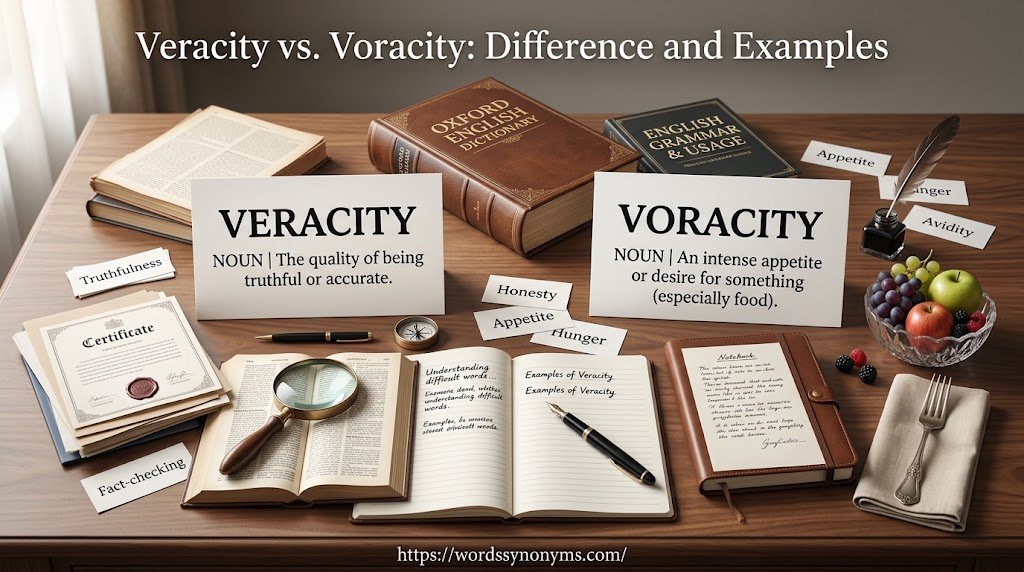
Veracity means truthfulness or accuracy, while voracity means an intense appetite or eagerness to consume something. If you’re discussing whether a claim is true, use veracity. If you’re describing someone eating, reading, or pursuing something with great eagerness, use voracity. A simple memory trick is: veracity = truth; voracity = devouring.
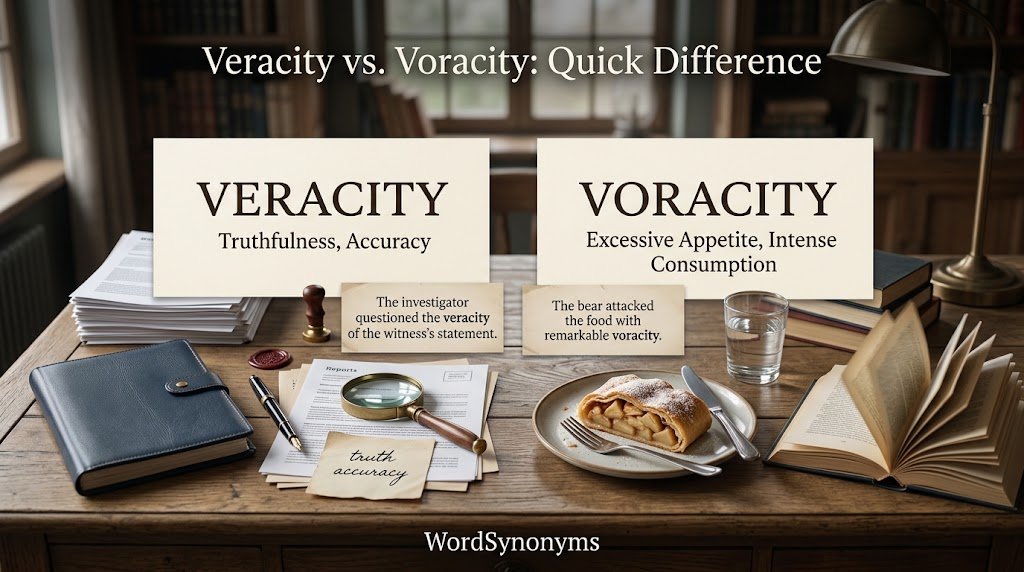
Veracity vs. Voracity: Quick Difference
The fastest way to understand veracity vs. voracity is to compare their central meanings.
| Word | Meaning | Part of Speech | Common Context |
| Veracity | Truthfulness, accuracy, or conformity to truth | Noun | Claims, statements, reports, testimony |
| Voracity | Excessive appetite, eagerness, or consuming something intensely | Noun | Food, reading, learning, consumption |
Here are two sentences that make the contrast clear:
- The investigator questioned the veracity of the witness’s statement.
- The bear attacked the food with remarkable voracity.
In the first sentence, the issue concerns truth.
In the second, the issue concerns appetite or intense consumption.
A useful shortcut is:
Veracity = truth. Voracity = devouring.
That simple contrast can prevent most mistakes.
What Does Veracity Mean?
Veracity is a noun that means truthfulness, accuracy, or adherence to the truth.
When you talk about the veracity of something, you’re asking whether it can be regarded as truthful or accurate. The word often appears when people evaluate claims, statements, reports, testimony, accounts, or information.
For example:
The journalist questioned the veracity of the anonymous source.
This sentence doesn’t mean the journalist disliked the source. It means the journalist wasn’t sure whether the source’s information was truthful or reliable.
Veracity Definition
The core idea behind veracity is simple:
Veracity is the quality of being truthful or accurate.
It can refer to a person’s truthfulness or to the factual reliability of something they have said.
Consider these examples:
- The evidence strengthened the veracity of the witness’s account.
- The editor checked the veracity of the reported facts.
- Several readers questioned the veracity of the claim.
- The investigation examined the veracity of his testimony.
- New documents supported the veracity of the original report.
Notice the pattern. Veracity usually concerns information, statements, accounts, or claims.
It doesn’t describe hunger or enthusiasm for food.
Veracity in a Sentence
The word often appears with phrases such as question the veracity, doubt the veracity, or establish the veracity.
For example:
The court had to determine the veracity of the testimony.
Here, veracity means the truthfulness or accuracy of the testimony.
Another example:
The researcher examined the veracity of the historical account.
The researcher isn’t examining whether the account was interesting. The question is whether its claims are accurate and truthful.
You can also use the word in a more general context:
The viral post raised serious questions about its veracity.
In other words, readers weren’t sure whether the information was true.
Veracity Synonyms
Depending on the sentence, possible synonyms include:
- truthfulness
- truth
- accuracy
- honesty
- authenticity
- reliability
However, these words aren’t perfect substitutes in every situation.
For example, honesty often describes a person’s character or behavior. Accuracy focuses more specifically on correctness. Veracity sits closer to the idea of truthfulness or conformity to truth.
That’s why the phrase “question the veracity of the claim” sounds natural in formal writing.
What Does Voracity Mean?
Voracity is a noun describing an intense or excessive appetite, eagerness, or desire to consume something.
The word most commonly refers to eating.
For example:
The hungry puppy attacked its dinner with voracity.
The sentence suggests that the puppy ate eagerly and intensely.
However, voracity doesn’t have to involve food. Writers sometimes use it figuratively to describe an intense desire for reading, learning, information, entertainment, or other forms of consumption.
Voracity Definition
The central meaning of voracity is:
An unusually strong, eager, or seemingly insatiable appetite or desire to consume something.
The literal sense is particularly easy to visualize.
Imagine someone finishing a large meal quickly because they’re extremely hungry. You could describe the person as eating with voracity.
The figurative sense works similarly:
She devoured the novels with intellectual voracity.
Here, she isn’t literally eating the books. The sentence uses voracity metaphorically to describe an intense appetite for reading.
Voracity in a Sentence
Here are several examples:
- The lion tore into its meal with voracity.
- The children ate the birthday cake with surprising voracity.
- He reads books with remarkable voracity.
- She pursued new knowledge with intellectual voracity.
- The audience consumed the information with voracity.
The last few examples demonstrate the figurative side of the word.
English frequently uses eating as a metaphor for intense interest. We say someone devours books, consumes information, or hungers for knowledge. Voracity fits naturally into that family of expressions.
Voracity Synonyms
Depending on context, related words include:
- greediness
- ravenousness
- insatiability
- eagerness
- avidity
- appetite
- intensity
Again, context matters.
If someone eats quickly because they’re extremely hungry, ravenousness may fit better. If someone eagerly pursues knowledge, avidity or voracity may work.
Veracity vs. Voracity: Key Differences
The biggest difference between veracity vs. voracity lies in what each word describes.
Veracity describes truth. Voracity describes appetite or intense consumption.
That’s the foundation. Everything else follows from it.
Veracity Concerns Truth
Use veracity when the subject involves whether something is true, accurate, or trustworthy.
Common subjects include:
- statements
- reports
- claims
- testimony
- stories
- allegations
- accounts
- information
- evidence
For example:
The editor questioned the veracity of the report.
The editor wants to know whether the report accurately represents the facts.
Voracity Concerns Appetite
Use voracity when the subject involves consuming something eagerly or excessively.
Common contexts include:
- eating
- drinking
- reading
- learning
- consuming information
- pursuing experiences
- intense desire
For example:
The athlete ate the meal with voracity after training.
The sentence focuses on appetite, not truth.
Their Meanings Don’t Overlap
This is an important point. Veracity and voracity aren’t two forms of the same concept.
They don’t represent different degrees of truth.
They don’t describe different kinds of appetite.
They’re simply different words that happen to look and sound similar.
That makes them a classic pair of easily confused English words.
Veracity vs. Voracity Examples
Paired examples make the distinction much easier to remember.
Examples With Veracity
The lawyer questioned the veracity of the witness’s statement.
The lawyer doubts whether the statement is truthful.
Investigators examined the veracity of the allegation.
They want to determine whether the allegation is accurate.
The documents supported the veracity of her account.
The documents provided evidence that her account was truthful.
Readers should consider the veracity of information found online.
The sentence concerns whether online information is reliable or true.
Examples With Voracity
The dog consumed its dinner with remarkable voracity.
The dog ate eagerly.
After hiking all afternoon, they attacked the meal with voracity.
Their hunger was intense.
She reads historical books with voracity.
Here, voracity describes an intense appetite for reading.
The students pursued new ideas with intellectual voracity.
The word is being used figuratively to describe eager learning.
Side-by-Side Comparison
| Sentence | Meaning |
| We questioned the veracity of the claim. | We questioned whether the claim was true. |
| The child ate with voracity. | The child ate very eagerly. |
| Researchers tested the veracity of the report. | Researchers checked its truthfulness or accuracy. |
| The wolf consumed the food with voracity. | The wolf consumed it intensely. |
| The journalist doubted the veracity of the story. | The journalist doubted the story’s truth. |
| She reads with voracity. | She reads eagerly and intensely. |
The difference becomes obvious when the words appear beside one another.
Incorrect Uses of Veracity and Voracity
Some mistakes become clearer when you see them directly.
Incorrect: Voracity for Truth
The journalist questioned the voracity of the report.
This is incorrect if the intended meaning is that the journalist questioned whether the report was true.
The correct sentence is:
The journalist questioned the veracity of the report.
Incorrect: Veracity for Appetite
The dog ate its dinner with veracity.
This doesn’t express the intended meaning.
A natural correction is:
The dog ate its dinner with voracity.
The distinction is straightforward:
Veracity doesn’t describe eating. Voracity doesn’t establish truth.
Veracity vs. Voracity Pronunciation
Pronunciation contributes to the confusion because the words have similar structures.
A simple approximation is:
- Veracity: vuh-RASS-uh-tee
- Voracity: vuh-RASS-uh-tee
Depending on accent and pronunciation style, the first vowel may sound slightly different. Their overall sound remains close enough that context often does the heavy lifting.
That makes spelling especially important when you’re writing.
If you’re unsure which word you need, don’t rely only on sound. Ask what the sentence actually means.
Is the sentence about truth?
Choose veracity.
Is it about appetite or eager consumption?
Choose voracity.
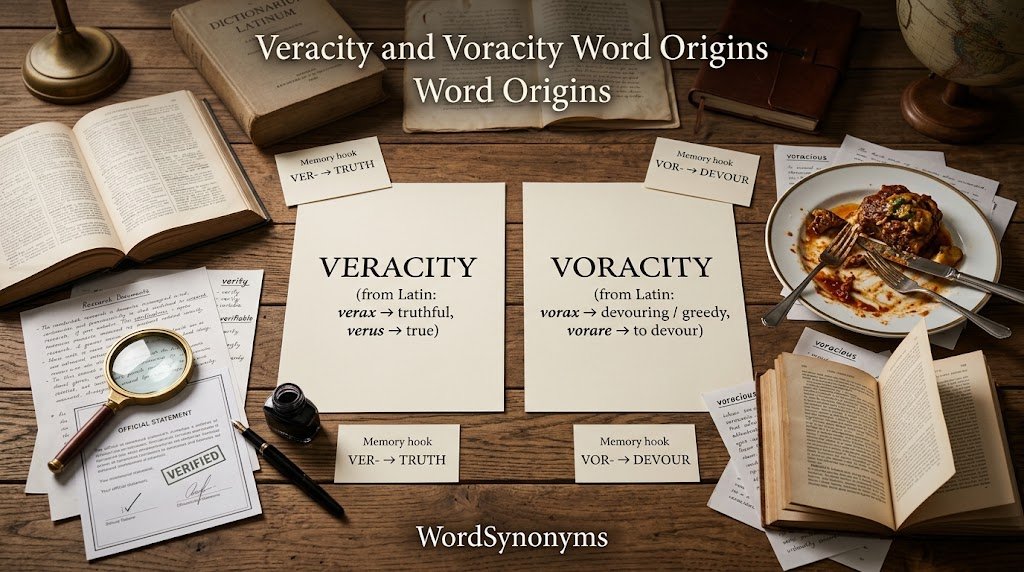
Veracity and Voracity Word Origins
Their similar appearance can be misleading because their roots point in different semantic directions.
Origin of Veracity
Veracity comes from Latin verax, meaning truthful or speaking truthfully. It is connected with verus, the Latin word for “true.”
That connection explains why veracity concerns truthfulness.
Several English words share related Latin roots connected with truth, including terms such as verifiable and verity.
This provides a useful conceptual family:
- veracity → truthfulness
- verity → truth
- verify → establish whether something is true
- verifiable → capable of being checked or established as true
The exact historical development of each word differs, but the association with truth is useful for learners.
Origin of Voracity
Voracity comes from Latin vorax, meaning “devouring” or “greedy.” It is related to the Latin verb vorare, meaning “to devour.”
That root gives you an excellent mental image.
Think of something devouring food.
That’s the territory of voracity.
The related adjective voracious carries the same basic idea:
- voracity = intense appetite or eagerness
- voracious = extremely hungry or intensely eager
Why Their Origins Help
Etymology isn’t merely a historical curiosity. It can give you a memory hook.
Remember:
VER- → truth
VOR- → devour
The distinction isn’t perfect as a spelling rule for every English word. Still, it’s an effective way to separate these two commonly confused terms.
Read more: Bunny vs Bunnie: Which Spelling Is Correct?
How to Remember Veracity vs. Voracity
A good memory trick should work quickly when you’re writing.
Veracity = Verifiable Truth
Associate veracity with verification.
When someone verifies a claim, they check whether it’s true.
So:
Veracity → truth → verification
For example:
The investigator questioned the veracity of the claim.
The investigator wants to verify whether the claim is true.
Voracity = Devouring
Connect voracity with voracious and devouring.
Imagine a person sitting down after a long hike and devouring an enormous meal.
That’s voracity.
For example:
After the race, the runners ate with surprising voracity.
Their appetite was intense.
The One-Line Memory Trick
Veracity is about truth. Voracity is about devouring.
If that sentence sticks, the two words become much harder to confuse.
Veracity vs. Voracity vs. Voracious
Another source of confusion is voracious, which belongs to the same family as voracity.
| Word | Part of Speech | Meaning | Example |
| Veracity | Noun | Truthfulness or accuracy | We questioned the veracity of the report. |
| Voracity | Noun | Excessive appetite or eagerness | His voracity surprised everyone. |
| Voracious | Adjective | Extremely hungry or intensely eager | She has a voracious appetite for books. |
The grammatical difference matters.
Voracity names the quality or behavior.
Voracious describes someone or something possessing that quality.
Compare:
His voracity was obvious.
He had a voracious appetite.
The first uses a noun.
The second uses an adjective.
Voracious Can Be Figurative
The word voracious doesn’t always describe food.
You might hear:
- a voracious reader
- a voracious learner
- a voracious appetite for knowledge
- a voracious consumer of information
These expressions describe intense eagerness.
For example:
Maya is a voracious reader who finishes several books each month.
She isn’t eating books. The sentence uses voracious metaphorically to emphasize how eagerly she reads.
When Should You Use Veracity?
Choose veracity when you need to discuss the truthfulness or accuracy of something.
It works particularly well in formal or analytical writing.
Use it when discussing:
- news reports
- legal testimony
- historical accounts
- scientific claims
- allegations
- statements
- online information
- eyewitness accounts
- disputed stories
For example:
The committee investigated the veracity of the allegations before issuing its report.
The committee’s concern is factual truth.
Another example:
Independent evidence strengthened the veracity of the witness’s account.
Again, the focus is truthfulness.
Veracity in Formal Writing
The word often appears in journalism, law, research, history, and critical analysis because those fields frequently require people to distinguish claims from established facts.
Consider this sentence:
The veracity of the testimony became a central issue during the investigation.
That sentence sounds natural because testimony can be truthful or untruthful.
By contrast:
The voracity of the testimony became a central issue.
That wording changes the concept entirely and doesn’t make sense in the intended context.
When Should You Use Voracity?
Choose voracity when you want to emphasize unusually strong appetite or eager consumption.
Its most straightforward use involves food:
The hungry hikers ate with voracity.
However, figurative use can make the word more expressive.
For example:
The researcher approached every new subject with intellectual voracity.
This suggests an almost insatiable desire to learn.
You can also use it when discussing reading:
Her voracity for mystery novels was legendary among her friends.
The sentence portrays reading as something eagerly consumed.
Literal and Figurative Voracity
| Type | Example | Meaning |
| Literal | He ate with voracity. | He ate extremely eagerly. |
| Literal | The animal consumed its meal with voracity. | It ate intensely. |
| Figurative | She reads with voracity. | She reads eagerly and extensively. |
| Figurative | He pursued knowledge with voracity. | He had an intense desire to learn. |
The figurative meaning relies on the metaphor of consuming something eagerly.
A Practical Case Study: Choosing the Right Word
Imagine you’re editing a newspaper article about a disputed historical document.
The original sentence says:
Experts questioned the voracity of the document’s claims.
The word voracity doesn’t fit because the experts aren’t discussing appetite.
They are questioning whether the claims are true.
The better sentence is:
Experts questioned the veracity of the document’s claims.
Now imagine a completely different scene.
A food critic describes a championship eating contest:
The competitors attacked the food with remarkable veracity.
Again, the word doesn’t fit.
The competitors aren’t demonstrating truthfulness. They’re eating intensely.
The better sentence is:
The competitors attacked the food with remarkable voracity.
This simple case study shows why context matters more than spelling.
Common Mistakes With Veracity and Voracity
The words often get confused because they share several letters and a similar rhythm.
Mistake 1: Thinking Both Words Relate to Truth
Some writers see veracity and voracity as interchangeable because they look nearly identical.
They’re not.
Veracity concerns truth.
Voracity concerns appetite or eager consumption.
Mistake 2: Using Voracity for Accuracy
If you’re discussing whether a report contains correct information, use veracity.
Correct:
The committee questioned the veracity of the report.
Not:
The committee questioned the voracity of the report.
Mistake 3: Using Veracity for Hunger
If someone eats aggressively because they’re extremely hungry, voracity can describe that behavior.
Correct:
He ate with remarkable voracity.
Not:
He ate with remarkable veracity.
Mistake 4: Confusing Voracity With Voracious
These words are related but serve different grammatical roles.
Voracity is a noun.
Voracious is an adjective.
Compare:
Her voracity was obvious.
She had a voracious appetite.
The first names the quality. The second describes the appetite.
Read more: Firsthand and Secondhand vs. First-Hand and Second-Hand
Veracity vs. Voracity: Word Forms and Related Terms
Understanding related words makes the distinction easier.
Words Related to Veracity
Some useful related terms include:
- veracity — truthfulness or accuracy
- veracious — truthful or habitually truthful
- verity — truth or a true statement
- verify — establish the truth or accuracy of something
- verification — the process of checking something
These words belong to a broader vocabulary surrounding truth and confirmation.
Words Related to Voracity
Related terms include:
- voracity — intense appetite or eagerness
- voracious — extremely hungry or intensely eager
- devour — eat quickly or consume eagerly
- ravenous — extremely hungry
- avidity — intense eagerness
These words revolve around appetite, consumption, or strong desire.
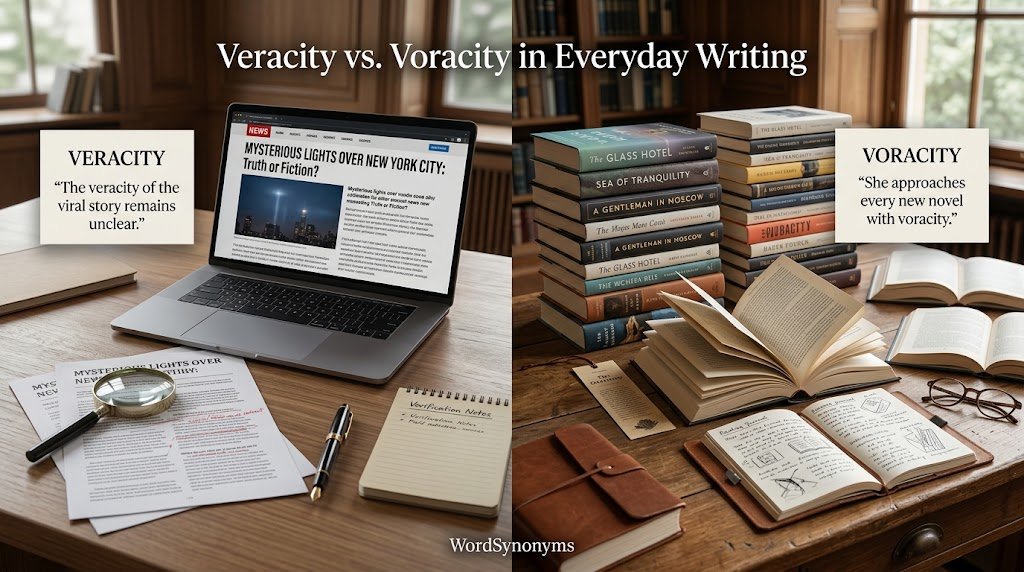
Veracity vs. Voracity in Everyday Writing
Although veracity is common in formal contexts, you can encounter both words outside academic or professional writing.
For example, social media often creates situations where people question the veracity of a claim.
You might see:
The veracity of the viral story remains unclear.
That means nobody has established whether the story is true.
Meanwhile, a book reviewer might write:
She approaches every new novel with voracity.
That means she reads eagerly and enthusiastically.
The contexts differ dramatically even though the words look similar.
Veracity vs. Voracity: A Simple Comparison Chart
| Feature | Veracity | Voracity |
| Core meaning | Truthfulness or accuracy | Excessive appetite or eagerness |
| Main idea | Truth | Consumption |
| Part of speech | Noun | Noun |
| Often describes | Claims and statements | Eating or intense desire |
| Literal food connection | No | Yes |
| Figurative use | Less common | Common |
| Related adjective | Veracious | Voracious |
| Useful memory clue | Verify | Devour |
| Example | The veracity of the claim was questioned. | He ate with voracity. |
How to Choose Between Veracity and Voracity
When you’re writing and suddenly hesitate, use this three-step test.
Ask What the Sentence Is About
Is it about whether something is true?
Use veracity.
Is it about consuming something with unusual eagerness?
Use voracity.
Look at the Noun Around It
Certain combinations provide strong clues.
Natural combinations with veracity include:
- veracity of a claim
- veracity of a report
- veracity of a statement
- veracity of testimony
- veracity of an account
Natural combinations with voracity include:
- voracity for food
- voracity of appetite
- eat with voracity
- read with voracity
- pursue knowledge with voracity
Replace the Word With a Simple Phrase
This trick works surprisingly well.
If you can replace the word with “truthfulness”, you probably need veracity.
If you can replace it with “eager consumption” or “intense appetite”, you probably need voracity.
For example:
The veracity of the statement was questioned.
Replace veracity:
The truthfulness of the statement was questioned.
The meaning remains intact.
Now:
He ate with voracity.
Replace voracity:
He ate with intense appetite.
Again, the meaning remains clear.
Why Veracity and Voracity Are Easy to Confuse
English contains many confusing word pairs that differ by only a few letters.
Veracity vs. voracity belongs to that category.
Both words:
- contain seven letters
- begin with v
- contain similar vowel and consonant patterns
- end in -acity
- function as nouns
- have a formal sound
Their visual similarity can trick your brain into treating them as related in meaning.
However, their roots and meanings point in different directions.
One moves toward truth.
The other moves toward devouring.
That contrast is worth remembering.
FAQs
1. What is the difference between veracity and voracity?
Veracity means truthfulness, honesty, or accuracy. Voracity refers to an intense desire to consume, especially a large amount of food.
2. Is veracity related to truth?
Yes. Veracity describes the quality of being truthful, honest, or accurate. For example, you might question the veracity of a statement if you aren’t sure it is true.
3. What does voracity mean?
Voracity means an insatiable appetite or eagerness to consume something. It most commonly describes a strong desire for food.
4. Is voracious the adjective of voracity?
Yes. Voracious is the adjective related to voracity. A voracious eater, for example, eats eagerly and often consumes a large amount of food.
5. Is veracious the adjective of veracity?
Yes. Veracious is the adjective related to veracity. It describes someone or something that is truthful or accurate.
6. How can I remember veracity and voracity?
Think of veracity as being connected with truth and voracity with appetite. If you’re talking about whether something is true, use veracity. If you’re describing an intense desire to consume, use voracity.
Conclusion
Veracity and voracity may look almost alike, but they point to completely different ideas. Veracity is about being truthful, honest, and accurate, while voracity describes an intense desire to consume, especially food. Their related adjectives make the difference even clearer: veracious means truthful, whereas voracious suggests an unusually strong appetite.
A simple memory trick can save you from mixing them up. Think of veracity when you are checking whether a statement is true. Think of voracity when someone is eating with an almost unstoppable appetite. Once you connect each word with its meaning, this easily confused pair becomes much easier to use correctly.

Muhammad Taqi is a content writer interested in English vocabulary and language. He writes clear and useful articles on synonyms, antonyms, word meanings, and English usage, helping readers expand their vocabulary and improve their communication skills.